


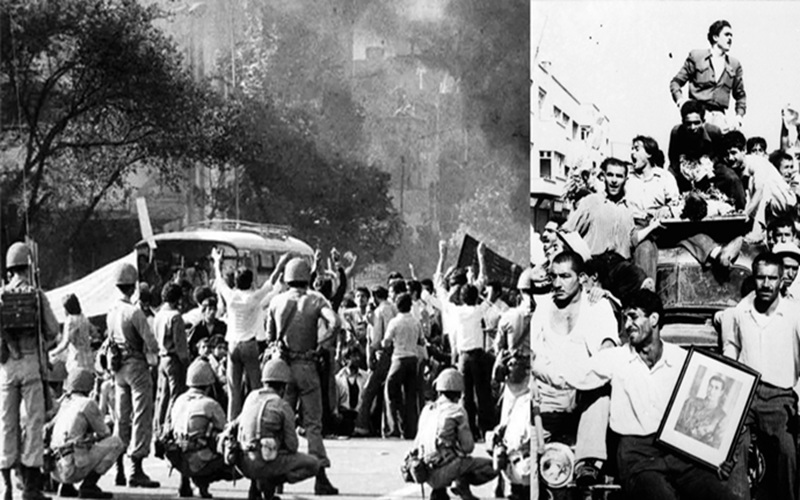

How Reza Pahlavi’s pride in the 1953 coup and Pahlavi dictatorship exposes the myth of his “democratic” alternative
More than seven decades have passed since the sinister coup of 28 Mordad, 1332 (August 19, 1953); a black day on which the only national, independent, and democratically mandated government in Iran after the Constitutional Revolution—the government of Dr. Mohammad Mosaddegh—was overthrown. This bitter event severed Iran’s democratic evolution, rule of law, and national sovereignty. The direct consequence of this coup was decades of captivity and darkness for Iranian society under the boots of Pahlavi dictatorship, followed by the clerical reaction’s horseshoes up to the present day. Today, rereading this event in the context of Iran’s ongoing political and social developments is key to understanding why dictatorship persists and why a complete break from it is necessary.
The Coup Triangle: Alliance of the Court, Religious Reaction, and Colonial Interests
The 28 Mordad coup was built on an unholy convergence of three anti-people forces: the court, religious reaction, and foreign imperialism. The illegitimate oil and geopolitical interests of Western powers—especially Britain and the United States—were threatened by the nationalization of Iran’s oil industry and its political independence. Thus, the think tanks of London and Washington devised the plan to overthrow Mosaddegh’s lawful government.
The Shah and loyalist army commanders, seeing their class interests and absolute rule at risk, organized mobs and repressive military units to execute the coup plan in the streets. Figures such as Kashani and Behbahani, by stabbing the National Movement in the back, paved the way for the Shah’s dictatorship, proving that at historical crossroads, the exclusive interests of religious elites converge with colonialism and traditional despotism.
International Documents and Confessions
In recent decades, repeated confessions by senior Western officials and the release of official documents have not only confirmed the historical legitimacy of the Iranian people’s demands but also exposed and discredited the statements of monarchists and deviant currents who shamelessly refer to this disgraceful coup as a fabricated “revolution” or “national uprising.”
-
Madeleine Albright (former U.S. Secretary of State): In 2000, she officially acknowledged the “significant role” of the United States in carrying out the 28 Mordad coup.
-
Barack Obama (former U.S. President): In his famous 2009 Cairo speech, he admitted to CIA actions in overthrowing Iran’s democratically elected government.
-
David Owen (former British Foreign Secretary): He emphasized the need for Britain to accept responsibility for damaging Iran’s democratic process by overthrowing Mosaddegh’s government.
-
Central Intelligence Agency (CIA): In October 2023, by releasing an audio document, it confirmed the entirely undemocratic nature of this operation and revealed that a large portion of related documents had been destroyed in the 1960s.
From the Formation of SAVAK to the Maturation of Revolutionary Struggle
The 28 Mordad coup left profound lessons for all parties involved on both the “people” and “anti-people” fronts: The Shah learned that to maintain power, he had no choice but to intensify repression, systematically expand the security apparatus, and become totally dependent on foreign powers. The establishment of the notorious SAVAK organization was the tangible result of this conclusion.
The backward-thinking stratum, specifically the Khomeinist current, learned how to lurk in the shadows of dictatorship and the suppression of democratic forces, waiting for national crises to harvest power and seize exclusive control. Colonial powers concluded that securing their illegitimate interests and plundering oil required supporting dictators—a policy that first propped up the Shah and then continued through blood-and-oil trade with the clerical regime.
Lessons of 28 Mordad for Vanguard and Struggling Generations
Iran’s self-sacrificing and freedom-seeking generations, reached the historical truth that spontaneous movements lacking revolutionary organization are crushed by the collusion of dictatorship and imperialism. They realized that victory and the preservation of freedom require a cohesive, self-sacrificing, and fighting organization—an approach recorded as a historical testament and guideline in Mosaddegh’s late-life writings and his reference to Algerian independence fighters (1340/1961).
Reza Pahlavi and Pride in His Father’s Legacy: The Mask of Democracy Falls
While the dominant discourse of Iran’s regime-change opposition emphasizes the simultaneous rejection of religious fascism and neo-monarchist neo-fascism, recent statements by Reza Pahlavi, the former crown prince and main claimant of the monarchist current, reveal another reality: Not only is he unwilling to condemn the 28 Mordad coup and Pahlavi dictatorship, but he explicitly takes pride in that legacy.
“I am proud of my family name and I support their actions”
In April 2026, at a press conference in Stockholm and in an interview with Swedish state television (the program Agenda), Reza Pahlavi was directly questioned about his family legacy. His answer was clear and unequivocal:
-
“I am proud of my family name.”
-
“I am proud of my background and heritage, and I support their actions.”
These were not merely emotional defenses of his family; they were a full political endorsement of a dictatorial system that was consolidated through the 1953 coup, institutionalized SAVAK as an instrument of terror and repression, and, by making the country a one-party state in 1354 (1975), suppressed all political pluralism.
“I will not judge my father; let history judge”
Even in older interviews, the same pattern is repeated. In a 1986 television interview with Lesley Stahl (CBS), when directly asked about his father and the coup, Reza Pahlavi said:
-
“I will not judge my father. I prefer to let history play that role, beyond our capabilities.”
-
And when reminded that “It was your father,” he added: “And I am proud to have that name.”
This stance—refusing to condemn the coup, SAVAK, torture, and repression while simultaneously claiming to be a democrat—shows that for him the issue is not criticizing dictatorship, but merely changing its face.
“Free Iran” Propaganda vs. the Reality of Defending Dictatorship
The monarchist current and aligned media have long marketed Reza Pahlavi as the symbol of a “free Iran” and “secular democracy.” But when he states on camera that he is proud of a legacy that includes the following, this propaganda collapses:
-
The 1953 coup against Mosaddegh’s elected government, with direct support from the CIA and MI6.
-
The establishment and expansion of SAVAK, with documented reports by organizations such as Amnesty International on systematic torture, executions without trial, and forced confessions.
-
The Rastakhiz one-party system (from 1354/1975 onward), which criminalized any independent political activity and forced opponents to join, face prison, or go into exile.
-
Widespread court and Pahlavi Foundation corruption, along with severe economic inequality and the accumulation of wealth by the royal family.
Someone who “takes pride” in such a legacy and “supports their actions” cannot simultaneously claim to represent “freedom” and “democracy” for Iran. This contradiction is not a verbal slip; it is his political essence.
Pathology of Accommodation and the Outlook for Iran’s Current Political Situation
The link between 28 Mordad and Iran’s current situation is most clearly manifested in drawing a line through the convergences and overlaps of religious fascism and neo-monarchist neo-fascism: Just as the Shah’s military government and SAVAK could not prevent the collapse of the monarchical system, the execution machine, mass killings of past decades (especially the summer of 1988), and street repression by the clerics have also failed to guarantee the survival of the Vilayat-e Faqih dictatorship, and this regime is approaching its inevitable end.
From 30 Khordad 1360 (June 20, 1981) to the nationwide uprisings of Dey 96 (December 2017), Aban 98 (November 2019), and 1401 and 1404 (2022–2026), Iranian society has targeted the simultaneous negation of religious fascism and neo-monarchist neo-fascism. This revolutionary consciousness indicates that the people do not seek a return to the dictatorial past, but aim to establish an independent, democratic republic based on the separation of religion and state.
Outlook for Realizing Mosaddegh’s Ideals
The 28 Mordad coup remains an open wound on the body of Iran’s history, but this wound has become an engine driving nationwide demands for justice and the evolution of struggle. The persistence of successive generations against two dictatorships and the emergence of a national liberation army and democratic alternative herald the removal of dictatorship and the ultimate realization of the long-standing dream of the National Movement’s leader, Dr. Mohammad Mosaddegh.
In this context, any attempt to reconstruct the legitimacy of the Pahlavi monarchy—whether through Western media or Persian-language social networks—is rendered null and void by the very statements of Reza Pahlavi himself regarding his pride in the coup, SAVAK, and his father’s despotism.
Iran’s freedom will be achieved not by returning to the past, but by rejecting all forms of dictatorship—religious and monarchical—and building a democratic, secular, and independent future.