


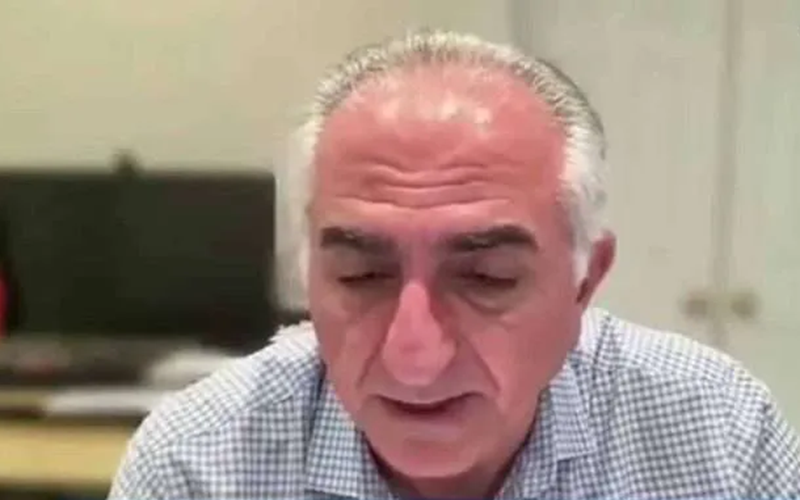

Reza Pahlavi presents himself as a unifying democratic figure for Iran’s future, but his own political positions raise fundamental questions about pluralism, accountability, and the role of former regime forces.
Reza Pahlavi has increasingly presented himself as a unifying figure capable of helping Iran move from the current regime toward a democratic future. His message emphasizes political pluralism, tolerance, a broad opposition coalition, and a transition in which Iranians ultimately determine their own form of government.
Yet beneath this carefully constructed image lies a series of unresolved contradictions. His political project remains deeply connected to the legacy of the Pahlavi monarchy, while his claims of representing a broad and inclusive opposition are challenged by persistent divisions among his supporters and opponents. His approach to the regime’s security apparatus also raises difficult questions about accountability and the future of those who have participated in repression.
The issue, therefore, is not simply whether Reza Pahlavi describes himself as a democrat. It is whether his political conduct, alliances, and proposed transition are consistent with the democratic principles he invokes.
A Claim to Unite an Opposition He Has Not United
One of Pahlavi’s central arguments is that he has spent years attempting to broaden the political tent and bring together Iranians from different ideological backgrounds. He portrays himself as someone capable of overcoming historical divisions and creating a common front against the regime.
But claiming to be a unifying force and actually building a durable coalition are two different things.
The opposition remains deeply fragmented, with sharp disputes between monarchists, republicans, ethnic and political movements, and other currents. In particular, repeated confrontations between Pahlavi supporters and other opposition activists have demonstrated how difficult it has been to translate the promise of unity into political practice.
A genuine democratic coalition cannot simply mean bringing people under one banner. It must also provide room for disagreement, criticism, competing political visions, and peaceful political organization.
That is precisely where serious questions emerge.
Pluralism Cannot Exist Without Tolerance for Critics
Pahlavi frequently speaks of pluralism and tolerance. Such principles are essential for any democratic transition. But pluralism is tested not when people agree, but when they disagree.
Over the years, numerous Iranian opposition activists have reported hostile online campaigns, intimidation, threats, and aggressive confrontations involving individuals identifying themselves as monarchists or Pahlavi supporters. Not every such incident can automatically be attributed to Pahlavi himself, and it would be wrong to treat allegations against individual supporters as proof of personal responsibility.
The political question is different.
What responsibility does a leader have for the political culture surrounding his movement?
If a movement claims to represent a democratic future, its supporters must be able to tolerate criticism without attempting to silence, threaten, or intimidate opponents. A movement that demands unity while treating disagreement as betrayal risks replacing one form of political intolerance with another.
The test of democracy is therefore not whether Pahlavi can attract supporters. It is whether those supporters can coexist peacefully with people who reject monarchy altogether.
The Unresolved Problem of the Pahlavi Legacy
Another contradiction lies in Pahlavi’s relationship with his father’s political legacy.
Pahlavi has repeatedly defended the historical legacy of his father and has described him in highly favorable terms. At the same time, he presents himself as a champion of democracy and the political freedom of the Iranian people.
This creates an unavoidable question: how does a political movement based so heavily on dynastic heritage reconcile that heritage with a democratic transition?
The problem is not that an individual is prohibited from taking pride in his family history. The problem arises when hereditary political legitimacy becomes part of a modern political project.
A democratic future cannot be inherited.
If Iran is to become a democratic country, no family, political faction, religious institution, military organization, or opposition figure can possess a predetermined right to rule. The Iranian people must be free to choose a republic, its institutions, its constitution, and its leaders without pressure from competing claims of inherited legitimacy.
Pahlavi’s supporters therefore face a fundamental question: is the monarchy merely a personal historical identity, or does it remain a political objective?
Until that distinction is made unmistakably clear, the contradiction will remain.
The IRGC Question: Accountability or Reintegration?
Perhaps the most consequential part of Pahlavi’s political vision concerns members of the regime’s military and security apparatus.
Pahlavi has spoken about creating an “exit strategy” for individuals inside the regime who are prepared to abandon it. He has argued that people who are not personally responsible for murder or other crimes should not necessarily be treated in the same manner as those who ordered or carried out repression.
There is a legitimate principle here: accountability should be based on individual responsibility rather than indiscriminate collective punishment.
But the proposal immediately raises difficult questions.
Who determines who is responsible for crimes? Who investigates the records of IRGC commanders, intelligence personnel, Basij members, police officers, and other security officials? What happens to those who participated in torture, executions, arbitrary detention, or suppression of protests but later claim to have changed sides?
A transition cannot simply replace political repression with political expediency.
Nor can the promise of future positions become an incentive for individuals to abandon the regime only when its survival is threatened.
If there is to be reconciliation, it must be built on truth, justice, transparency, and individual accountability. Otherwise, “reintegration” could become another mechanism for allowing powerful actors to preserve their influence after a political transition.
Grand Claims Require Evidence
Pahlavi has also made substantial claims about the number of people inside the military and security establishment who supposedly want to defect or join the Iranian people.
Such claims, if accurate, could have enormous political significance. But numbers alone do not demonstrate an organized movement.
Who are these individuals? What positions do they hold? What concrete actions have they taken? How many have actually defected? How many have publicly broken with the regime? And what independent evidence exists to verify the scale of these claims?
These are not unreasonable questions.
A serious political transition requires more than declarations of support. It requires functioning organizations, identifiable structures, transparent decision-making, credible leadership, and demonstrable capacity to turn political claims into reality.
The Central Contradiction
The deeper problem confronting Pahlavi’s political project is therefore not one isolated statement or one controversial supporter.
It is the gap between political image and political practice.
He seeks to portray himself as a democratic bridge capable of bringing together Iranians across ideological boundaries. Yet his movement remains associated with fierce disputes over monarchy, hostility between opposition factions, controversies surrounding aggressive supporters, unresolved questions about the Pahlavi legacy, and a controversial proposal for dealing with elements of the regime’s security apparatus.
None of these issues automatically proves that Pahlavi is incapable of contributing to Iran’s future. But together they demand serious scrutiny.
Iran’s struggle for freedom cannot be reduced to replacing one political center with another. The objective of a democratic transition must be to dismantle the principle of political monopoly itself.
That means rejecting both religious dictatorship and hereditary rule. It means guaranteeing freedom of expression even for political opponents. It means establishing justice for victims of repression while distinguishing individual responsibility from collective vengeance. And it means ensuring that no faction can claim ownership of Iran’s revolution or its future.
Reza Pahlavi can claim to support democracy. But democracy is ultimately measured not by declarations, titles, ancestry, or political branding. It is measured by the willingness to accept competition, accountability, criticism, and the people’s unrestricted right to choose.
That is the standard by which every political current seeking a role in Iran’s future must be judged—including the monarchist current and Reza Pahlavi himself.