
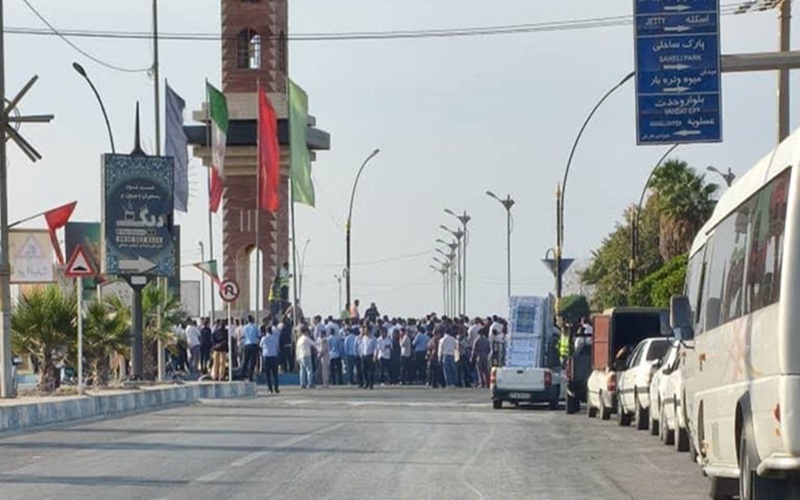

Iran’s merchants, farmers, and families are being crushed by currency depreciation, power outages, rising costs, and collapsing purchasing power as the regime’s economic crisis deepens.
Iran’s economic crisis is no longer confined to statistics, currency charts, or government statements. It is increasingly visible in shuttered shops, empty markets, indebted farmers, and families struggling to afford basic food.
Across Iran, merchants complain that the value of their capital is evaporating as the rial loses purchasing power, while electricity cuts disrupt already weak businesses. Farmers say they are forced to cultivate their land on credit, only to find that the value of their produce fails to cover their costs. Meanwhile, households are cutting back on basic necessities as food prices continue to rise.
The result is a vicious cycle: inflation reduces purchasing power, declining sales weaken businesses, currency depreciation destroys working capital, and rising costs push merchants and producers toward bankruptcy.
When a Day’s Sale Becomes Tomorrow’s Loss
For many Iranian shopkeepers, the central problem is no longer simply declining sales. Even when they manage to sell their goods, replacing what they have sold can cost considerably more.
One merchant illustrated the problem by showing the date on an invoice. A product had been sold on the 29th for around 680,000 tomans per unit. When the merchant returned to purchase the same goods for his customer, the price had risen to approximately 800,000 tomans.
In other words, the apparent profit from the original sale had disappeared. The merchant now had to put additional money into the transaction merely to replace the goods he had sold.
“This is no longer a market where the dust is gold,” the merchant said bitterly. “I don’t think there is even any dust left in the market that could be called gold. We don’t know what to do with ourselves.”
This is the destructive effect of rapid currency depreciation on small businesses. A merchant who sells inventory today must pay more to replenish it tomorrow. Unless sales prices rise immediately—and customers can afford them—the merchant’s working capital steadily disappears.
Power Cuts Add Another Burden to a Struggling Market
Currency instability is not the only problem confronting businesses. Frequent electricity outages are disrupting commercial activity across the country.
One merchant described the daily reality:
“Every night you go to sleep and in the morning the dollar is 10,000 tomans more expensive. You go to the gas station and find a two- or three-kilometer queue. Then you come to your shop and the electricity goes out for two or three hours a day. Who are we supposed to tell our problems to?”
He directly challenged the authorities responsible for running the country, saying that if they cannot manage it, they should resign.
Another shopkeeper described a situation in which businesses are squeezed from every direction. Electricity is cut when bills are due; water is cut when payments are late; meanwhile, merchants no longer have enough money to restock their stores.
Customers themselves increasingly arrive without sufficient money to buy what they need.
“We can no longer even extend credit,” the merchant said. “Whatever little credit we had in the market, you destroyed that too.”
The deterioration of commercial credit is particularly damaging. In traditional markets, merchants often rely on trust and delayed payment to keep transactions moving. When inflation becomes too rapid and businesses themselves become financially unstable, that system begins to break down.
Is the $200,000 Dollar Rate Temporary?
The crucial question is whether the rial can recover—or whether the current currency crisis is only the beginning of a much deeper collapse.
A state-run media outlet, Tose’e Irani, quoted Central Bank Governor Abdolnaser Hemmati as saying that the widening gap between exchange rates in the market was temporary and that short-term fluctuations should not cause a change in exchange-rate policy.
But even within the regime’s own economic discourse, there are warnings that the situation may be far more serious.
The outlet cited experts who argued that if the government fails to regulate the foreign-exchange market, or if the country’s broader prospects for obtaining foreign currency deteriorate, the dollar’s movement toward the 200,000-toman range cannot necessarily be considered temporary.
Some projections have gone even further, raising the possibility of the dollar reaching 300,000 tomans.
For merchants, these are not abstract forecasts. Every additional decline in the value of the rial means higher replacement costs, weaker working capital, and greater pressure to raise prices in a market where consumers are already struggling.
Bankruptcy Moves From the Shop Floor to the Streets
The consequences are becoming visible in the lives of individual business owners.
One shopkeeper announced his bankruptcy in an emotional message to his parents, saying that he had sold his car to finance the business and had now lost what remained of his investment.
“I sold my car for this shop,” he said. “A car whose rims I can’t even afford to buy back now.”
Another merchant blamed the authorities directly for destroying his livelihood and said that his shop was about to close permanently.
These testimonies reflect a broader economic mechanism. A merchant can survive a temporary decline in sales. What becomes unsustainable is the combination of falling purchasing power, rising input costs, higher rents and utilities, taxation, currency depreciation, and repeated losses.
The result is a predictable progression:
- Working capital declines as the rial loses value.
- Government taxes and fees increase business costs.
- Electricity, water, and other services become more expensive or unreliable.
- Rents and operating expenses rise.
- Consumers lose purchasing power.
- Sales decline.
- Continuous losses eventually turn into bankruptcy.
The crisis therefore feeds upon itself.
Empty Markets and Rotting Produce
The same deterioration is visible in wholesale markets.
At Tehran’s Central Fruit and Vegetable Market, a vendor described the situation at around 11 a.m. as one in which the entire market had effectively “gone to sleep.”
“Nothing is being bought,” he said. “The market has completely collapsed.”
For agricultural producers, weak demand creates another layer of losses. Produce cannot simply be stored indefinitely. When buyers disappear, fruits and vegetables spoil, transforming the farmer’s labor and investment into waste.
The crisis therefore reaches backward through the entire supply chain—from consumers to retailers, wholesalers, farmers, transporters, and producers.
Farmers Produce on Credit—and Sink Deeper Into Debt
In rural areas, the economic crisis takes a different but equally destructive form.
Farmers describe having to obtain almost everything on credit. One farmer explained that he plowed his land on credit, purchased electricity on credit, bought fertilizer and pesticides on credit, and even transported goods by truck on credit.
“Everything is on credit,” he said. “Then they issue the invoices, and you have to go and try to collect the money.”
The farmer is effectively financing the entire production process with borrowed resources while facing uncertainty over whether the eventual sale of his crop will cover his accumulated debts.
Another farmer compared the increase in the price of his agricultural product with the enormous price increases experienced by petrochemical and steel products, arguing that the price of his produce had risen only around fivefold while those industrial products had increased hundreds of times.
His conclusion was blunt: the system’s economic structure leaves producers carrying the burden while others capture the value created by their labor.
This is not merely a crisis of agricultural income. It threatens the sustainability of production itself. When farmers cannot recover their costs, they accumulate debt, reduce cultivation, abandon fields, or become dependent on still more credit.
Two Shifts of Work Are No Longer Enough
The ultimate measure of an economic crisis is not the exchange rate but what families can actually afford to put on the dinner table.
One woman described going to buy a chicken and discovering that her budget was insufficient. A whole chicken would cost roughly one million tomans, forcing her to buy only a portion of it.
She recalled that the same item had cost around 20,000 tomans per kilogram the previous year, compared with approximately 150,000 tomans now.
For households already working multiple shifts simply to survive, even basic food is becoming a financial calculation.
This is the other side of the economic collapse seen in the markets. The merchant cannot replenish inventory. The farmer cannot recover production costs. The worker cannot keep pace with inflation. The consumer cannot afford the goods being sold.
The entire economic chain is under pressure simultaneously.
A Crisis Without an Exit Under the Current System
The regime’s economic crisis is therefore not simply a matter of temporary inflation or an unfavorable exchange-rate fluctuation.
It is a systemic crisis in which currency depreciation, inflation, energy shortages, declining purchasing power, indebtedness, and business failures reinforce one another.
For merchants, the question is increasingly how long they can remain open.
For farmers, it is whether they can continue producing while carrying growing debts.
For ordinary families, it is whether their income can still provide the most basic necessities.
And for the broader economy, the question is whether a productive system can survive when the value of capital is continuously eroded and demand is simultaneously collapsing.
The anger expressed by merchants and farmers points to a deeper political reality. People are not merely complaining about prices; they are questioning the system responsible for their deteriorating livelihoods.
As businesses close, markets empty, debts accumulate, and families struggle to afford basic food, economic hardship increasingly converges with social and political discontent.
Across Iran, resistance activities continue to signal that this discontent has not disappeared. For many Iranians, the growing economic hardship is becoming inseparable from the demand for fundamental political change.
The question is no longer simply how much higher prices can go.
It is how long a society can be pushed deeper into poverty and insecurity before economic crisis becomes a catalyst for a broader social explosion.