
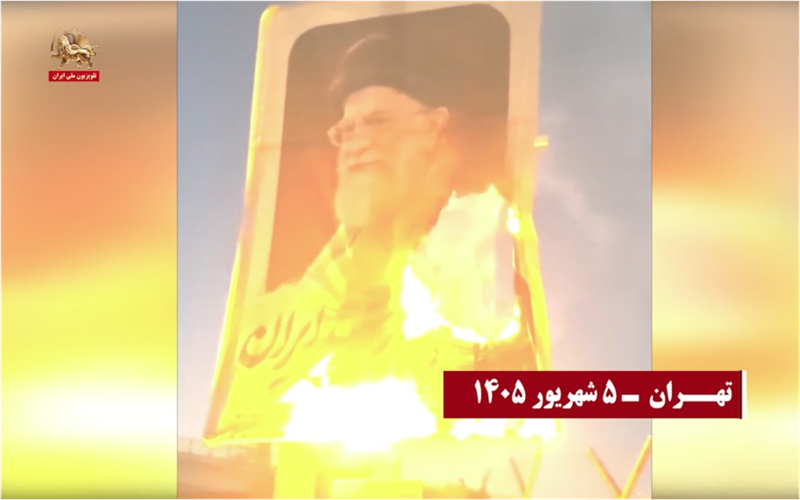

As executions intensify, resistance activities inside and outside Iran are expanding while economic hardship and political divisions deepen the regime’s crisis.
As Iran’s economic and political crises deepen, the regime is increasingly relying on executions and repression to intimidate a society already burdened by inflation, poverty, and political frustration. The frequent announcement of executions, particularly involving young people accused of taking part in protests or resistance activities, has become one of the regime’s principal instruments for creating fear.
But the executions have not produced the silence the authorities seek.
Instead, resistance activities inside Iran continue to challenge the regime, while supporters of the Iranian Resistance abroad have expanded their campaigns against executions and repression.
The Noose as an Instrument of Repression
The regime’s repeated use of the death penalty serves a purpose extending beyond the punishment of individual prisoners. It is intended to send a warning to an increasingly restless population: anyone who challenges the ruling system could face the harshest possible consequences.
Yet the response inside Iran indicates that fear has not eliminated resistance.
According to accounts from the Iranian Resistance, Resistance Units and other organized networks continue to carry out activities against the regime and respond to executions and repression. Their activities are presented as evidence that opposition to the ruling system remains active despite the authorities’ extensive security apparatus.
The significance of these activities lies not only in their immediate impact. They also challenge the regime’s claim that it has succeeded in suppressing organized opposition.
Resistance Extends Beyond Iran’s Borders
The struggle against executions and repression is not confined to Iran.
Supporters of the Iranian Resistance abroad have organized campaigns in different countries to expose the regime’s human rights abuses and draw international attention to executions and political prisoners.
Their activities include public demonstrations, awareness campaigns, and efforts to communicate the situation inside Iran to political institutions and international audiences.
From this perspective, the resistance movement operates on two interconnected fronts: opposition networks inside Iran confronting repression directly, and activists abroad attempting to amplify the voices of those facing that repression.
A Regime Increasingly Burdened by Internal Divisions
At the same time, the regime is facing growing internal contradictions.
The weakening of the central authority following the death of Ali Khamenei has intensified factional disputes and power struggles within the ruling establishment. Such divisions can become particularly consequential when a government is simultaneously confronting economic deterioration, public dissatisfaction, and organized opposition.
Internal conflict does not automatically produce political change. But it can weaken the regime’s ability to respond cohesively to social unrest and create additional space for popular protests.
That space is already visible in demonstrations across Iran.
Economic Crisis Fuels Political Protest
Workers, retirees, and other groups have repeatedly taken to the streets to demand their rights. While many protests begin around wages, pensions, prices, or living conditions, their slogans increasingly extend beyond purely economic demands.
Calls for the release of political prisoners and broader political freedoms demonstrate how economic grievances can merge with political opposition.
The underlying economic pressure is enormous. Inflation and soaring prices have dramatically reduced household purchasing power. Estimates cited in discussions of the current poverty crisis put the monthly cost of living for a four-person family at around 160 million tomans to remain above the poverty line.
For millions of Iranians, the question is therefore no longer simply whether their income can maintain their previous standard of living. It is whether they can afford basic necessities at all.
Repression Cannot Resolve a Systemic Crisis
The regime’s response has increasingly relied on coercion rather than addressing the roots of public anger. Executions may temporarily intimidate individuals, but they cannot resolve inflation, unemployment, poverty, corruption, or the collapse of purchasing power.
Nor can repression permanently eliminate a society’s demand for political change.
The continuing protests, resistance activities inside Iran, and international campaigns against executions demonstrate that the underlying grievances remain unresolved.
For the regime, this creates a dangerous convergence: a population facing severe economic hardship, growing political discontent, internal divisions within the ruling establishment, and an opposition movement determined to remain active despite repression.
The noose may be intended to silence dissent. But the persistence of resistance suggests that the regime’s strategy of fear is failing to address the crisis at its roots—and may instead be deepening the anger that ultimately threatens its survival.