

With food inflation already exceeding 128 percent, Iran’s economy faces a new wave of price increases driven by currency instability, sanctions, structural deficits, and collapsing public confidence.
Iran’s economy has entered the second half of 1405 (2026) in a condition where debating a few percentage points of inflation is no longer the central issue. Official statistics, currency-market developments, restrictions on foreign trade, and warnings from economists all point toward another substantial increase in the general price level before the end of the year.
The more urgent question is therefore no longer simply how high inflation will be, but how much additional economic pressure Iranian households can withstand.
A Saturday, August 29, report by Donya-e Eqtesad outlined three possible inflation scenarios for the remainder of the year. Even its most optimistic scenario points to continued exceptionally high inflation, while continued sanctions and economic restrictions could push the country toward near-triple-digit annual price increases.
Inflation approaching unprecedented levels
According to Iran’s Statistical Center, monthly inflation reached 3.4 percent in August, while year-on-year point-to-point inflation reached 89 percent. The Central Bank reported slightly different figures, putting monthly inflation at 3.7 percent and point-to-point inflation at 84.4 percent.
The difference between the two official institutions does little to change the overall picture: Iran remains trapped in an exceptionally high-inflation environment.
Economic analysts have outlined three possible trajectories. If monthly inflation averages 6.4 percent through the remainder of the year, point-to-point inflation could reach approximately 99.2 percent by March 2027. Under a middle scenario—described as “neither war nor peace”—with average monthly inflation of 4.8 percent, year-end inflation could reach around 80.3 percent.
Even under the most optimistic scenario, involving a sustained ceasefire, reduced tensions, and average monthly inflation of 3.2 percent, point-to-point inflation would still be approximately 61.7 percent.
The projected range of roughly 62 to 99 percent demonstrates how deeply Iran’s inflation outlook has become intertwined with political and security developments, foreign trade, exchange rates, and regional tensions.
Multiple inflation engines are operating simultaneously
Iran’s inflation is not being driven by a single factor. Several pressures are reinforcing one another: persistent budget deficits, monetary expansion, banking-sector imbalances, currency depreciation, declining foreign-exchange revenues, trade restrictions, higher import costs, energy shortages, declining production capacity, and growing uncertainty about the future.
The exchange rate is particularly important because currency depreciation rapidly feeds into consumer prices. A weaker rial does not only make imported finished goods more expensive. Raw materials, machinery, spare parts, industrial equipment, and the replacement cost of existing inventories are also affected.
When businesses cannot predict what foreign currency or imported inputs will cost three months from now, they increasingly price goods according to anticipated future costs rather than today’s expenses.
Foreign-trade restrictions are adding another layer of pressure. President Masoud Pezeshkian acknowledged in a televised interview on Friday, August 28, that Iran’s exports and imports had declined by 25 to 35 percent. He said disruptions to trade routes had increased costs and forced goods that were previously imported directly by sea to enter through more complicated and expensive channels.
He also acknowledged that continued sanctions would mean higher costs and further price increases.
This admission has significant inflationary implications. Lower exports reduce foreign-exchange earnings and increase pressure on the currency market, while lower imports can restrict the availability of consumer goods, raw materials, and production equipment. A shortage of foreign currency combined with rising procurement costs can quickly transform an external shock into domestic inflation.
Economists warn the crisis is changing in nature
Warnings about these conditions are not new. Economist Vahid Shaghaghi-Shahri warned in 2025 that Iran’s interconnected structural imbalances—including the budget deficit, banking system, pension funds, water, and energy—could push the economy toward triple-digit inflation in 1405 and 1406 if they remained unresolved. He also warned of a severe recession and widening fiscal deficits.
Economist Masoud Nili issued an even more serious warning this year. Speaking at the “Iran Economic Outlook 1405” conference, he argued that there is an intermediate stage between chronic inflation and hyperinflation: a period of very high or severe inflation that can represent the station immediately before hyperinflation.
The significance of this warning is that Iran may no longer simply be experiencing another cycle of the chronic inflation seen over previous decades. The nature and intensity of the crisis may be changing.
Even an end to military tensions or a reduction in political pressure would not immediately restore economic stability. Once currency and inflationary shocks become embedded in prices, slowing inflation does not mean that prices return to their previous levels.
Inflation expectations are becoming an inflation engine
One of the most dangerous features of the current situation is the rise of inflation expectations.
When households expect the rial to lose further value, they have less incentive to hold cash and greater incentive to purchase foreign currency, gold, durable goods, or other assets. Businesses likewise raise prices when they expect the cost of replacing their inventories and inputs to increase.
Workers demand higher wages to compensate for declining purchasing power, while companies pass higher labor costs into consumer prices.
Inflation expectations can therefore become self-reinforcing: expectations of tomorrow’s price increases become part of today’s price increases.
This creates a major challenge for the Pezeshkian government. After years of currency depreciation, rising food prices, energy shortages, and declining purchasing power, promises to reduce inflation are unlikely to restore confidence without measurable evidence of stability.
The social breaking point
Perhaps the most important indicator is not whether inflation reaches 62, 80, or nearly 100 percent by the end of the year, but how much additional pressure Iranian society can absorb.
Food inflation provides the clearest picture. The latest August figures put year-on-year point-to-point inflation for food products at 128 percent. This means that households are confronting dramatically higher costs for necessities at a time when many have already suffered years of declining real purchasing power.
The social impact of inflation is therefore not linear. Every new price shock hits a population that has already exhausted part of its financial reserves.
Inflation approaching 100 percent would mean that prices are roughly twice as high as a year earlier, while household incomes are unlikely to have increased at the same pace.
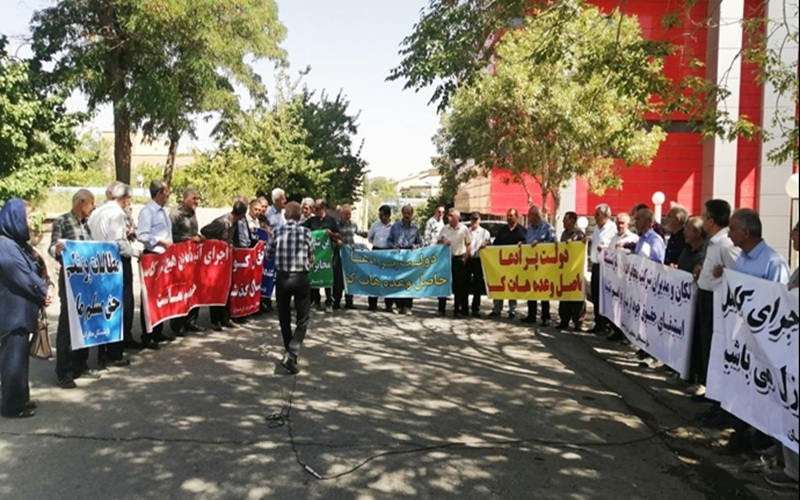
Former Economy Minister Ehsan Khandouzi has recently warned of the possibility of renewed street protests in the coming months. Such concerns cannot be separated from the deteriorating economic conditions.
Iran’s previous protests demonstrate how economic decisions can become triggers for much broader unrest. The November 2019 protests erupted after a gasoline-price increase, while the first sparks of last year’s January protests were also associated with sharp currency fluctuations that disrupted activity across multiple markets.
With the rial again under severe pressure and the possibility of higher gasoline prices looming, Iran faces a potentially combustible combination: rapid currency depreciation, rising living costs, and another possible increase in fuel prices.
The inflation crisis is therefore no longer merely an economic problem. It is increasingly becoming a question of social stability—and of how long Iranian households can continue absorbing the cost of the regime’s structural economic failures.