


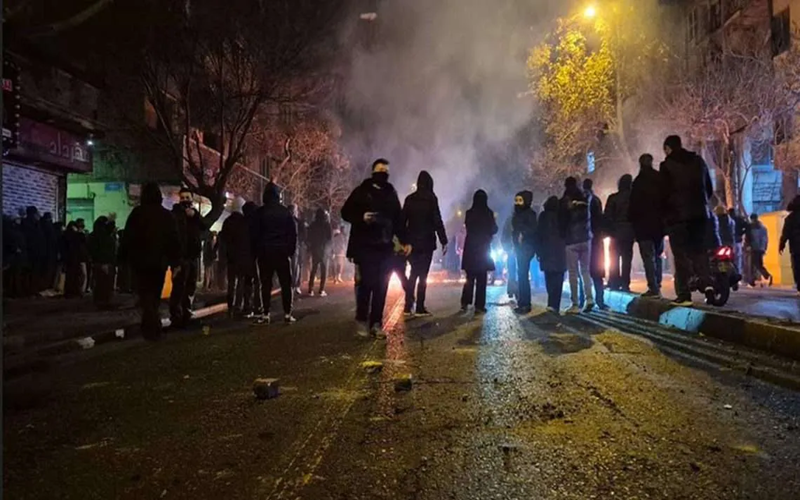

As regime officials repeatedly warn of “riots” and “disorder,” growing threats against Iranian youth reveal the leadership’s deep fear of another nationwide uprising—and an internal dispute over whether war or negotiations offer the best path to regime survival.
The Iranian regime has once again intensified its warnings about “riots” and “disorder,” accompanied by increasingly explicit threats against the Iranian people, particularly young people. The language used by senior officials reveals more than a security policy. It reflects a profound fear that the country’s mounting economic, social, and political crises could once again converge into a nationwide uprising.
The issue has become prominent across different factions of the regime. Parliament Speaker Mohammad Bagher Ghalibaf described the current confrontation as a “hybrid war,” claiming that its objective was to create “disorder and unrest” inside Iran.
Judiciary Chief Gholam-Hossein Mohseni Ejei issued an even more direct warning, saying that if anyone attempted to create “riots” or “disorder,” the response from the police, security and intelligence forces, as well as the judiciary, would be “very strong and decisive,” adding that it would be harsher than in previous periods.
These statements point to a shared fear among the regime’s factions: the possibility of another uprising. Yet, despite their common concern, they disagree over how best to prevent it.
War as a Shield Against the Uprising
One faction around Mojtaba Khamenei and the regime’s hardline elements sees continued war as an essential instrument for controlling the domestic situation.
According to the analysis presented in the interview, this faction views war and executions as complementary mechanisms. War creates an atmosphere of permanent emergency, allowing the regime to militarize society, portray dissent as collaboration with an external enemy, and attribute economic failures to wartime conditions.
“War is a political and psychological shield,” the interview analysis states. “It creates a security atmosphere inside society, attributes every protest to the enemy, and blames the economic crisis on the war.”
In such circumstances, arrests, executions, and other forms of repression become easier to justify. The regime can invoke national security while suppressing dissent and attempting to prevent protests from developing into an organized uprising.
The analysis therefore concludes that the hardline faction sees its survival increasingly tied to the continuation of war and repression.
“For them, like Khomeini, war is a divine blessing,” the interview argues. “They see their survival in war and repression, and have turned war into a shield against the uprising.”
Negotiations as Another Strategy for Survival
Other factions, particularly those associated with Ghalibaf and President Masoud Pezeshkian, are portrayed as viewing prolonged war as increasingly dangerous because of its devastating economic consequences and its potential to accelerate public anger.
Their proposed alternative is negotiation with Washington, sanctions relief, and an attempt to ease economic pressure.
Yet the analysis argues that this approach should not be confused with a genuine effort to improve the lives of ordinary Iranians.
“Negotiation and understanding for them are a means of calculated retreat and preserving the regime, not a path toward providing for the people,” it states.
The repeated emphasis on people’s livelihoods, according to the analysis, reflects fear that worsening poverty and economic hardship could become the catalyst for another uprising.
The Common Fear Behind the Factional Conflict
Despite their disagreements, the regime’s factions share fundamental interests. They differ over tactics, but not over the need to preserve the existing power structure.
“The wolves have no disagreement over repression, killing, and plunder,” the analysis says. “Their disagreement is only over the method and type of plunder and looting.”
This also explains their rivalry over the consequences of either continued war or negotiations. Each faction fears that its rival could emerge stronger from a political settlement, while the faction held responsible for military failure or economic collapse could lose influence.
The dispute, therefore, is not fundamentally between war and peace, or between defending the people and confronting an external threat. It is a struggle over how to preserve the regime and which faction will control the resources of power afterward.
“War and Repression Are the Key to Survival”
The analysis points to a series of developments surrounding Mojtaba Khamenei as evidence of the hardline camp’s growing influence. These include personnel changes within the Supreme National Security Council and public messaging emphasizing the centrality of war to the country’s affairs.
A website associated with the Supreme Leader’s office reportedly described the “grand idea of war” as something that should govern all aspects of the country. The interview interprets this as an acknowledgment that war has become central to the regime’s strategy for confronting its internal vulnerabilities.
Ultimately, the repeated warnings about “riots,” the intensification of repression, and the struggle between war-oriented and negotiation-oriented factions all point to the same underlying reality: the regime fears the Iranian people more than it fears its external adversaries.
As economic hardship deepens and organized resistance remains a persistent concern, the regime is increasingly relying on security measures, executions, arrests, and the atmosphere of war to prevent social discontent from becoming a nationwide revolt.
The conclusion of the analysis is stark: “War and repression are the key to the regime’s survival.”