


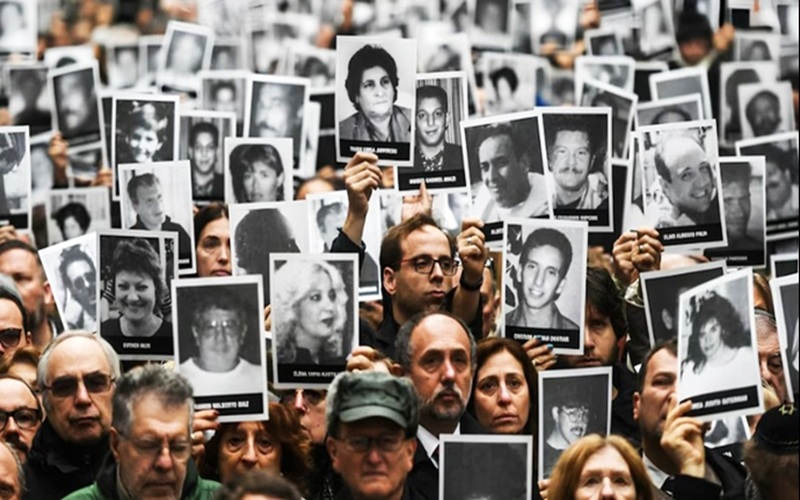

A 648-page ruling formally processes seven Iranian regime officials and a Hezbollah operative over the 1994 AMIA bombing, while Argentina moves toward the country’s first trial in absentia for the attack.
Argentina has taken a major new step toward bringing those accused of planning and executing the 1994 AMIA bombing to trial, formally processing seven Iranian regime officials and a Lebanese Hezbollah operative in connection with the attack that killed 85 people and wounded more than 150.
Federal Judge Daniel Rafecas issued a 648-page ruling on September 21, formally charging the eight suspects with different levels of participation in the bombing of the Argentine Israelite Mutual Association (AMIA) in Buenos Aires.
The ruling also ordered an asset freeze of $500 million for each of the eight defendants. Because the suspects are outside Argentina, the proceedings are being pursued under the country’s recently established legal framework for trials in absentia.
The development marks a significant advance in a case that has remained unresolved in court for more than three decades.
Court Identifies Iranian Regime Leadership Behind the Attack
Based on evidence assembled by the AMIA Special Prosecutor’s Office, headed by prosecutor Sebastián Basso, Rafecas determined that the strategic decision to carry out the bombing was made in August 1993 by the highest levels of the Iranian regime.
According to the ruling, the Iranian regime delegated the operational execution of the attack to Hezbollah, which subsequently organized the operation through a network of support in Latin America, including activity connected to the Triple Frontier area shared by Argentina, Brazil, and Paraguay.
The judicial reconstruction therefore attributes separate roles to the regime’s senior leadership and Hezbollah’s operational apparatus.
Four former Iranian regime officials were processed as the principal decision-makers behind the attack:
- Ali Fallahijan, then regime intelligence minister;
- Ali Akbar Velayati, then regime foreign minister;
- Mohsen Rezai, then commander of the Islamic Revolutionary Guard Corps;
- Ahmad Vahidi, then commander of the Quds Force.
Three other Iranian regime officials were processed as necessary accomplices for their alleged roles in providing the local and diplomatic infrastructure required to implement the operation:
- Hadi Soleimanpour, former regime ambassador to Argentina;
- Mohsen Rabbani, former cultural attaché at the regime’s embassy;
- Ahmad Reza Asghari, identified in the investigation as an intelligence operative associated with the Revolutionary Guard.
The eighth defendant is Salman Raouf Salman, also known as Samuel El Reda, a Lebanese Hezbollah operative whom Rafecas identified as having coordinated the final operational phase of the attack in Buenos Aires.
AMIA Bombing Classified as a Crime Against Humanity
The bombing took place on July 18, 1994, when a vehicle loaded with explosives was used to attack the AMIA building in Buenos Aires. The attack killed 85 people, wounded more than 150 others, and caused extensive destruction. The investigation’s reconstruction indicates that the vehicle used in the bombing was acquired shortly before the attack and prepared with explosives before being driven to the target.
Rafecas classified the alleged crimes as aggravated homicides and intentional injuries, including aggravating factors related to racial or religious hatred and public danger, as well as aggravated property damage motivated by discrimination.
Beyond those domestic criminal classifications, the judge described the bombing as a crime against humanity and also considered it within the international-law framework of genocide.
A Legal Path Toward Trial in Absentia
The latest judicial action became possible following Argentina’s adoption in 2025 of legislation establishing procedures for criminal proceedings in the absence of defendants who remain abroad.
On September 21, Argentina’s Federal Court of Criminal Cassation rejected a constitutional challenge to Law 27.784, clearing an important procedural obstacle to proceeding without the defendants physically present in Argentina. The court held that the defense’s objections concerning the law’s provisions for a possible later retrial were hypothetical because the accused had not appeared before the authorities.
The new legal framework does not eliminate the defendants’ right to legal representation. Argentine criminal procedure provides for the appointment of an official defense lawyer when proceedings continue in the defendant’s absence.
The processing orders can still be appealed. If the ruling survives the relevant appeals, the case can move toward a public oral trial before a federal criminal court.
A Case Linking the Iranian Regime to Global Terrorism
The Argentine proceedings have renewed attention on the Iranian regime’s support for global terrorism and its alleged use of Hezbollah as an operational partner outside Iran.
The Rafecas ruling states that the strategic decision for the AMIA attack was made at the highest levels of the Iranian regime and that responsibility for carrying out the operation was transferred to Hezbollah. The investigation further describes a support network operating in Latin America to facilitate the attack.
The case thus extends beyond the question of individual criminal responsibility. It documents, through a judicial investigation, allegations concerning the use of state-level decision-making and an allied armed organization to conduct a terrorist operation thousands of kilometers from Iran.
The development also comes after years of investigations and public allegations concerning the involvement of senior Iranian regime officials in the AMIA bombing.
The National Council of Resistance of Iran and the People’s Mojahedin Organization of Iran have for decades publicized information alleging direct responsibility by senior Iranian regime officials for the attack.
Argentina Signals an End to Decades of Legal Stagnation
Argentina’s Justice Ministry described the September 21 developments as a historic advance for the victims, their families, and Argentine society, particularly because the new legal framework allows the proceedings to advance despite the defendants remaining outside the country.
President Javier Milei welcomed the development, while Presidential Secretariat chief Karina Milei said the new proceedings represented an end to what she described as unacceptable impunity over the AMIA bombing.
Justice Minister Juan Bautista Mahiques likewise said the processing of the eight defendants marked a significant advance and indicated that the case could proceed toward an oral public trial.
For the families of the 85 people killed in 1994, however, the latest ruling comes after more than 30 years without a completed trial establishing criminal responsibility.
The September 2026 decisions do not constitute final convictions. They represent a major procedural step: Argentina has formally processed eight defendants and established a legal route toward trying them in absentia, while the court’s findings place the alleged strategic decision for the attack at the highest levels of the Iranian regime and attribute its operational execution to Hezbollah.