


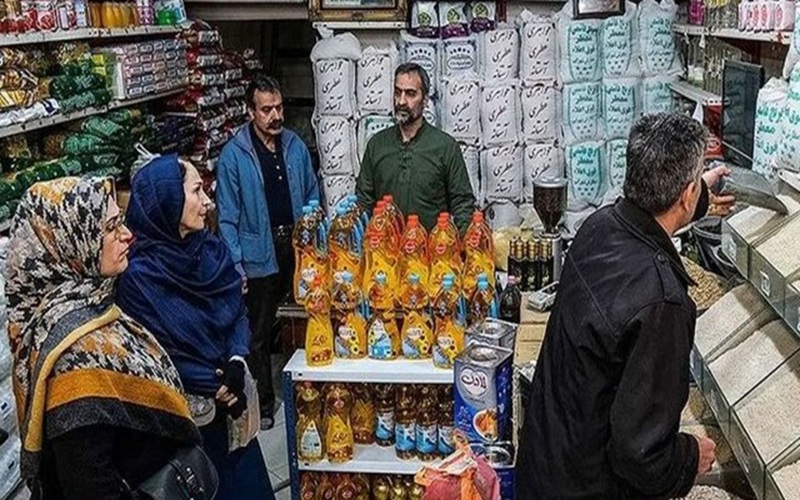

A collapsing currency, soaring food prices, and shrinking wages are intensifying concerns within Iran’s regime over worsening living conditions and the potential for renewed unrest
Iran’s regime is once again placing “people’s livelihoods” and “social unity” at the center of its public messaging as the country’s economic crisis reaches increasingly alarming levels.
On September 29, Hassan Mirzaei, President Masoud Pezeshkian’s chief of staff, said that Pezeshkian was not concerned about the United States but was worried about conditions inside Iran, particularly people’s livelihoods and the cohesion of society.
Such statements are not new. What has changed is the severity of the economic conditions surrounding them.
The Iranian rial has continued its precipitous decline, with the dollar recently surpassing 265,000 tomans. At the same time, official figures indicate that year-on-year inflation reached 89.8 percent between September 2025 and September 2026.
For millions of Iranian families already struggling with stagnant incomes, the combination of currency depreciation and rapidly rising prices has pushed purchasing power to unprecedented lows.
A wage that buys less every day
The collapse of the rial has made the scale of the crisis particularly visible when wages are converted into dollars.
The minimum monthly income of an Iranian worker, including benefits, has fallen to roughly $60 at the current exchange rate. That amounts to approximately $2 a day for a household dependent on that income.
The figure illustrates how far living standards have deteriorated. International poverty benchmarks have historically placed considerably higher minimum income thresholds even for individuals in lower- and middle-income economies.
The comparison is even more severe when the Iranian figure represents the income available to an entire household rather than one individual.
For workers, therefore, the problem is not simply inflation in the abstract. It is the rapid destruction of the real value of wages.
A salary that may appear unchanged in nominal terms can purchase dramatically less food, medicine, housing, transportation, and other necessities than it did only months earlier.
Food inflation hits hardest
The official inflation figure of 89.8 percent is itself an average and therefore does not fully capture the pressure experienced by households purchasing basic necessities.
Food prices have risen particularly sharply. Official figures cited in the discussion put some food-price increases well above the overall inflation rate, with increases of more than 100 percent reported for parts of the food basket.
This is especially significant because food is not a discretionary expense. Families can postpone buying a car, replacing household appliances, or taking a vacation. They cannot indefinitely postpone buying food.
As prices rise, households are forced to reduce consumption, substitute cheaper products, or eliminate items altogether. The result is a steady decline in living standards even among people who remain formally employed.
The regime’s repeated references to livelihoods therefore come against an economic reality that its own statistics increasingly expose.
The regime’s fear extends beyond economic hardship
The economic crisis is also becoming a political problem.
Iranian officials and security commanders have increasingly warned about the possibility of unrest and the danger of a sudden trigger turning accumulated grievances into broader protests.
Former security officials and senior commanders, including Ahmad-Reza Radan and Esmail Ahmadi-Moghaddam, have issued warnings about potential unrest and the regime’s readiness to confront it.
The significance of such warnings lies partly in their timing. Authorities are discussing how to respond to a possible uprising before a specific new nationwide protest movement has emerged.
This suggests that the regime recognizes the connection between economic deterioration and political instability.
The experience of previous protests has demonstrated that economic grievances can rapidly acquire broader political dimensions. Once people take to the streets over prices, wages, fuel, or living conditions, the grievances can quickly expand into demands concerning the entire political system.
Token subsidies cannot reverse the crisis
The regime has responded by discussing additional assistance through its electronic food subsidy, or kalabarg, program.
Government spokesperson Fatemeh Mohajerani reportedly announced an increase of 300,000 tomans in the subsidy. But the measure is tiny compared with the scale of price increases confronting households.
Even government-linked discussions acknowledge that such payments cannot compensate for the loss of purchasing power caused by inflation approaching 90 percent.
The government has also discussed other forms of financial compensation, including additional payments associated with changes in fuel policy. Yet these measures address symptoms rather than the underlying causes of the crisis.
The fundamental problem is the continuing depreciation of the national currency, persistent inflation, structural economic mismanagement, corruption, and an economy heavily distorted by the regime’s political and security priorities.
A crisis the regime cannot easily contain
The economic deterioration is particularly dangerous for the regime because it is occurring across multiple sectors simultaneously.
Workers, retirees, employees, nurses, students, and other groups face rising costs while their incomes fail to keep pace. Economic grievances are therefore not confined to one social class or one occupation.
At the same time, the regime’s ability to use financial incentives to maintain the loyalty of its own security and administrative apparatus is also coming under pressure as the currency loses value.
The result is a widening gap between the regime’s promises and the daily reality experienced by ordinary Iranians.
Pezeshkian’s repeated emphasis on improving livelihoods may be intended to reassure the population, but it also underscores the seriousness of the problem. A government does not repeatedly declare that the economy and social cohesion are its primary concerns unless it recognizes that both are under strain.
The regime’s growing emphasis on “unity,” meanwhile, reveals another concern: economic discontent could become a catalyst for broader political confrontation.
With the dollar above 265,000 tomans, inflation approaching 90 percent, and food prices rising even faster, the economic crisis is no longer simply a question of household hardship. It has become a central challenge to the regime’s ability to maintain social stability.
The more the regime tries to suppress the symptoms without addressing the underlying crisis, the greater the danger that an economic grievance could become the spark for a much broader eruption of public anger.