


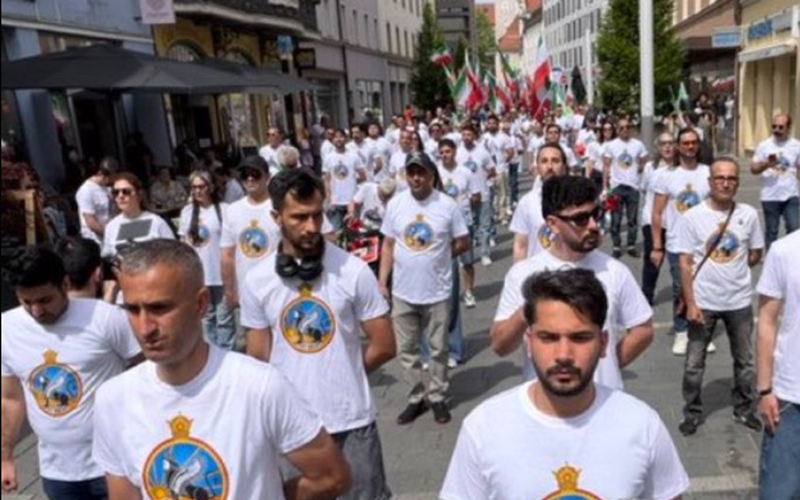

From harassment at PMOI events to threats against businesses and the cancellation of a major Paris rally, the growing pattern of intimidation associated with the monarchist current exposes an authoritarian approach to political opposition—one that echoes the methods Iran’s ruling regime uses to silence dissent.
Since Iran’s January 2026 protest wave, a disturbing pattern has emerged across the Iranian diaspora. Supporters of Reza Pahlavi have been implicated in incidents involving harassment, threats, disruption, and physical violence against PMOI supporters, Kurdish and leftist activists, journalists, business owners, and other critics who reject the restoration of the monarchy.
These incidents span several countries and target people with different political backgrounds. What connects them is not merely disagreement over Iran’s future, but the apparent unwillingness of some monarchist activists to accept the legitimacy of competing opposition currents. From confrontations at political events to pressure on businesses and threats against rival dissidents, the recurring pattern raises a fundamental question: is a movement that claims to offer Iran a democratic future prepared to respect the political freedoms it promises?
Accountability matters! While executions multiply in Iran, Reza Pahlavi supporters worked to silence the democratic opposition through violence outside of it (while regime President was inside the @UN). They hence serve his regime. Reza Ebrahimi was arrested on 09/22/26 @NYPDnews pic.twitter.com/kNHvBALjJ8
— OIAC: Organization of Iranian American Communities (@OrgIAC) October 14, 2026
The comparison with the ruling regime is not that monarchist activists possess the same state apparatus or exercise the same scale of repression. It is that the methods of intimidation, enforced political conformity, and hostility toward dissent reproduce the very authoritarian logic that Iran’s people have struggled against for decades. Replacing one claim to absolute political authority with another would not constitute democratic change.
The cancellation of the National Council of Resistance of Iran’s (NCRI) June 20 rally in Paris brought these concerns into sharp focus. French police banned the event over the risk of public-order disturbances. A subsequent security assessment reported by Reuters described heightened threats associated with monarchist activists, including calls to block the PMOI march and alleged bomb threats. The episode exposed the consequences when political intimidation threatens the ability of opponents of Iran’s regime to assemble peacefully.
A pattern of authoritarian political behavior—not ordinary opposition rivalry
Disagreements over leadership, ideology, and Iran’s political future are inevitable within a diverse opposition. But intimidation is not a legitimate form of political competition. Nor is the right to oppose the ruling regime a license to dictate who else may participate in that struggle.
Reuters documented at least four recent incidents across three countries involving violence or harassment by self-identified Pahlavi supporters. These included an assault on a Kurdish reporter in London and incidents in Austria, the Netherlands, and Canada. Reuters also reported that two Pahlavi supporters were charged in Canada in connection with the murder of a critic of Pahlavi; the investigation was ongoing at the time of the report.
The broader pattern described by activists and diaspora accounts includes confrontations involving PMOI/NCRI supporters, Kurdish activists, leftists, republicans, journalists, and critics of the monarchy. These are not simply disagreements between rival political camps. They concern whether people who reject monarchist rule can exercise their political rights without facing intimidation.
وقتی سقوط اخلاقی و سقوط اجتماعی شاه و شیخ به اعلا میرسد . دیروز ما شکنجه گران ساواک و سپاه را در خیابانهای ونکور دیدیم !
وحشی گری و لمپنی وبی ادبی و وابستگان به استعمار بیگانه در ونکور #نه_شاه_نه_شیخ#No2ShahNo2Mullahs pic.twitter.com/CGVT2mW9Ts— Free Iran Women Association – Vancouver (@iran_vancouver) October 18, 2026
The authoritarian danger lies in the underlying political logic: one faction presents itself as the rightful representative of the nation, treats competing voices as illegitimate, and uses pressure to make dissent costly. That logic is fundamentally incompatible with a democratic republic based on political pluralism, free expression, and the right of citizens to choose their own future.
Harassment at public events: the politics of intimidation
Reports from Iranian diaspora communities describe a recurring pattern at PMOI, NCRI, Kurdish, and other non-monarchist events: monarchist activists confront participants, shout insults, attempt to provoke altercations, film those present, and circulate footage online.
Accounts shared by diaspora organizers describe incidents in London, Cologne, Hamburg, Regensburg, Rome, Vienna, Toronto, Vancouver, Los Angeles, and New York. The reported conduct ranges from verbal abuse to alleged physical attacks and attempts to disrupt commemorative events, exhibitions, book tables, and demonstrations against executions in Iran.
Not every online account independently establishes every detail of an incident. Yet the recurrence of similar reports across different cities and political settings warrants serious attention, particularly alongside incidents independently documented by Reuters.
Political intimidation does not have to be centrally directed to serve an authoritarian purpose. When activists attempt to disrupt rival gatherings, humiliate participants, or create an atmosphere of fear around peaceful political activity, the practical message is that some opponents are not entitled to speak freely. That is precisely the kind of political coercion that a democratic opposition should reject—not excuse or normalize.
«بهنام زاپاتا» لمپن هوادار بچه شاه در لندن توسط پلیس دستگیر شد.
بهنام زاپاتا قبلأ در یکی از تجمعات اطلاعاتیهای طرفدار پهلوی مشخصأ فریاد زده بود که با نیروهای سیاسی مخالف سلطنت بدتر از ولایت دینی رفتار خواهد کرد.
کودنی زر پاتا نشعت گرفته از عدم درک او از انقلابیون است.… pic.twitter.com/fo59eZhMuk
— مسئول انجمن دفاع از آزادی بیان هامبورگ (@FardinHH) March 23, 2026
Threats against Iranian businesses: demanding political conformity
Allegations that monarchist activists have threatened Iranian-owned businesses are especially revealing. Several social-media posts describe pressure on shop, café, and restaurant owners over their political positions, including demands to display the pre-revolutionary lion-and-sun flag.
Reuters separately reported that self-identified Pahlavi supporters intimidated restaurant owners in London and Vienna who refused to display the pre-revolutionary flag.
The significance goes beyond a dispute over a national symbol. A business owner should not have to demonstrate allegiance to a particular political faction to operate without intimidation. Demanding public conformity from people who hold different views is a form of coercion, whether it occurs in a commercial district in Europe or under the far more powerful machinery of repression inside Iran.
A movement that seeks to impose its symbols and political preferences through intimidation is not defending freedom of choice; it is undermining it. The right to reject the monarchy must be as secure as the right to oppose the current regime.
فحاشی اوباش ساواکی/ سپاهی به خانواده های شهدا …#نه_شاه_نه_شیخ pic.twitter.com/heJ65lSLF2
— SIA30 (@SIA30MUSIC) September 23, 2026
Violence against journalists and activists
The allegations involving physical violence represent the most serious dimension of this pattern. Reuters reported that self-identified Pahlavi supporters beat a Kurdish reporter in London, leaving him hospitalized, and documented violence or threats involving supporters in Britain, Austria, the Netherlands, and Canada.
Journalists, peaceful demonstrators, and political activists must be able to work, report, assemble, and express their views without fear of attack. When political identity becomes a pretext for violence, the issue is no longer simply an internal dispute among Iranian exiles. It becomes a direct challenge to the democratic freedoms that any credible alternative to Iran’s regime must uphold.
The comparison with the regime’s methods is therefore political, not an assertion that the two possess equal power. Iran’s ruling authorities use state institutions, security forces, imprisonment, and executions to crush dissent. Monarchist intimidation abroad operates on a different scale and through different means. But the attempt to silence opponents rather than defeat them through open political argument reflects the same contempt for pluralism and the same authoritarian instinct.
🔹بعد از اقدامات پلیس وین، هنوز هم این زنک سطلشور و اراذل و اوباش سلطنت آدم نشدن!
این حرومزاده های هرزه روباید صافشون کرد✊✊✊#تفاله_سلطنت_مدفون pic.twitter.com/VPkLGO9OhL— شروین (@AliAzad19038) February 14, 2026
The Paris rally cancellation: when intimidation restricts political freedom
The NCRI’s June 20 rally in Paris was intended to be a major demonstration against executions and repression in Iran. Instead, police banned the event at the last minute, citing a serious risk of confrontations between activists with opposing views in a “particularly tense national and international context.” A Paris court upheld the ban on the morning of the planned rally.
The NCRI denounced the decision as politically motivated and said it had coordinated with police for months. The wording of the police order referred broadly to public order. However, a later Reuters report on a security assessment said French authorities had warned of a heightened threat associated with rival monarchist activists. The assessment reportedly cited calls by a prominent monarchist activist to block the PMOI march, threatening online rhetoric, and alleged bomb threats by people using symbols associated with the Shah-era SAVAK security service.
حمله چند قلاده سطلی شاهپرست با پرچم اسرائیل به نمایشگاه تصاویر شهیدان مجاهد و شورشگر و آکسیون مجاهدین در هامبورگ آلمان
#نه_شاه_نه_شیخ@farbodmah pic.twitter.com/JXIlmJcN2R
— امین الرعایا (@hosainini821) May 16, 2026
The distinction between the official grounds for the ban and the details reported subsequently is important. Nevertheless, the episode illustrates how threats of confrontation can deprive peaceful political movements of their ability to assemble.
When intimidation helps prevent an anti-regime demonstration from taking place, the damage extends beyond the targeted organization. It restricts the public space in which Iranians can advocate competing visions of their country’s future. A movement that claims to speak for Iran cannot credibly demand political freedom while its supporters are associated with efforts to obstruct the peaceful assembly of other opponents of the regime.
Why the January 2026 protests exposed the problem
Iran’s January 2026 protest wave intensified competition among exile opposition currents. Pahlavi’s public profile rose as he called for continued demonstrations and sought to establish himself as a leading figure of the opposition. The PMOI and other non-monarchist currents also remained active, presenting alternative political programs and rejecting the restoration of hereditary rule.
This competition is legitimate. No individual or faction has an automatic right to monopolize the opposition, and no political movement should be entitled to determine Iran’s future without the freely expressed consent of its people.
همین دیروز در لندن رَپر #بسیجی-سطلی شان را برای فحاشی به تظاهراتی که برای بزرگداشت شهدای قیام برپاشده بود، فرستادند.
تقسیم کار بین خامنه ای و بچهِ شاه جهت اشغالِ فضای مجازی با «دستکاری دیجیتال» به همان اندازه برای #پهلوی_شیاد مهم است که ارسال #بسیجی-سطلی ها برای برهم زدن تظاهرات. pic.twitter.com/xu81O1Flqq— Amir TARAJ (@alxtaraj) January 3, 2026
The problem emerges when the contest for legitimacy becomes a justification for intimidation. If a faction responds to competing political voices by attempting to silence them, it reveals a fundamental contradiction between its democratic rhetoric and its political practice.
Iran’s struggle is not simply about removing the current rulers. It is about ending the system of imposed authority that denies the people the right to determine who governs them. A return to monarchy would not resolve that problem merely by changing the identity of the ruler. Nor can a democratic future be built by treating republicans, Kurdish activists, leftists, or supporters of the PMOI as enemies who must be silenced.
Who benefits when the opposition intimidates itself?
There is no need to establish that Iran’s ruling regime directs every incident to recognize the strategic consequences of this behavior. The effects are plain: rival dissidents are intimidated, demonstrations are disrupted, media attention shifts from repression inside Iran to confrontations among exiles, and Tehran gains material for portraying the opposition as divided and incapable of offering a democratic alternative.
Reuters described a bitter schism among exiled opposition factions, while Time argued that Pahlavi’s inability or unwillingness to control supporters who attack non-monarchist dissidents had fractured what should have been a united front.
These assessments reinforce a broader political point. The regime benefits whenever the struggle for freedom is weakened by attempts to impose a new political monopoly. That does not prove that every act of intimidation is coordinated with Tehran, nor does it establish that Pahlavi personally ordered or approved any particular incident. It does mean that the political consequences deserve scrutiny—and that leaders who seek national legitimacy have a responsibility to confront intimidation within their own political camp.
A democratic opposition must be capable of drawing a clear line between vigorous political advocacy and coercion. It must reject threats, condemn attacks, and defend the rights of people whose political convictions differ from its own. Silence in the face of repeated intimidation only deepens doubts about its commitment to pluralism.
The real test: democracy or another form of imposed rule?
The recurring reports of harassment, threats, disruption, and violence associated with some self-identified Pahlavi supporters pose a question that extends far beyond individual confrontations. What political culture is being cultivated among those who claim to represent Iran’s future?
A democratic alternative cannot be defined solely by opposition to the current regime. It must also be defined by its treatment of dissent, its rejection of hereditary entitlement, and its willingness to accept political competition without intimidation. The test is not whether a faction invokes national unity, patriotism, or freedom. The test is whether it respects the rights of those who refuse to follow it.
Violence & injury initiated by oppressors against the innocent, mark the distance between freedom fighters and oppressors. Reza Pahlavi & his supporters are in this manner, Iran regime enablers, co-conspirators, & must be exposed. https://t.co/EHrQUv26vJ pic.twitter.com/zqm6Jguw7p
— OIAC: Organization of Iranian American Communities (@OrgIAC) October 14, 2026
Iran’s people have endured a system in which political power is concentrated, dissent is punished, and the authorities claim the right to decide which voices are legitimate. The answer cannot be another movement that treats political disagreement as disloyalty and seeks to establish its authority by silencing rivals.
No Shah, No Mullahs is not merely a rejection of two political figures or historical periods. It expresses a fundamental principle: Iran’s future must not be imposed by either a clerical establishment or a monarchist claim to inherited authority. A democratic republic requires free political competition, equal citizenship, and the right of every political current to advocate its program peacefully.
The responsibility now rests with the broader monarchist current, and especially with those seeking to lead it, to confront intimidation openly, reject political violence without qualification, and demonstrate respect for the rights of rival opposition groups. If they fail to do so, the consequences will extend beyond their own credibility. They will help reproduce the authoritarian political culture that Iran’s people are struggling to overcome.
سرنوشت عبرت انگیز یک لیدرفاشیست «چادرصدای پهلوی» درلندن امیرحسین ترکان
امیرحسین ترکان اول بار درحمله به اکسیون ها و تجمعات مجاهدین و گروهای مارکسیستی شناخته شد سپس ماهیت فاشیستی و کینه توزانه بچه شاه را درمیان بهت ایرانیان درتجمع شاه پرست ها در لندن علنی کرد او گفت : «لعنت برروح… pic.twitter.com/8ASjfz5vgi— Mohsen Abbasi (@AbbasiMhahhm) October 7, 2026
The question is not whether every monarchist supporter is responsible for every reported incident. It is whether a political current that seeks national leadership will reject the coercive behavior associated with some of its supporters—or allow intimidation to become an accepted instrument of political competition.
Iran does not need a change of rulers that preserves the logic of authoritarian rule. It needs a decisive break with that logic.