


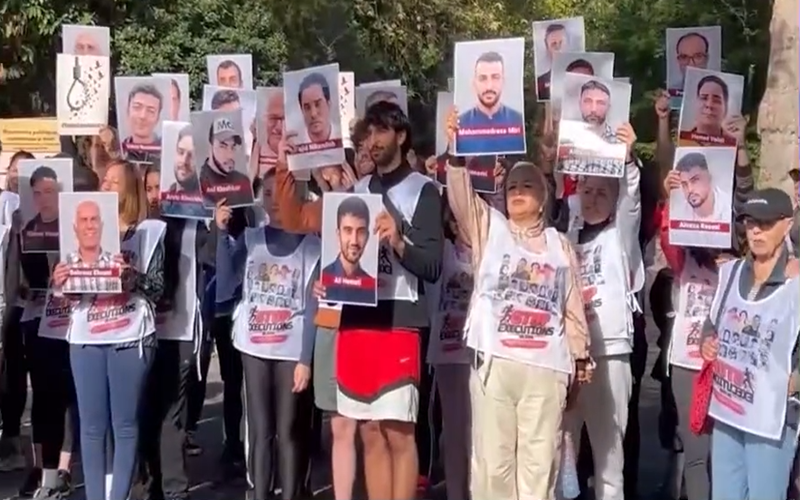

What began as a weekly hunger strike by political prisoners has grown into a nationwide and international campaign challenging the regime’s execution apparatus, with support from families, resistance activists, political figures, and human rights advocates.
Iran’s “No to Execution” campaign has developed from a protest initiated by political prisoners into a broader movement challenging one of the central instruments of repression used by the clerical regime. Launched at Qezel Hesar Prison in February 2024, the campaign is approaching its third anniversary, with prisoners in 66 prisons across Iran participating in weekly hunger strikes every Tuesday.
Its expansion beyond prison walls has brought together prisoners’ families, supporters of the Iranian Resistance, resistance activists inside Iran, political figures, and human rights advocates abroad. The campaign has also reached political forums and parliaments internationally, turning opposition to executions into a prominent demand in the struggle against the regime’s repression.
The movement’s growth demonstrates how prisoners have used collective action to challenge executions despite the severe risks they face, while connecting their protest to a wider demand for an end to state-sanctioned killing in Iran.
“No to Execution Tuesday” solidarity event at the European Parliament. We stand with people of #Iran pic.twitter.com/DrVga1TuIB
— Petras Austrevicius (@petras_petras) October 21, 2026
From Qezel Hesar to 66 Prisons Across Iran
The “No to Execution” campaign began in the political prisoners’ ward at Qezel Hesar Prison in February 2024. It gradually spread to other prisons, including Evin, as increasing numbers of prisoners joined the weekly protests.
Although the campaign initially experienced periods of slower expansion, it subsequently gained renewed momentum. It now encompasses 66 prisons across the country, where political prisoners stage hunger strikes every Tuesday to protest executions.
#Iran On Tuesday the 13th, I am joining the 'No Execution Tuesdays' hunger strike.
The death penalty is being used against people for exercising their rights to freedom of assembly, association, and expression, as well as their political rights. 1/ pic.twitter.com/Ld2kAj1Djq
— Gina Romero (@Ginitastar) October 11, 2026
The campaign’s persistence is significant in a prison system where inmates face intense pressure and the threat of execution itself. By maintaining a coordinated weekly action across dozens of facilities, prisoners have continued to challenge the normalization of capital punishment and draw attention to the regime’s reliance on executions as a means of repression.
The campaign targets more than individual death sentences. It challenges the broader system through which the regime uses executions to intimidate political opponents, suppress dissent, and maintain its grip on power.
I support the #NoToExecutionTuesdays campaign. On 20 Oct the Iranian prisoners’ campaign marks its 143rd consecutive week. UN Special Rapporteur Léopoldo Maldonado joins tomorrow with a 24-hour hunger strike following Gina Romero last week. Stand with them. End the executions.
— Jim Shannon MP (@JimShannonMP) October 19, 2026
How Prisoners’ Resistance Reached Iran’s Streets
The campaign’s expansion has not been confined to prisons. Families of political prisoners, supporters of the Iranian Resistance, and resistance activists have helped carry its message into Iranian cities.
Resistance activities have promoted the demand to end executions through public messaging and other forms of activism. In Zahedan, the campaign has also remained a recurring theme in public expressions of opposition to the regime.
I am joining in solidarity with Leopoldo Maldonado @SRfreedex_LMG, UN Special Rapporteur on the promotion and protection of the right to freedom of opinion and expression, in support of the "No to execution Tuesdays' campaign.@drmaisato @volker_turk #StopExecutionsInIran pic.twitter.com/qqn79Svhwn
— Ali Safavi (@amsafavi) October 20, 2026
These efforts have helped transform the weekly hunger strikes into a broader political and social demand. The message is straightforward: executions must not be accepted as an ordinary feature of political life, and prisoners facing death sentences must not be left to confront the regime in isolation.
The participation of people outside prison walls has also given the campaign a wider reach, linking the determination of prisoners to a broader movement against repression.
Executions of Campaign Supporters Intensified International Attention
The campaign gained further visibility outside Iran following the executions of individuals associated with the movement, including six members of the Resistance Units, as well as Vahid Ghahreman and other political prisoners identified with the campaign.
Rather than silencing opposition to executions, these cases helped draw greater attention to the movement among Iranian communities abroad and international political circles.
Supporters of the Iranian Resistance began raising the issue more prominently at public gatherings, conferences, roundtables, book tables, and exhibitions in cities around the world. Political figures subsequently joined these efforts, helping bring the campaign into parliamentary discussions and other international forums.
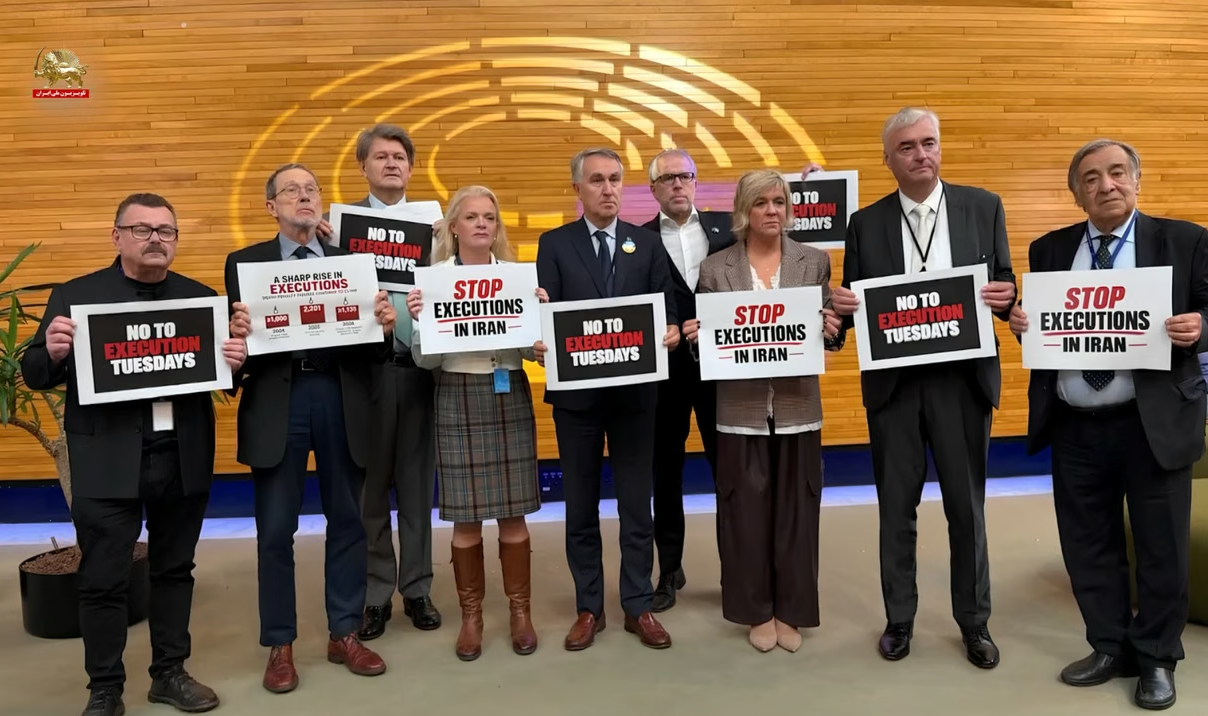
The development reflects a gradual shift from solidarity activities organized by supporters toward a wider political debate over the regime’s use of the death penalty.
For the campaign, international visibility is not simply a matter of public recognition. It offers a means of drawing sustained attention to prisoners at risk, exposing the role of executions in political repression, and increasing pressure on a regime that continues to rely on capital punishment.
From a Prison Protest to an International Demand
The campaign’s reach illustrates how a demand rooted in the immediate experience of prisoners can become a broader political issue. The weekly hunger strikes provide a sustained focal point, while activities inside and outside Iran amplify the message and connect it to international human rights advocacy.
The participation of political figures and the campaign’s appearance in parliamentary debates have helped establish opposition to executions as a recurring subject in international discussions about Iran.
6-Gothenburg, Sweden — Oct 20, 2026: PMOI supporters condemn the mullahs’ execution machine in solidarity with week 143 of “No to Execution Tuesdays” across 66 prisons in Iran.
Down with the executioner regime!#StopExecutionsInIran #NoDeathPenalty #FreePoliticalPrisoners pic.twitter.com/iKfFpv1vit— Iran Freedom (@4FreedominIran) October 21, 2026
However, international recognition and political support do not, by themselves, guarantee an end to executions. The challenge remains translating solidarity into sustained action capable of protecting prisoners facing death sentences and confronting the institutional machinery that carries out executions.
That distinction makes the campaign’s continued activity particularly important. Its weekly protests keep the issue visible even when international attention shifts elsewhere.
Can the Regime’s Execution Machine Be Stopped?
The expansion of the “No to Execution” campaign from one prison to 66 facilities, alongside its growing international profile, demonstrates the capacity of organized resistance to sustain a challenge to the regime’s repressive practices.
Its central strength lies in the continuity of the prisoners’ action. Every Tuesday, political prisoners renew their protest, despite the risks and pressures they face. Outside prison, families, resistance activists, supporters, and international advocates extend that demand into public and political arenas.
7-Gothenburg, Sweden — Oct 20, 2026: PMOI supporters condemn the mullahs’ execution machine in solidarity with week 143 of “No to Execution Tuesdays” across 66 prisons in Iran.
Down with the executioner regime!#StopExecutionsInIran #NoDeathPenalty #FreePoliticalPrisoners pic.twitter.com/s2kBOkoDpB— Iran Freedom (@4FreedominIran) October 21, 2026
The campaign has also helped connect opposition to the death penalty with the wider struggle for political freedom in Iran. By challenging executions as a pillar of the regime’s system of repression, it confronts not only the punishment imposed on individual prisoners but also the use of fear to discourage dissent.
Stopping the execution machine will require sustained pressure, continued attention to prisoners at risk, and concrete efforts to hold the regime accountable for its use of capital punishment. The campaign’s expansion shows that the demand for an end to executions has gained a durable platform inside Iran and an increasingly visible presence internationally.
Leopoldo Maldonado Gutiérrez:
Chers amis, comme je l’ai annoncé hier, j’ai rejoint la campagne « Non aux ex*écutions du mardi », en solidarité avec les prisonniers politiques qui risquent la peine de mo*rt en Iran
Stop aux exécutions en #Iran #StopExecutionsInIran https://t.co/WNx1lrtGEr pic.twitter.com/TRxVI7Oo08— csdhi.org (@CSDHI) October 20, 2026
The message emerging from Qezel Hesar and the other participating prisons remains clear: the fight against executions cannot be separated from the struggle for freedom. As prisoners continue their Tuesday hunger strikes, the “No to Execution” campaign stands as a continuing challenge to the regime’s attempt to use death sentences to silence its opponents.