


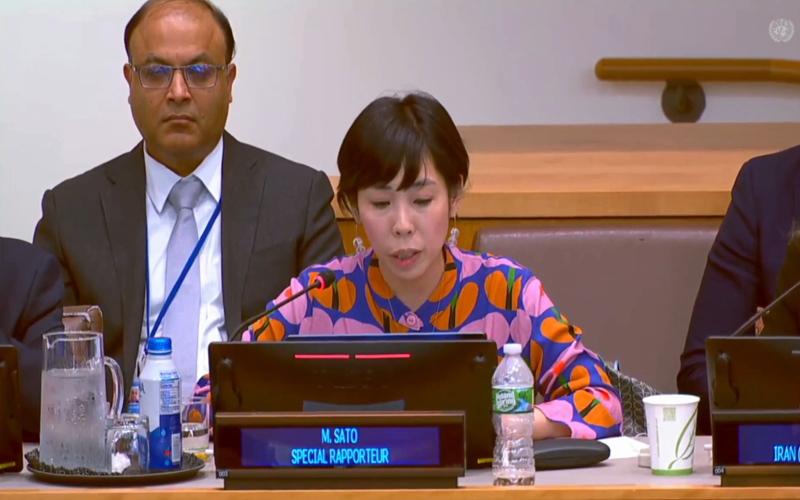

Presenting her report to the UN General Assembly, Mai Sato detailed the execution of protesters, mass arrests, enforced disappearances, and systematic efforts to silence victims and conceal human rights violations.
Iran’s regime continues to use executions, arbitrary arrests, and restrictions on communications to suppress dissent and conceal human rights violations, UN Special Rapporteur Mai Sato warned on October 28, 2026, when presenting her report to the United Nations General Assembly’s Third Committee.
This is the correct link for the General Assembly ID today (28 October at 3pm New York time) https://t.co/0ZU6h89P89 https://t.co/KPEjO2x4Uc
— Mai Sato (@drmaisato) October 28, 2026
Covering the period from February to August 2026, Sato’s report documented a widening crackdown in the aftermath of the nationwide protests of January 2026. Protesters, political prisoners, human rights defenders, lawyers, journalists, women, and members of ethnic and religious minorities remain targets of repression.
The report also highlighted the authorities’ efforts to intimidate families seeking information about relatives killed during the protests, restrict independent documentation, and portray dissent as a national security threat.
Sato warned that the scale of the violations remains difficult to establish because of the regime’s restrictions on information and the risks faced by people attempting to communicate with international human rights bodies.
At least 34 protesters executed as death sentences mount
The consequences of the January uprising continue to be felt by families of those killed and by protesters facing prosecution. According to Sato, relatives have been pressured to remain silent, denied the ability to hold funerals freely, threatened with criminal punishment, and subjected to asset confiscation when they demand truth and accountability.
Thousands of arrests on national security charges have been reported. Many detainees have been held incommunicado at undisclosed locations, raising serious concerns about enforced disappearance.
At least 34 people have been executed in connection with the January protests, including at least five in public, Sato reported. More than 100 people, including women and children, remain on death row in connection with the protests, according to the UN fact-finding mission that presented its findings alongside her report.
The cases reveal how the regime uses the death penalty to punish dissent and deter further protests. Concerns about the fairness of trials have intensified as senior officials have called for expedited proceedings and authorities have broadcast confessions before defendants have had a meaningful opportunity to defend themselves.
In one case highlighted by Sato, 34 adults were tried in just five days. Twelve were sentenced to death, and seven had been executed by the time of her presentation.
Sato warned that proceedings conducted without adequate safeguards cannot reliably establish individual criminal responsibility and risk producing arbitrary death sentences. She also reiterated that broadcasting confessions before trial violates the presumption of innocence and that confessions obtained through torture must be excluded from judicial proceedings.
Protest-related executions form only part of the broader crisis. Hundreds of executions have been carried out in Iran during 2026, including for murder-related offenses under qisas provisions and drug-related offenses.
Sato called for an immediate moratorium on executions. She also drew attention to the No to Execution Tuesdays campaign, through which prisoners have conducted weekly hunger strikes against capital punishment for more than two years and eight months.
Internet blackouts conceal the scale of the crackdown
The regime’s restrictions on communications have made it harder to document violations and have left people inside Iran increasingly isolated from the outside world.
Sato explained that nationwide internet shutdowns deprived people of secure means of transmitting information to international organizations and foreign media. Even when communications remained possible, surveillance exposed those sharing information to serious risks.
Under espionage laws, sharing information with foreign media can carry the death penalty. Some people who initially provided information to her mandate subsequently withdrew their consent after considering the potential consequences for themselves and their families.
As a result, Sato cautioned that her report captures only a fraction of the violations and cannot be considered a comprehensive account of the suffering inflicted on Iran’s population.
The UN fact-finding mission reported that the authorities imposed the longest nationwide internet shutdown in the country’s history following the January protests, lasting almost five months. The blackout restricted access to information during a period marked by widespread killings, arrests, and uncertainty over the fate of detainees.
The Iranian government has published a list of more than 3,000 people killed, but the fact-finding mission believes the actual number is significantly higher. Its documented deaths include at least 221 children, the youngest just four months old.
Detainees have also faced torture and other forms of ill-treatment. Families have struggled to establish the whereabouts and fate of relatives, including children, while restrictions on communication and access to information have compounded their distress.
By criminalizing or threatening legitimate contact with foreign media and international human rights mechanisms, the regime further obstructs independent scrutiny and accountability.
Lawyers, women, and minorities face systematic persecution
Sato’s findings describe a pattern of repression that extends beyond the prosecution of protesters. Lawyers, journalists, women and girls, ethnic minorities, and religious minorities face overlapping forms of discrimination, intimidation, and punishment.
Lawyers representing protesters have been summoned, threatened, and, in some cases, arrested. These measures undermine access to legal representation and discourage others from defending people accused of national security offenses.
Women and girls continue to face institutionalized discrimination and coercive enforcement of mandatory hijab rules. Such restrictions limit personal autonomy and expose women who resist the authorities’ demands to punishment.
Ethnic minorities, including Kurds, Baluch, Ahwazi Arabs, and Azerbaijani Turks, face discrimination and repression. Azerbaijani Turks have also raised concerns about land confiscation, environmental degradation, and restrictions on the use of their language in schools and public life.
Religious minorities remain vulnerable as well. Baha’is and Christian converts continue to face persecution and arbitrary arrest, with the authorities increasingly scapegoating minority communities.
These violations often receive limited international attention despite their effects on the daily lives of millions of people. The report underscores how the regime’s security apparatus and discriminatory policies restrict basic freedoms across different sections of Iranian society.
Families and activists face intimidation beyond Iran’s borders
The campaign to silence critics also reaches Iranians living abroad and people cooperating with international investigations.
The UN fact-finding mission documented digital threats and other forms of transnational repression targeting journalists, human rights defenders, and individuals providing information about violations. Reported methods include doxing, online intimidation, spyware, and malicious software.
Such tactics can expose victims and their families to further threats while discouraging witnesses from cooperating with investigators. They also create risks for members of the Iranian diaspora who seek to document abuses or advocate for accountability.
The mission called on governments to strengthen protection for people at risk, improve early-warning systems, provide safe avenues for refuge, and pursue accountability for digital threats and other forms of transnational repression.
It also highlighted potential avenues for justice, including universal jurisdiction and other applicable international legal mechanisms, alongside continued support for victims and organizations documenting violations.
International scrutiny grows as Tehran rejects accountability
During the presentation, the European Union, Germany, the United Kingdom, France, Canada, Australia, Switzerland, Norway, and other governments raised concerns about executions, arbitrary detention, and the crackdown on dissent. They called for fair trials, accountability, and unrestricted access for UN human rights mechanisms.
Several governments urged the regime to establish an immediate moratorium on executions and release those arbitrarily detained. The European Union reported imposing additional sanctions since January on 37 individuals and nine entities responsible for human rights violations in Iran.
Iran’s representatives rejected Sato’s mandate and the UN fact-finding mission as politically motivated. They criticized sanctions and foreign interference while disputing the legitimacy of country-specific human rights scrutiny. Russia, Belarus, Nicaragua, Eritrea, China, and North Korea also questioned such mandates or criticized what they described as politicization.
Sato noted that the Iranian government had engaged with her mandate over the preceding two years. However, she criticized the lack of comparable, published information on executions and killings by security forces. The publication of such data, she stressed, is the state’s responsibility.
She renewed her request to visit Iran, arguing that access to the country is essential for assessing the situation and documenting violations.
The report’s findings point to a sustained campaign in which executions, mass arrests, information blackouts, and intimidation reinforce one another. By treating peaceful dissent as a security threat, the Iranian regime continues to deny victims and their families meaningful access to truth and justice.
Sato’s presentation underscored the need for sustained international scrutiny, protection for witnesses and human rights defenders, and credible accountability for those responsible. An immediate moratorium on executions, an end to arbitrary detention, and access for independent UN investigators remain essential steps toward protecting the fundamental rights of Iran’s population.