


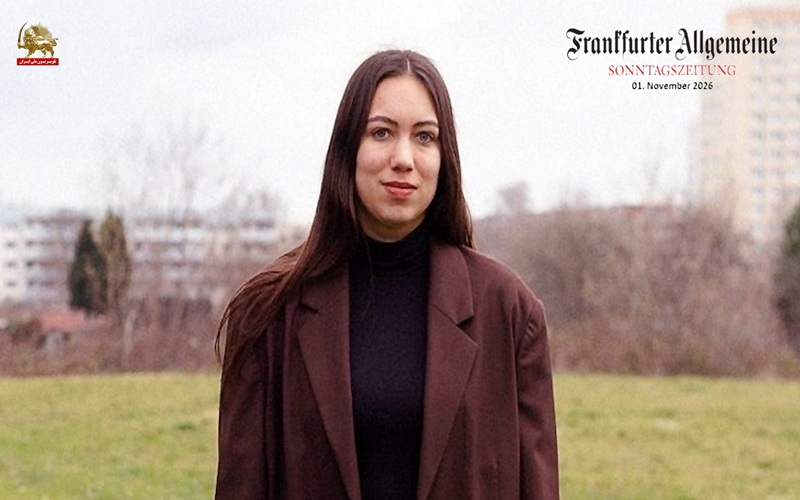

In a November 7 column, writer Ronya Othmann argues that the Friedrich Naumann Foundation made the right decision to honor the Iranian people but the wrong one in selecting the son of the former shah to receive the award, highlighting his failure to confront his father’s repression, hostility among minorities, and the conduct of monarchist supporters.
A column published by Germany’s Frankfurter Allgemeine Zeitung (FAZ) on November 1 has questioned the Friedrich Naumann Foundation’s decision to designate Reza Pahlavi as the representative recipient of its 2026 Freedom Prize, arguing that the recognition rightly belongs to the Iranian people but that the foundation chose the wrong person to receive it.
In her column, titled Political Naivety or Calculation?, writer Ronya Othmann distinguishes between honoring Iranians fighting for freedom and elevating Pahlavi, the son of Iran’s last shah, to a position of political representation without a democratic mandate.
The award is scheduled to be presented on November 7 at Frankfurt’s historic Paulskirche. The foundation says it is recognizing the courage and determination of the Iranian people and those working for their rights, freedom, and an open democratic society.
Othmann welcomes that decision, particularly at a time when international attention has increasingly shifted toward the Strait of Hormuz, energy prices, and geopolitical tensions, leaving the Iranian people suffering under the regime’s repression largely out of the headlines.
However, she argues that the foundation overlooked far more appropriate representatives: women who took to the streets following the murder of Jina Amini, activists shot, arrested, and tortured by the regime’s security forces, as well as political prisoners’ relatives, poets, artists, lawyers, and other activists.
These are people who have personally confronted repression and whose voices, she writes, are rarely heard internationally.
Instead, the foundation selected Pahlavi.
Pahlavi’s unresolved relationship with his father’s dictatorship
Othmann examines the historical legacy of the Pahlavi monarchy, recalling that Reza Pahlavi’s father ruled Iran as a dictator until his overthrow in 1979. Corruption, surveillance, and torture characterized his rule, she writes, before the monarchy was replaced by the clerical dictatorship.
She also refers to estimates of the wealth transferred abroad by the former shah before his departure, ranging from $20 million to $2 billion, noting that his son continues to benefit from that fortune.
According to Othmann, Pahlavi attracted little attention outside his own supporters for many years. His political profile rose considerably following the Woman, Life, Freedom movement and amid the prospect of regime change before the 12-day war, when international actors began looking for a recognizable interlocutor.
Pahlavi subsequently presented himself as a central figure in the opposition. During a visit to Berlin in April 2026, he reportedly declared: “Tens of millions shouted my name.”
Othmann questions the extent of his actual support inside Iran, pointing out that independent opinion polling is impossible under the current conditions.
Ethnic minorities have little reason to trust Pahlavi
One of the column’s most significant arguments concerns the position of Iran’s ethnic minorities, particularly the Kurds.
Othmann notes that Kurdish communities experienced severe repression under the former shah, including restrictions on Kurdish clothing, books, media, and the use of Kurdish as a language of instruction.
She argues that Pahlavi has never clearly distanced himself from his father’s crimes. On the 46th anniversary of the former shah’s death, he published a commemorative message on X portraying his father as a great statesman whose vision should be preserved.
Othmann also criticizes Pahlavi’s repeated references to ethnic minorities seeking greater rights as “separatists.”
For Othmann, these positions do little to build confidence among minorities who have experienced repression under successive governments.
She also emphasizes Iran’s multiethnic composition, noting that Azeris, Kurds, Lurs, Arabs, and Baluchis constitute significant population groups, while Persians account for only around half of the population. Any political figure claiming to represent the country, she argues, must take this diversity seriously.
Monarchist supporters accused of intimidating other opposition voices
The FAZ column also raises serious concerns about the behavior of sections of Pahlavi’s supporters, arguing that their political conduct contradicts the democratic principles they claim to defend.
Othmann describes how monarchist supporters have countered the Woman, Life, Freedom slogan with alternatives such as “Man, Homeland, Prosperity” and “God, Shah, Fatherland.”
She writes that some Pahlavi supporters repeatedly behave aggressively and disrupt public events, directing their hostility not only against Iran’s ruling regime but also against other opponents of the dictatorship.
Their political logic, she argues, is that anyone who does not support the restoration of the monarchy must therefore support the current regime.
Othmann recounts her own experience at a solidarity event for the Iranian people in September. Supporters of Pahlavi repeatedly interrupted speakers, disputing the accounts of activists who had participated in protests against the regime and subsequently fled Iran.
“They claimed that people were no longer chanting ‘Woman, Life, Freedom,’ but instead ‘Long live the Shah,'” she writes.
The organizers initially allowed them to express their views before deciding to continue the event. The monarchist participants then complained that their freedom of expression was being restricted.
Othmann describes a similar experience when she addressed the history of Kurdish repression under the former shah. She was immediately called a liar.
The incident, she argues, illustrates the intolerance toward dissent within sections of the monarchist movement, including toward people who oppose the clerical dictatorship but reject the restoration of the monarchy.
Who has the democratic mandate to represent Iran?
Othmann emphasizes that Iran’s opposition abroad is politically diverse, with groups holding sharply conflicting positions on the country’s future. The question of who can legitimately speak for the Iranian people therefore cannot be settled by selecting a prominent political figure from outside the country.
Criticism of the foundation’s decision, she notes, comes from torture survivors under the former shah, opponents and victims of the current regime, as well as various organizations and initiatives.
The columnist ultimately raises two possible explanations for the foundation’s choice: political naivety or a deliberate attempt to provide a leader for Iran’s protest movement and establish Pahlavi more firmly as the opposition’s central figure through the prestige of the award.
“Whether it was political naivety that led to this choice, or the desire to place a leader at the head of leaderless protests in Iran and further establish Pahlavi as the opposition leader with the help of the prize, is difficult to say,” she writes.
She also questions whether Pahlavi’s political profile is compatible with the values of the Friedrich Naumann Foundation.
Othmann concludes that the foundation’s original decision to honor the Iranian people was entirely justified. The problem, she argues, is that the choice of recipient risks undermining the very purpose of the recognition.
“How Pahlavi as a figure can be reconciled with the values of the Naumann Foundation is certainly questionable. A pity. Because the decision to honor the people who courageously and desperately rise up against the regime was so right.”
Recognition of Iran’s people should not become political endorsement
The FAZ column adds an important contribution to the growing debate in Germany over the November 7 ceremony at the Paulskirche. Its criticism goes beyond disagreements over political preferences: it questions the assumption that a member of the former ruling dynasty can automatically represent a population whose political future remains contested.
The experiences described by Othmann also highlight a central issue for Iran’s democratic future: opposition to the clerical dictatorship does not require support for the former monarchy. Nor should the suffering of political prisoners, ethnic minorities, women, and other opponents of dictatorship be subordinated to the political ambitions of any individual or faction.
The Iranian people are not a political possession to be represented by hereditary entitlement or international recognition. Their right to determine their country’s future must remain at the center of any genuine effort to support freedom and democracy in Iran.