


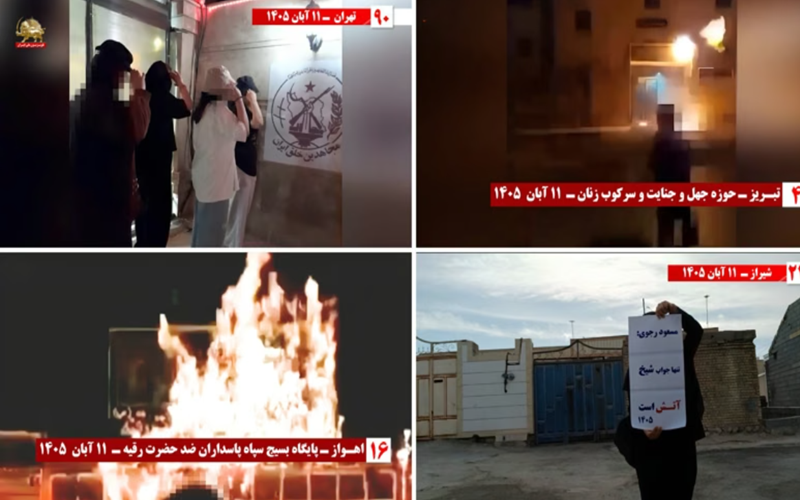

Resistance Units honor uprising martyrs with coordinated activities across dozens of Iranian cities, rejecting both monarchical and clerical dictatorship and calling for a democratic republic.
Iran’s Resistance Units have reported a new wave of activities across the country as part of their November uprising campaign, commemorating those killed in past uprisings and reaffirming their opposition to both the ruling clerical establishment and the former monarchy.
According to the campaign report, the activities included 30 fire-setting actions and 60 other revolutionary practices, carried out in cities across Iran. The reported operations targeted symbols and facilities associated with the Islamic Revolutionary Guard Corps (IRGC), the Basij paramilitary force, the Ministry of Intelligence, and the regime’s political and ideological leadership.
Actions targeting regime institutions and symbols
The reported fire-setting actions took place in numerous cities, including Tehran, Tabriz, Mashhad, Isfahan, Ahvaz, Kermanshah, Abadan, Bojnurd, Sabzevar, Dezful, Babol, Marand, Mahshahr, Chabahar, Iranshahr, and Rask.
Among the reported targets were several Basij and IRGC facilities in Tehran, Tabriz, Ahvaz, Dezful, Chabahar, and Iranshahr, as well as an IRGC battalion headquarters in Rask.
In Tabriz, the activities also targeted two religious seminaries described by the campaign organizers as centers of ideological indoctrination and repression, including the enforcement of restrictions on women.
Other reported actions targeted banners and posters bearing the images of former and current regime leaders, including Ali Khamenei, Mojtaba Khamenei, Ruhollah Khomeini, and former president Ebrahim Raisi. Images of Qassem Soleimani and other regime commanders killed during the war were also among the reported targets.
In Isfahan, activists additionally targeted a sign directing visitors to a Ministry of Intelligence facility.
Rejection of both monarchy and clerical rule
Alongside the fire-setting actions, Resistance Units carried out extensive graffiti and poster campaigns emphasizing their rejection of all forms of dictatorship and their demand for freedom and democracy.
Messages appearing in Tehran, Isfahan, Mashhad, Kermanshah, and Sari included:
- “Neither monarchy nor supreme leadership — democracy and equality.”
- “Neither crown nor turban — the mullah’s rule is finished.”
- “Down with the principle of velayat-e faqih; long live freedom.”
- “Down with the principle of velayat-e faqih.”
- “The monarchy and the clerical rule: one hundred years of crimes.”
- “Woe to the day we become armed.”
In Mashhad, the slogan “Long live the National Liberation Army of Iran” appeared at three locations, while activists in Isfahan displayed messages rejecting the principle of absolute clerical rule.
These messages underline the campaign’s central political position: Iran’s future must not be a return to monarchy or a continuation of religious dictatorship, but a democratic alternative based on popular sovereignty and equality.
Messages of resistance and tribute to the opposition leadership
The campaign also featured messages from Maryam Rajavi and Massoud Rajavi, the leaders of the Iranian Resistance.
In Shiraz, slogans carrying Maryam Rajavi’s message, “Iran, the rebellious nation, will rise up,” were displayed. Other messages attributed to Massoud Rajavi called for an end to clerical rule and the system of absolute religious authority. One declared: “The only answer to the Mullah is fire.”
In Tehran, members of the Resistance Units also paid tribute before the emblem of the People’s Mojahedin Organization of Iran (PMOI/MEK).
Posters and graffiti bearing slogans in support of the Rajavi leadership were reported in Tehran, Mashhad, Isfahan, Shiraz, Sari, Kermanshah, Bushehr, Arak, Zahedan, Nahavand, Kordkuy, Rudsar, and Nurabad.
A campaign against dictatorship and for democratic change
The November campaign comes amid continuing political and social tensions in Iran. Its messages emphasize that opposition to the current regime is inseparable from rejecting the restoration of the Pahlavi monarchy.
Through activities spanning multiple provinces, the Resistance Units are seeking to keep the memory of those killed in Iran’s uprisings alive while promoting their vision of a democratic republic.
The recurring slogan — “Neither Shah nor Mullah” — captures the campaign’s defining message: Iran’s future belongs neither to hereditary monarchy nor to clerical dictatorship, but to a system founded on freedom, equality, and the sovereignty of the Iranian people.