


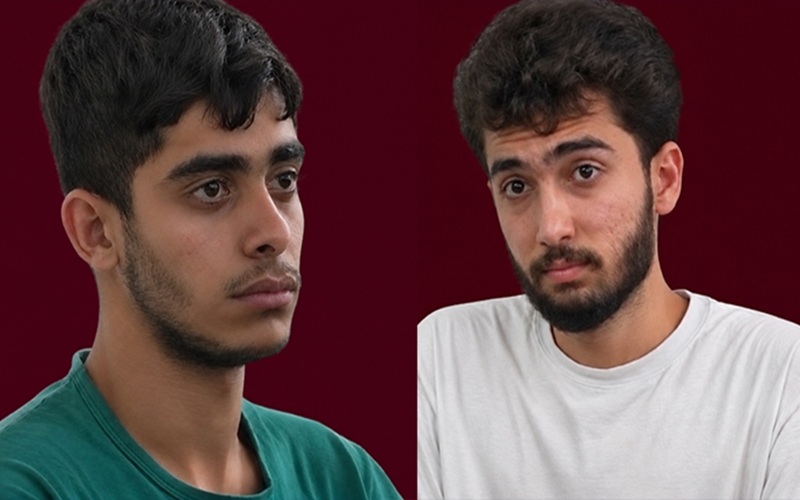

Amirhossein Maleki and Amirhossein Ebrahimi were hanged in Dastgerd Prison after being sentenced in the Ali Khani Square case. Their executions come as prisoners in 66 Iranian prisons continue a nationwide hunger strike, backed by growing international solidarity.
The Iranian regime executed two more young prisoners arrested during the January 2026 uprising, hanging Amirhossein Maleki and Amirhossein Ebrahimi at Dastgerd Prison in Isfahan on November 3. Both were around 20 years old and had been sentenced to death in connection with the case known as Ali Khani Square, alongside several other protesters.
The case concerned the deaths of four Special Units officers involved in suppressing demonstrators during the uprising. Seven other young prisoners associated with the same case had already been executed in previous months. The latest executions demonstrate the regime’s continued use of capital punishment to intimidate a society that has repeatedly challenged its rule.
The executions took place as the nationwide No to Execution Tuesdays campaign entered its 145th consecutive week. Prisoners in 66 prisons across Iran are participating in the campaign through weekly hunger strikes, sustaining an unprecedented movement of resistance against the death penalty despite persistent pressure from prison authorities.
International support for Iran’s anti-execution movement expands
Over more than two and a half years, No to Execution Tuesdays has evolved from a protest initiated by political prisoners into an internationally recognized campaign against executions in Iran. Despite repeated efforts by the regime to suppress it, the movement has continued to expand both inside and outside the country.
Its international supporters now include UN human rights experts, Nobel Peace Prize laureates, parliamentarians, human rights organizations, and political figures.
Among those expressing support are Gina Romero, Leopoldo Maldonado Gutiérrez, Andrea Bolanios Vargas, UN Special Rapporteur on human rights defenders, and Ana Lorena Delgado Pérez, UN Special Rapporteur and Vice-Chair of the Working Group on Enforced or Involuntary Disappearances. David R. Boyd, former UN Special Rapporteur, has also supported the campaign.
Oleksandra Matviichuk, head of Ukraine’s Center for Civil Liberties and recipient of the 2022 Nobel Peace Prize, has joined the international voices backing the prisoners. Alexis Anagnostakis, president of the Human Rights Committee of the European Criminal Bar Association, is among the other prominent supporters.
Earlier, nine Nobel Peace Prize laureates from nine countries signed a joint statement supporting the campaign. In October 2026, several members of the European Parliament, including Petras Auštrevičius, Helmut Brandstätter, and Milan Zver, also publicly expressed their support.
Canada has directly endorsed the campaign through an official position by its Department of Foreign Affairs’ Office of Human Rights and Freedoms, calling for an immediate halt to executions and the release of people arbitrarily detained.
Germany, France, Britain, and dozens of other countries have also condemned the Iranian regime’s executions. Meanwhile, Iranian communities and supporters of the Resistance have organized demonstrations, rallies, and conferences in different countries to amplify the voices of prisoners on hunger strike. A recent example was a conference in Cuneo, Italy.
A campaign challenging the regime’s machinery of repression
The campaign’s significance extends well beyond prison walls. Its first and most immediate impact is on the prisoners themselves. Knowing that their resistance is heard beyond the prison gates and receives international support strengthens their determination to continue.
By organizing coordinated hunger strikes across dozens of prisons, prisoners are directly challenging one of the Iranian regime’s principal instruments of repression: the death penalty as a means of spreading fear throughout society.
The campaign has also reinforced activities by Resistance Units, which regularly undertake initiatives in support of the prisoners and publicize their struggle. These activities help spread a culture of resistance among different sectors of Iranian society and connect the prisoners’ demands with broader protests.
This connection was visible in a recent demonstration by retirees in Rasht, where protesters voiced their opposition to executions and demanded the release of political prisoners and detained workers and teachers. Their slogans included:
- “We swear by the blood of our comrades: We will stand until the death penalty is abolished!”
- “Outcry, outcry against all this injustice!”
- “Political prisoners must be freed!”
- “Imprisoned workers, imprisoned teachers must be freed!”
Such expressions of solidarity demonstrate how opposition to executions is increasingly becoming part of broader social and economic protests. Demands that initially concern prisoners and their families are finding a place in demonstrations by workers, teachers, retirees, and other sections of society.
Families of prisoners sentenced to death have also become increasingly active. Their repeated gatherings and public protests challenge the regime’s attempts to isolate prisoners and silence opposition to executions.
Growing pressure on the Iranian regime
The campaign is also increasing the political and international costs of the regime’s execution policy. Tehran can no longer carry out executions without facing organized protests, public condemnation, and sustained international scrutiny.
An increasingly prominent international demand is that relations with the Iranian regime be made conditional on stopping executions in its prisons. This position was first advanced by Maryam Rajavi, the President-elect of the National Council of Resistance of Iran (NCRI), and has subsequently appeared in international statements condemning the regime.
The 145-week campaign, now active in 66 prisons, illustrates the determination of political prisoners to resist even under the most severe conditions. The executions of Maleki and Ebrahimi underscore the urgency of this struggle.
Yet the continued participation of prisoners, the mobilization of their families, the activities of Resistance Units, and growing international solidarity show that the regime has failed to silence the movement.
By confronting capital punishment at the heart of the regime’s machinery of intimidation, No to Execution Tuesdays has become an important front in the broader struggle against repression and for a free Iran.