


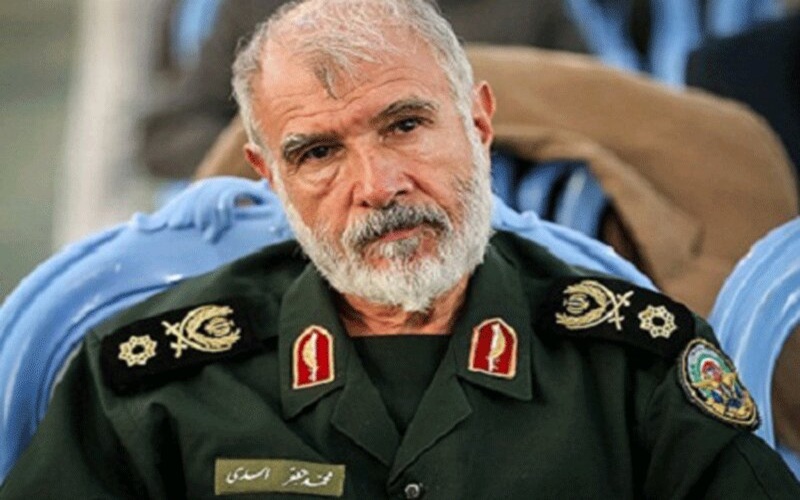

Mohammad-Jafar Asadi acknowledges that intelligence penetration reaches the IRGC, the Intelligence Ministry, state broadcasting, and other institutions, exposing the depth of the regime’s security crisis.
A senior Islamic Revolutionary Guard Corps (IRGC) commander has publicly acknowledged extensive intelligence penetration across Iran’s ruling establishment, including its most sensitive military and security institutions. His remarks offer an unusually candid picture of a security apparatus struggling to protect even its highest levels from infiltration.
Mohammad-Jafar Asadi, a senior IRGC figure and former deputy inspector of the Khatam al-Anbiya Central Headquarters, made the admission in an interview with the regime-affiliated Defa Press news agency, published on November 16, 2026.
“Enemy infiltration has taken place at high levels,” Asadi said. “There is infiltration even within the IRGC, the Intelligence Ministry, state broadcasting, and various government institutions. This infiltration is sometimes direct and sometimes indirect.”
His acknowledgment is particularly significant because it extends beyond individual security failures. It identifies penetration across several of the regime’s principal institutions responsible for intelligence, military operations, and information control.
Surveillance infrastructure has become a security vulnerability
Asadi also described how modern surveillance and data systems can expose individuals to intelligence monitoring. He identified mobile phones, cameras installed in streets, shops, and private residences, and databases associated with everyday services as potential sources of information.
According to him, camera footage is analyzed and processed using artificial intelligence. Information collected when people obtain electronic prescriptions, purchase fuel, or book airline tickets can also be used to track their movements.
He further acknowledged that control of some of these systems and their hardware rests with outside parties.
“We ourselves are providing services and information, and it can no longer be said that there is anywhere to hide,” he said.
The admission carries an additional implication. The same surveillance infrastructure that the regime has used to monitor Iranian citizens and identify opponents can potentially expose its own personnel and operations. Systems designed to expand state control are not necessarily under the regime’s exclusive control.
An extraordinary account of an IRGC member’s abduction
Asadi also recounted an incident involving the alleged abduction and interrogation of an IRGC member.
According to his account, the individual was taken away with a sack placed over his head under the pretext that he was a debtor being transferred to a private residence. Once inside, his captors allegedly established direct communication with Tel Aviv.
Asadi said the man was interrogated and subsequently taken blindfolded to a desert area near Varamin. His captors reportedly warned him that he would be shot if he moved during the following two hours.
Asadi did not identify the individual or provide a date for the incident. Nevertheless, his account illustrates the extent of the security concerns being expressed by a senior figure within the IRGC itself.
Araghchi had already acknowledged an unresolved security breach
Asadi’s remarks follow an earlier admission by Foreign Minister Abbas Araghchi concerning the regime’s security failures during the 40-day war.
In an interview published on July 19, 2026, Araghchi acknowledged that the United States and Israel had obtained information about meetings scheduled at the Pasteur compound on February 28, the first day of the 40-day war. He described this as evidence of a security breach that might still not have been eliminated.
Araghchi went further, warning that the penetration might extend beyond access to confidential information, potentially influencing decision-making and the regime’s psychological environment.
These admissions come against the background of the deaths of dozens of senior regime officials, including IRGC commanders, during the 12-day and 40-day wars.
The admissions by Asadi and Araghchi point to a security crisis extending across the regime’s military and political leadership. The killing of senior commanders, the exposure of high-level meetings, and the acknowledged presence of infiltrators inside key institutions all raise serious questions about the regime’s ability to protect its own officials and operations.
What makes Asadi’s remarks particularly striking is that he is no outsider describing the regime’s weaknesses. He is an IRGC commander openly acknowledging that infiltration has reached the IRGC itself, the Intelligence Ministry, and other state institutions. His warning that “there is nowhere to hide” is a remarkable admission from an establishment that has spent decades building an extensive apparatus of surveillance and repression.