
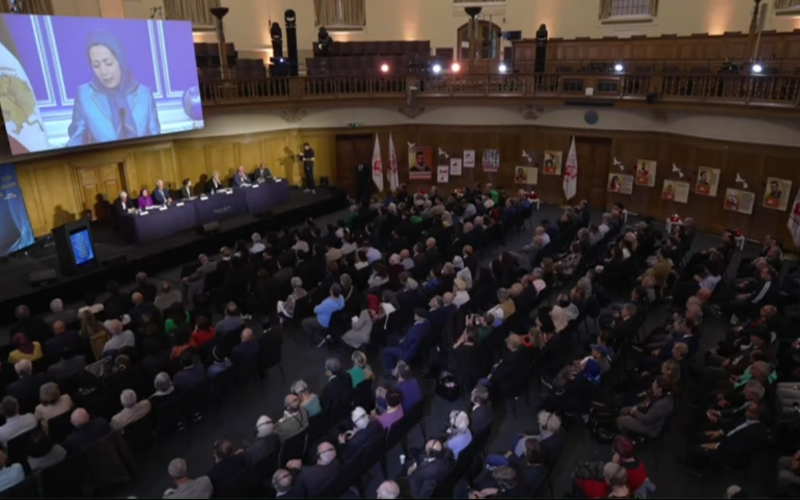

LONDON – On the occasion of the World Day Against the Death Penalty, international parliamentarians, human rights advocates, and former officials convened in London to fiercely condemn the Iranian regime’s accelerating rate of executions, which speakers characterized as a barbaric political weapon wielded to suppress dissent. The central focus of the conference was the immediate need for decisive international action to stop the executions, prosecute the perpetrators of crimes against humanity, and support the democratic alternative led by Mrs. Maryam Rajavi, President-elect of the National Council of Resistance of Iran (NCRI).
A Regime of Fear and Unprecedented Killing
Speakers highlighted the shocking scale of state-sanctioned killings. Baroness O’Loan noted that Iran has long ranked as the world’s leading executioner, but “never in the past four decades has the death penalty been used so frequently”. Since July last year, over 1,820 executions have been reported, leading to a rate where “every three and a half hours, a person is executed in Iran”. Rosa Zarei confirmed that “Today, Iran has the highest rate of executions per capita in the world”.
#StopExecutionsInIran:
Join us on the #WorldDayAgainstTheDeathPenalty https://t.co/lChfJl8tj3— Maryam Rajavi (@Maryam_Rajavi) October 10, 2025
John Bercow, former UK Parliament Speaker, detailed the global extent of the tragedy, stating that “Indeed, 64% of state executions worldwide, almost two-thirds, are now perpetrated by the Iranian government, making it, if you like, the capital punishment capital of the world”. Bercow stressed that these acts are not about justice, but about terror: “it’s about terrorizing people, it’s about intimidating people, it’s indeed about breaking people”. Azadeh Hosseini, a teacher who lost family members to the regime, asserted that this brutality is a sign of desperation: “The rising number of executions in Iran… is not a sign of strength, but a sign of the regime’s weakness and desperation”.
Gerard Craughwell, Irish Senator, reported that over the past 14 months, “more than 1,850 souls have been lost. 61 of them have been women and countless political prisoners among them”, further noting that the trials are “nothing but a mockery of true justice”.
Targeting the Organized Resistance
The speakers stressed that executions are primarily aimed at crushing the political opposition. Baroness O’Loan explained that the focus is on executing supporters and members of the NCRI and PMOI because the regime fears “an organized [resistance] offering a democratic alternative, capable of guiding dissent into a decisive moment for change”.
Ingrid Betancourt, former Colombian Senator, called the death penalty a “barbaric political weapon, wielded to instill fear and suppress dissent”. She highlighted the plight of the 17 political prisoners currently awaiting execution, noting that “Their crime is to support the MEK, the Iranian opposition movement fighting for the right of Iranian people to choose democracy”. Massoud Zabeti affirmed that the regime targets PMOI supporters because of “fear. They fear the organization, they fear its members, and they fear the vast support that it has within Iran”.
Dowlat Nowrouzi, NCRI Representative in the UK, condemned the judicial system, stating that “Everybody in Iran knows that the whole judiciary system is a major tool in the hands of the supreme religious leader, Khamenei, who is using this institution, which is absolutely not independent”. Neda Zabeti, a law student, detailed how charges like “enmity against God” are “broad, ambiguous, and deliberately designed to criminalize dissent, silence political opposition, and instill fear across society”.
The speakers also highlighted the immense courage of those resisting inside Iran, including the prisoners who participate in the “No to Execution Tuesdays” campaign by refusing food. Omid Ebrahimi, a young doctor, spoke for the new generation, saying: “I speak as part of a generation that refused and refuses to stay silent in the face of tyranny… They are the Resistance Units, the rebellious youth who dare to say no to dictatorship and yes to freedom and a Democratic Republic”.
The Shadow of 1988 and the Call to End Impunity
A consistent theme was the culture of impunity stemming from the 1988 massacre of 30,000 political prisoners, mostly PMOI/MEK members. State-run media, such as Fars News Agency, recently praised the 1988 atrocity as “a successful historical experience”, advocating for a repeat.
Javaid Rehman, the former UN Special Rapporteur on Human Rights in Iran, emphasized the seriousness of the historical crimes, noting that “atrocity crimes, in particular the 1988 massacre, represent the commission of the worst and the most egregious human rights abuses of our living memory”. Rehman stated that his findings had concluded that the executions of opponents between 1979 and 1988 amounted to “the crimes against humanity of murder and extermination, as well as genocide”. He issued a stark warning: “The international community failed to act in 1988. It must not fail again”.
In the face of this history and current brutality, speakers demanded concrete action to end impunity. Dowlat Nowrouzi called on the world community “to remove impunity and to have Khamenei and Mohseni-Eje’i, the head of the mullahs’ judiciary, face justice”. Baroness O’Loan urged the UK government to end impunity by “referring the regime’s human rights record and the perpetrators to the UN Security Council for prosecution in the International Criminal Court”.
Urgent Demands: Sanctions, Proscription, and Support for the NCRI
The conference emphasized that words and appeasement have failed. Rana Rahmanfard stated plainly: “Your words alone mean nothing if your actions fail you”. She warned that “Talks and negotiations with the regime, in other words, appeasement with the regime, only breathe more life into it”.
Dame Theresa Villiers highlighted that the regime is a fundamental threat to security, posing “a wide-ranging, persistent, and unpredictable threat to the UK”. She demanded: “Targeted sanctions should be imposed on the Supreme Leader and other officials responsible for crimes against humanity… And the UK should and must proscribe the IRGC, the theocracy’s principal instrument of repression and terror”. Gerard Craughwell also called for the proscription of the IRGC, describing it as a “terrorist force that threatens safety in Europe”. Giulio Terzi, former Minister of Foreign Affairs for Italy, concurred that the inclusion of the IRGC on the terrorist list “is no longer questionable. It is an imperative choice”.
Multiple speakers concluded by affirming their support for the NCRI and its democratic platform. Omid Ebrahimi called the NCRI “the one true alternative to the mullahs’ theocracy”. Giulio Terzi emphasized that the “third option” is “the National Council of Resistance of Iran and its Ten-Point Plan for the future of Iran”. This plan, supported by Baroness O’Loan, Dame Theresa Villiers, and Azadeh Hosseini, envisions a democratic, secular republic without the death penalty.
John Bercow summed up the resistance’s core message: “No to the Shah, no to the Mullahs”. He characterized the Iranian regime as “fascist, and we have to resolve that it will be defeated”. Neda Zabeti reiterated this defiant stance: “Let us say no to executions. Let us say no to dictatorship. No Shah, no Mullah. Long live freedom and long live democracy”.