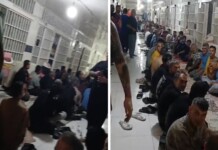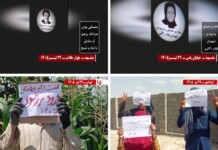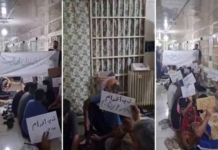
Messages from imprisoned PMOI supporters Parisa Kamali and death-row boxer Mohammad Javad Vafaei Sani reveal unwavering determination in the face of executions, persecution, and mounting repression.
Defiance Behind Prison Walls
As Iran’s authorities intensify their crackdown on political dissent and continue to expand the use of executions, messages emerging from the country’s prisons tell a different story—one not of fear or surrender, but of resilience and steadfast resistance.
Two recent messages from political prisoners and supporters of the People’s Mojahedin Organization of Iran (PMOI), Parisa Kamali and death-row prisoner Mohammad Javad Vafaei Sani, offer a rare glimpse into the determination of those facing some of the regime’s harshest forms of repression.
Although separated by prison walls and hundreds of kilometers, both prisoners convey a common theme: the conviction that the struggle for freedom cannot be extinguished through imprisonment, intimidation, or even execution.
“They Answer Cries for Freedom with Bullets and Gallows”
Parisa Kamali, currently imprisoned in Yazd Central Prison, is serving an eight-and-a-half-year sentence on charges that include insulting the regime’s slain Supreme Leader Ali Khamenei, propaganda against the regime, and membership in the PMOI.
In a powerful message from prison, she described the atmosphere of repression that has come to characterize contemporary Iran.
“This is a place where cardboard rulers govern. This is a place where one is stunned by the endless crimes. They answer cries with bullets and the gallows.”
Kamali condemned the regime’s extensive use of capital punishment, arguing that executions have become an instrument of fear designed to preserve political power rather than administer justice.
“No to executions, because they are a tool for creating fear and repression. No to executions, because they are essential to the survival of the mullahs’ regime and destructive to humanity.”
Her message linked the growing number of executions directly to the authorities’ fear of social unrest and political opposition.
At the same time, she rejected the notion that executions can silence dissent, invoking the memory of numerous political prisoners and resistance activists who have faced death sentences or execution.
“You think executions will end us. You are mistaken. We are the wheat seeds. One by one, we become a thousand harvests.”
Kamali also called for the cancellation of death sentences against political prisoners and activists currently facing execution, warning that the machinery of repression ultimately threatens all sectors of society.
A Champion’s Message from Death Row
A similarly powerful message came from Mohammad Javad Vafaei Sani, the 31-year-old boxing champion and political prisoner who remains under a death sentence after years of imprisonment in Vakilabad Prison in Mashhad.
Describing his statement as possibly his most important message, Vafaei Sani reflected on faith, sacrifice, and commitment to freedom during what he called one of the most critical moments of his life.
Rather than expressing despair, the imprisoned athlete emphasized spiritual conviction and loyalty to what he views as the cause of justice and liberation.
“I ask only that God increase my determination and courage in this time and accept my loyalty to the oppressed, to truth, and to the freedom of my people.”
Throughout his message, Vafaei Sani repeatedly stressed that repression cannot overcome deeply held beliefs.
“We will not surrender, and we have proven that we possess the most powerful weapon possible: faith and righteousness.”
He portrayed resistance not as a temporary reaction to oppression but as a moral obligation toward future generations and the Iranian people.
“We have no choice but to rise in defense of our people, our future, and our freedom.”
A Shared Message of Resistance
Despite differences in tone and circumstance, the messages of Kamali and Vafaei Sani converge around a common political reality: the regime may control the prisons, but it has failed to break the resolve of many of its political prisoners.
Both prisoners depict executions and imprisonment not as signs of strength but as evidence of a government fearful of dissent and determined to suppress opposition through intimidation.
Yet both also insist that repression cannot extinguish the desire for freedom.
Kamali’s declaration that “we become a thousand harvests” and Vafaei Sani’s pledge that “we will not surrender” reflect a broader spirit that has long characterized political resistance inside Iran’s prisons.
The Enduring Symbolism of Political Prisoners
Throughout Iran’s modern history, political prisoners have often served as symbols of resistance during periods of intensified repression. From inside prison cells, their statements frequently transcend individual circumstances and speak to broader political aspirations.
The messages from Parisa Kamali and Mohammad Javad Vafaei Sani continue that tradition.
One speaks with the urgency of a prisoner witnessing an expanding wave of executions. The other speaks from death row itself. Yet both articulate the same belief: that freedom, justice, and human dignity remain worth defending regardless of the personal cost.
Their words stand as a reminder that even under the harshest conditions, many political prisoners continue to view themselves not as victims of repression, but as participants in a larger struggle for Iran’s future.