


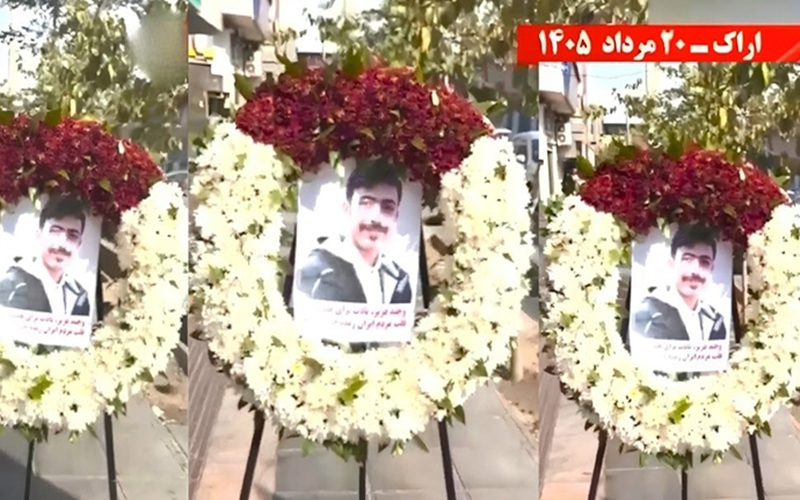

From Tehran and Mashhad to Sanandaj and Tabriz, Resistance Units and freedom-seeking youths are taking to the streets with posters, wall writings, and protest messages demanding an end to executions.
Young people associated with the Resistance Units and freedom-seeking Iranians in cities across Iran have stepped up activities in support of the “No to Execution Tuesdays” campaign, calling for the abolition of death sentences and solidarity with political prisoners facing execution.
From Tehran and Mashhad to Sanandaj, Tabriz, Isfahan, Karaj, and other cities, activists have used posters, photocalls, wall writings, and public messages to denounce executions and express support for prisoners sentenced to death.
The latest activities underscore a growing message: executions are not merely individual acts of repression but part of a broader machinery of intimidation aimed at silencing dissent and deterring resistance.
Calls to stand with prisoners facing execution
In Mashhad, activists issued messages of solidarity with political prisoners facing execution, including Arvin Khairkhahan. One message described prisoners facing death sentences as the “conscience of an awakened society” and called on the public, activists, and media to raise their voices against executions.
The message condemned the reported executions of Abolfazl Sepahi Badjani, Amirhossein Safari Hosseinabadi, Mehdi Khanki, and Arvin Khairkhahan, while emphasizing that their memory and struggle would remain alive in the pursuit of freedom.
Another message from Mashhad declared opposition to the executions and urged people to become the voice of prisoners facing death sentences and support the No to Execution Tuesdays campaign.
In Saqqez, activists similarly called on the public and media to prevent executions from taking place in silence, emphasizing that political prisoners are not alone and that society must stand behind them.
Anti-execution messages spread across cities
In Tehran, Resistance Units installed posters carrying messages including:
- “No to execution, no to a government of death.”
- “One voice, one cry: No to execution.”
- “Every execution increases the people’s anger.”
In Tabriz, activists used the slogan: “I swear by the blood of our comrades, we are ready to the end — No to execution.”
In Karaj, posters and messages declared:
- “No to execution.”
- “We neither forgive nor forget.”
- “We will continue; bowing our heads is forbidden.”
The messages combine opposition to executions with a broader declaration of resistance against repression.
Isfahan: “We will stand until the end”
In Isfahan, activists described support for the No to Execution Tuesdays campaign as a national and patriotic responsibility.
Other messages included: “From the red blood of our comrades, a thousand storms will rise. No to execution,” and “I swear by the blood of our comrades, we will stand until the end.”
In Islamshahr, wall writings carried the stark messages: “Execution of youths—the rulers’ disgrace” and “No to execution.”
In Yazd, posters called for the immediate cancellation of death sentences and urged the public to become the voice of prisoners facing execution and support the No to Execution Tuesdays campaign.
The campaign reaches northern and western Iran
In Gorgan, activists called on people to raise their voices for prisoners facing execution and support the weekly campaign.
In Babol, messages demanded the immediate cancellation of death sentences and condemned the reported executions of Arvin Khairkhahan, Abolfazl Sepahi, Amirhossein Safari, and Mehdi Khanki.
In Sari, activists invoked the memory of past martyrs with the slogan: “In memory of the Sarbedaran—fire upon these criminals.”
In Sanandaj, several posters and slogans directly challenged the regime’s use of capital punishment as a tool of intimidation.
Among the messages were:
- “We demand the abolition of the inhumane death penalty in Iran.”
- “Executions will not intimidate us; they will only strengthen our determination for regime change.”
- “From Kurdistan to Tehran, everyone against execution. No to execution.”
The same message was repeated publicly in Sanandaj: “From Kurdistan to Tehran, everyone against execution. No to execution.”
Executions as a tool of repression
The nationwide activities come as the Iranian regime continues to rely heavily on executions and death sentences amid mounting social and political discontent.
For the Resistance Units, opposing executions has therefore become inseparable from defending political prisoners and challenging the regime’s broader system of repression.
The No to Execution Tuesdays campaign has emerged as a sustained protest movement inside and outside Iran’s prisons. Prisoners participating in the campaign have repeatedly used hunger strikes and collective action to protest executions and demand an end to the death penalty.
The latest activities demonstrate that the campaign is also resonating beyond prison walls.
The messages appearing in different cities share a common theme: executions cannot erase dissent, intimidate an increasingly discontented population, or silence the demand for freedom.
Instead, the activists argue, every execution deepens public anger and strengthens the determination to resist.
A growing challenge to the politics of fear
The geographic spread of these activities is significant. From the capital to Kurdistan, from major metropolitan centers to northern cities, the same anti-execution message is being expressed in different forms.
Posters, wall writings, slogans, and public messages may appear simple, but under a regime that criminalizes dissent and imposes severe punishment on political opponents, such acts carry a clear political message.
They reject the normalization of executions.
They reject the idea that fear can permanently suppress society.
And they call on ordinary Iranians to stand with prisoners facing death sentences rather than allow executions to take place in silence.
The latest activities of the Resistance Units therefore represent not only support for a weekly campaign, but a broader challenge to the regime’s use of capital punishment as an instrument of repression.
As activists across Iran continue to repeat the same demand—“No to execution”—the campaign seeks to turn opposition to the death penalty into a nationwide expression of solidarity, resistance, and defiance.