


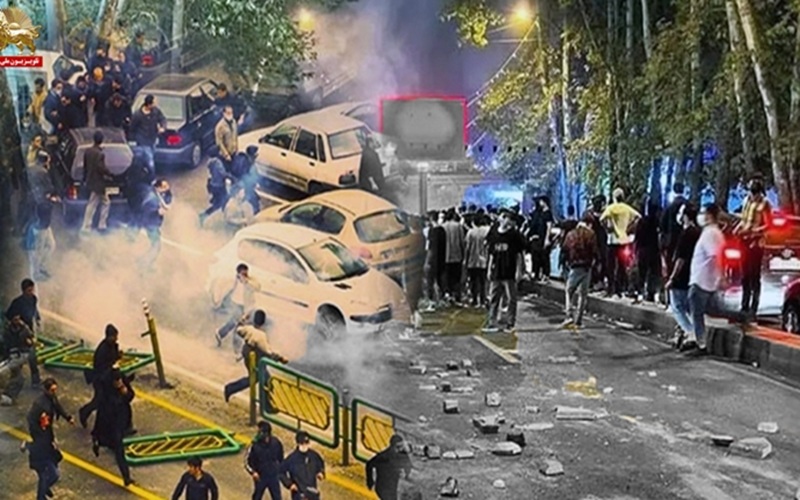

Five years of recurring unrest have exposed the widening gap between Iran’s ruling establishment and a society confronting economic hardship, political repression, and demands for fundamental change.
The anniversary of Iran’s 2022 nationwide uprising arrives not as an isolated moment of remembrance, but as another marker in a political trajectory that has increasingly challenged the ruling establishment’s ability to restore legitimacy.
The death of Jina Mahsa Amini in September 2022 triggered nationwide protests that demanded accountability, equality, and fundamental rights. The UN Fact-Finding Mission has documented serious human-rights violations surrounding the protests and has emphasized that meaningful accountability remains elusive.
Since then, the central question has become larger than the events of September 2022: can repression restore political stability when the underlying sources of public discontent remain unresolved?
The record of the years since 2022 suggests that repression may suppress demonstrations temporarily, but it does not necessarily resolve the political and socioeconomic pressures that generate them.
From One Uprising to a Continuing Cycle
Iran’s recent history is better understood as a sequence of interconnected waves of protest than as isolated episodes.
The nationwide protests of 2017–18, the November 2019 protests, the 2022 uprising, and the nationwide unrest that began in December 2025 emerged from different immediate triggers, but they shared a broader environment of economic frustration, political restrictions, and widespread dissatisfaction with the governing system.
The latest wave began at Tehran’s Grand Bazaar on December 28, 2025, amid severe economic pressures including inflation, currency depreciation, and declining living standards. The UN Special Rapporteur subsequently raised serious allegations concerning violations committed during the protests, while the Human Rights Council convened a special session on the repression of the demonstrations.
That continuity matters.
A government can disperse a demonstration. It is much harder to eliminate the social grievances that produced it.
The significance of the 2022 uprising therefore lies not only in its scale or symbolism, but in the political memory it created. The names and stories associated with the protests—from young victims such as Sarina Esmailzadeh and Mehrshad Shahidi to the killings reported in Zahedan—remain part of that memory. They have become reminders to many Iranians that the conflict over political rights and state accountability has not been settled.
The UN Fact-Finding Mission has itself stressed the continuing importance of documenting and preserving evidence concerning violations committed during the 2022 protests.
Repression Is Not the Same as Legitimacy
The regime’s continued control of state institutions can easily be mistaken for political stability.
But political stability is not simply the physical survival of a government. It also involves legitimacy, institutional capacity, public consent, and the ability to manage conflicts without relying predominantly on coercion.
Iran’s authorities continue to rely heavily on arrests, prosecutions, restrictions on assembly and expression, and the death penalty. In 2026, UN mechanisms have continued to receive allegations concerning arbitrary detention, enforced disappearance, torture, violations of fair-trial guarantees, and executions connected to or occurring in the context of protests.
This does not mean that every act of repression automatically brings a government closer to collapse. States can survive prolonged periods of repression. But it does demonstrate a fundamental contradiction: coercion can preserve control while simultaneously deepening the grievances that undermine political legitimacy.
The continued use of capital punishment illustrates that contradiction particularly starkly. In August 2026, UN experts raised concerns about Iranian legislation containing provisions that could impose the death penalty under broadly defined national-security offenses.
The message is unmistakable: the authorities continue to treat dissent primarily as a security problem.
But a society experiencing persistent economic and political grievances cannot be permanently transformed into a security problem.
The Economic Crisis Makes the Political Crisis Harder to Contain
Political discontent does not develop in a vacuum.
Iran’s economic problems have become an important component of the broader crisis. Inflation, currency depreciation, sanctions, disrupted trade, declining purchasing power, and the effects of prolonged geopolitical confrontation have placed additional pressure on households and businesses.
Recent reporting has described severe economic deterioration, including a sharp fall in oil exports and rapidly rising prices.
At the same time, economic hardship alone does not explain Iran’s political unrest.
The deeper problem is the interaction between economic insecurity and political exclusion. When citizens experience declining living standards while lacking effective channels for accountability, representation, and peaceful political participation, economic grievances can acquire a broader political meaning.
This helps explain why demonstrations that begin over prices, wages, currency depreciation, or living conditions can develop into challenges to the governing system itself.
The Memory of 2022 Has Become Political Capital for Society
The fourth anniversary of the 2022 uprising demonstrated that the regime was not confronting only an old protest movement. It was confronting a continuing struggle over memory, accountability, and the meaning of political change.
The authorities have repeatedly attempted to contain the public commemoration of protesters and victims. Yet the persistence of remembrance itself has political significance.
The state can control streets, arrest activists, restrict communications, and prosecute demonstrators. It cannot easily dictate what an entire generation remembers.
That is why figures such as Sarina Esmailzadeh, Mehrshad Shahidi, Khodanour Lajai, and the victims of Zahedan remain politically significant beyond the circumstances of their deaths. Their stories connect individual cases to a larger question: whether the grievances that produced successive waves of protest can be addressed without fundamental political change.
The answer cannot be supplied through repression alone.
The Missing Question: What Happens Between Uprisings?
This is where the debate over organization becomes important.
Spontaneous mass protests can expose the depth of public dissatisfaction, but sustaining political pressure over long periods presents a different organizational challenge. Protest movements require communication networks, social resilience, political coordination, and mechanisms capable of surviving repression.
The Iranian opposition, particularly the People’s Mojahedin Organization of Iran (PMOI/MEK) and the broader National Council of Resistance of Iran (NCRI), argues that organized resistance networks—referred to as “Resistance Units”—can help maintain political pressure during periods when large demonstrations are not taking place.
Their supporters describe these networks as part of a broader strategy aimed at breaking what they call the “wall of repression” and keeping opposition activity alive between major protest waves.
That is a political strategy, and its effectiveness should be assessed on the basis of evidence rather than slogans.
What is nevertheless clear is the underlying organizational problem: a protest movement cannot rely indefinitely on spontaneous eruptions alone.
The experience of Iran suggests that each new uprising inherits lessons, memories, networks, and grievances from the previous one. Whether those accumulated pressures eventually translate into sustained political transformation depends not only on the depth of public dissatisfaction, but also on organization, leadership, social participation, and the ability to articulate a credible political alternative.
Beyond Waiting for Either Collapse or War
Two simplistic assumptions should therefore be avoided.
The first is that the regime’s survival automatically proves its stability.
The second is that external military pressure by itself can deliver political transformation inside Iran.
Neither conclusion follows from the evidence.
The six months of war and continuing confrontation in 2026 have demonstrated how profoundly external conflict can affect Iran’s economy and political environment, while also creating additional risks for Iranian society.
Political change ultimately depends on developments inside Iranian society: the relationship between citizens and state institutions, the resilience of civil resistance, the capacity of opposition forces, and the emergence of a political framework capable of replacing authoritarian rule.
For those who seek a democratic future for Iran, this makes organization and political preparation as important as protest itself.
The anniversary of the 2022 uprising should therefore not be reduced to a ceremony of remembrance. It is an opportunity to examine what has changed—and what has not.
Five years after the death of Jina Mahsa Amini, the central unresolved issue remains the relationship between an increasingly coercive state and a society that has repeatedly demonstrated its willingness to challenge it.
The regime can attempt to suppress each new wave.
It can impose arrests, prosecutions, censorship, and executions.
But none of these measures addresses the underlying question of political legitimacy.
Iran’s future will ultimately be determined not by the regime’s ability to postpone that question, but by whether Iranian society can translate accumulated grievances, political memory, and resistance into a sustained demand for a fundamentally different political order.