


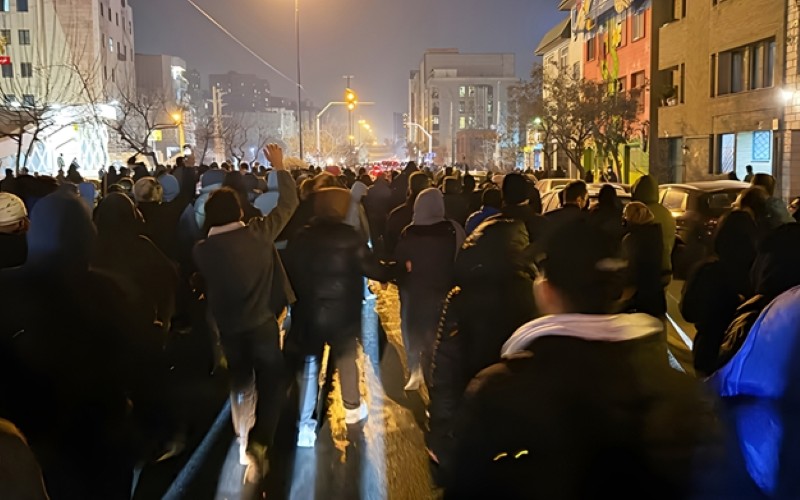

From reductionism to rupture, the regime’s own media reveal a system that can no longer understand—or govern—society
In recent weeks, a striking pattern has emerged across Iran’s state-aligned and semi-official media. Words such as deadlock, warning, fear, anxiety, crossroads, and even self-destruction out of fear of death increasingly dominate headlines and commentary. This language is not the vocabulary of stability or control; it is the lexicon of a system trapped in its own contradictions.
Despite differing political affiliations and tones, these outlets share a revealing commonality: they unintentionally expose the regime’s growing inability to understand the society it rules. What appears on the surface as fragmented criticism is, in reality, a collective confession of systemic failure.
At the heart of this failure lies a profound rupture between lived social reality and the regime’s cognitive and political framework—a rupture that no amount of narrative manipulation can now conceal.
The Failure of Reductionism
One recurring theme in regime media is the insistence on reductionist explanations for nationwide unrest. Protest movements are repeatedly reframed as temporary emotional outbursts, foreign-instigated disturbances, or disputes over lifestyle choices. This approach is not new—but it is now visibly collapsing.
As some commentators reluctantly acknowledge, Iranian society no longer accepts these narratives. When officials and their media allies attempt to reduce mass protests to issues of “entertainment,” “dress,” or “external agitation,” they reveal not control but detachment. The language of power no longer matches the experience of the governed.
This disconnect has become a driver of social anger in its own right. People do not merely suffer; they are told that their suffering is either imaginary or irrelevant. Such denial transforms economic and social grievances into political defiance.
When Survival Becomes Political
Perhaps the most telling admission emerging from regime media is the recognition that the demand for a “normal life” has itself become radical.
In a society where the national currency has lost half its value in a single year, where the middle class is collapsing, and where officials openly declare that “there is no money,” survival is no longer a private concern. Bread, dignity, and psychological security have become political demands precisely because the system has failed to provide them.
This is not a society mobilized by ideology or excess; it is a society driven by necessity. People are not in the streets for luxury or symbolism. They are there because the most basic conditions of life—work, stability, future—have been systematically eroded.
When normalcy becomes unattainable, rebellion ceases to be a choice and becomes an inevitability.
Elite Blindness and Self-Inflicted Escalation
Rare moments of candor from within the ruling structure further underscore the depth of the crisis. Statements by former insiders acknowledging legislative incompetence, reckless policymaking, and tone-deaf governance expose what many Iranians already know: the regime is not only authoritarian, but structurally incapable of correction.
Proposals to tighten media control or expand censorship during periods of national grief and unrest are not acts of strength. They are acts of panic—equivalent, as one former official put it, to pouring fuel on dying embers and reigniting the fire.
This pattern reveals a ruling elite that responds to crisis not with understanding, but with provocation; not with accountability, but with escalation.
A Regime That Cannot Understand Cannot Rule
Taken together, these regime-media narratives point to a single, unavoidable conclusion: Iran’s ruling system is facing a crisis of legitimacy rooted in a collapse of meaning. Its language no longer persuades, its explanations no longer convince, and its policies no longer stabilize.
A government that cannot accurately name the problem it faces cannot solve it. A system that mocks or minimizes social pain only accelerates its own isolation. What regime media now inadvertently document is not a temporary disturbance, but a structural rupture between state and society.
In such conditions, repression may delay change—but it cannot restore legitimacy. And when a regime loses both understanding and consent, its future is no longer a question of if, but when.