
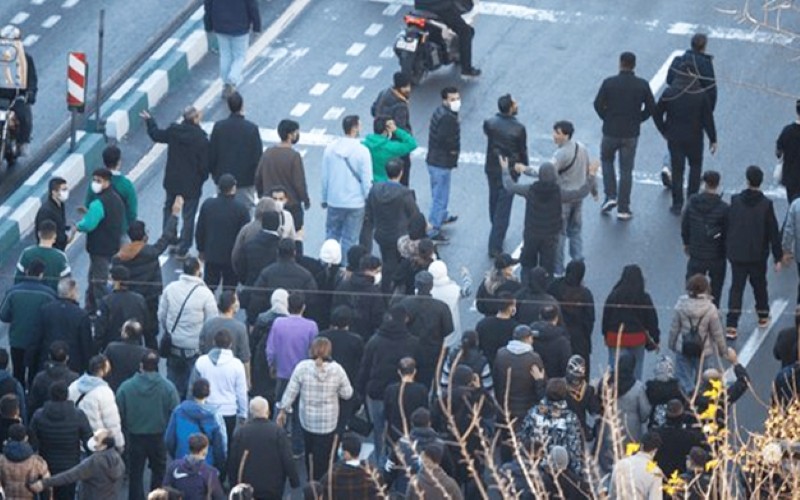

As economic implosion merges with political paralysis, Iran’s ruling system is confronting the inevitable consequences of decades of coercion, repression, and systemic failure.
In late 1989, Mikhail Gorbachev uttered a sentence that would soon prove prophetic for the Soviet Union: the economy had collapsed, and there was nothing left to be done. Within a short time, economic disintegration—combined with political exhaustion—triggered a mass social eruption that brought the system to its final reckoning. Today, in Iran, the same trajectory is unfolding with striking clarity.
What Iran is experiencing is no longer a cyclical economic crisis or a temporary downturn. It is the cumulative outcome of a political system that has exhausted its economic, social, and ideological resources. Economic collapse has now fused with the political fate of the ruling establishment, making confrontation unavoidable.
A System Reaping What It Sowed
Over recent months—and increasingly in recent weeks—the ruling structure of Velayat-e Faqih has begun harvesting the consequences of decades of economic mismanagement and political repression. The destruction of the economy has reached a point where no meaningful repair is possible within the existing framework. As a result, the crisis has become fully politicized, inseparably tied to the survival of the system itself.
This is no accident. From its inception, the ruling order was designed not to heal Iran’s historical wounds or overcome underdevelopment, but to consolidate and preserve power. Accountability, pluralism, and social repair were never part of its DNA. Inevitably, this produced permanent tension with society—particularly with dissidents, independent thinkers, and progressive political forces.
Despite repeated tactical shifts and deceptive political maneuvers, the system proved incapable of reforming itself from within. Today, reform and non-reform alike have lost all credibility as paths to survival.
Coercion as Governance—and Its Inevitable Outcome
From the outset, governance was built on coercion, compulsion, and control rather than freedom, openness, and innovation. The long-term result of this approach is now fully visible: an economy crushed under the weight of repression and corruption, collapsing directly onto the political system that created it.
Iran now faces a deep, generalized stagnation—economic and political—that has seized daily life itself. For millions, survival has become incompatible with silence. When life is suffocated, the street becomes the only remaining arena for decision and determination.
What is unfolding is not merely protest; it is society’s struggle to escape asphyxiation and to confront what many now perceive as an existential threat imposed by the ruling order.
The Collapse of Reformist Illusions
In the streets of Iran’s cities, chants increasingly reflect the collapse of what many describe as a political “circus,” including the final unraveling of reformist narratives. Iranian society has learned through lived experience—politically, socially, economically, and culturally—that a future cannot be built with corroded structures and obsolete ideas.
For years, each day of governance effectively planted another explosive beneath the surface of society. Those accumulated charges—economic, political, and social—now cover the entire geography of Iran. The recent uprising of merchants and traders is only one visible example of how systemic plunder and repression have ignited long-delayed detonations.
A Society Saturated with Anger
In such a society, every incident—small or large—becomes a potential trigger. Beneath the surface lies an accumulation of rage and resentment toward those held responsible for the destruction of livelihoods, dignity, and freedom. The resulting eruptions are not anomalies; they are the natural and unavoidable outcome of this trajectory.
The Street as the Price of Survival
A dollar exchange rate soaring to unprecedented levels, with daily volatility, is not merely an economic statistic—it is a direct assault on the right to breathe and live. For many Iranians, existence itself has become a daily confrontation with economic death.
In such conditions, survival demands resistance. The expansion of protests from city to city reflects a stark reality: for millions, protest is no longer a choice but the cost of staying alive. This is the clearest and most comprehensive expression of the relationship between Iranian society and the ruling system today.