


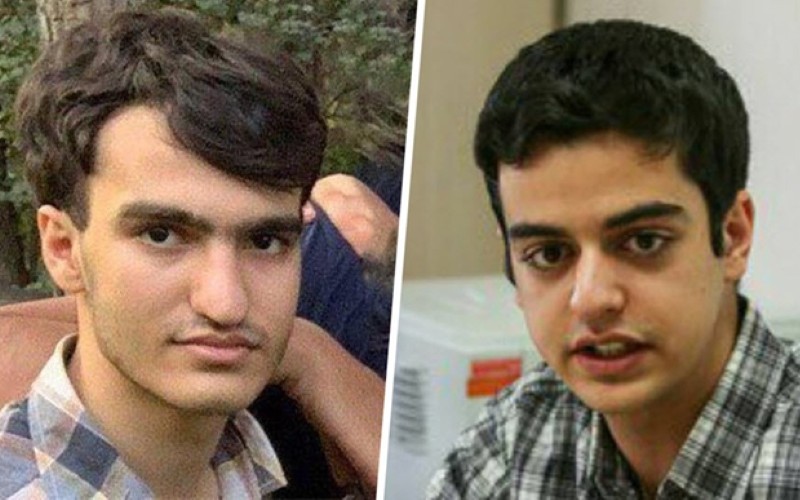

Messages from Evin and Ghezel Hesar prisons highlight the continuity of student resistance from 1953 to today—condemning mass executions, state repression, and urging young Iranians to lead the struggle for freedom.
As Iran marks 16 Azar (Student Day), imprisoned student activists aligned with the People’s Mojahedin Organization of Iran (PMOI/MEK) have sent powerful messages from behind bars. Their letters—written from Evin Prison and Ghezel Hesar Prison—reflect deep anguish over the regime’s escalating executions, but also unbroken determination to continue the country’s decades-long fight for freedom.
Two imprisoned students, Amir Hossein Moradi and Ali Younesi, both former award-winning university students, delivered statements that connect the historical memory of 1953 with today’s national uprising and the ongoing crackdown on campuses.
“A regime of executions in its weakest historical moment” — Message from Evin Prison
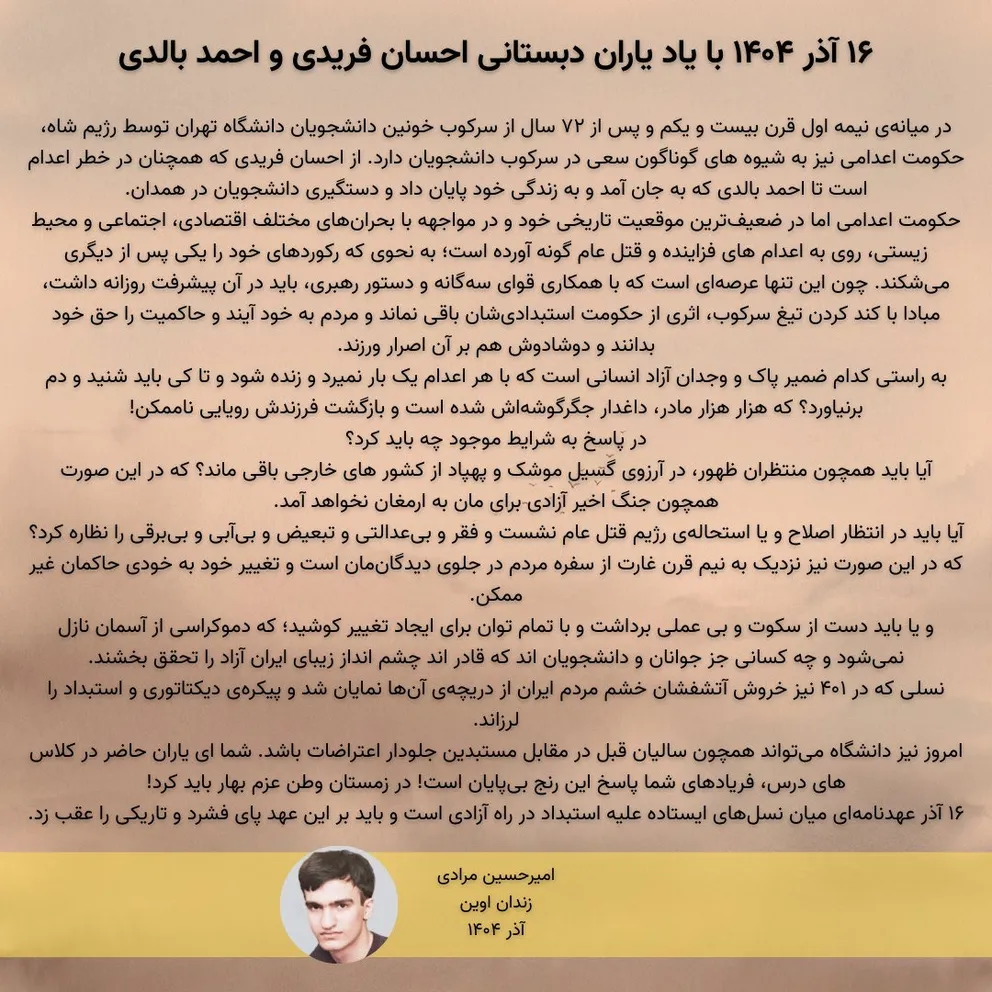
Amir Hossein Moradi, detained in Evin, opened his message with a tribute to two emblematic student victims: Ehsan Faridi—still at risk of execution—and Ahmad Baledi, who recently took his own life under intense pressure. He wrote:
“In the middle of the first half of the 21st century, and 72 years after the bloody repression of Tehran University students under the Shah, the executioner-government also tries in various ways to suppress students. From Ehsan Faridi, who is still in danger of execution, to Ahmad Baledi who was driven to end his life, and to the arrests of students in Hamedan.”
Moradi described the Iranian regime as relying increasingly on executions to maintain political control amid overlapping crises:
“The executioner-government is in its weakest historical moment and, facing economic, social, and environmental crises, has turned to escalating executions—breaking its own records one after another. This is the only area where, with the cooperation of all three branches and by order of the leadership, they must show daily progress, lest by dulling the blade of repression nothing remains of their dictatorship.”
He condemned the mass grief imposed on society:
“Which pure conscience can die and live again with every execution and remain silent? How long must we hear this and say nothing—while thousands of mothers mourn their children, and the return of their sons and daughters is an impossible dream?”
Moradi rejected passivity, foreign intervention, or hopes of internal reform:
“Should we, like those waiting for salvation, hope for missiles and drones from foreign countries? That will not bring us freedom—as we saw in the recent war. Should we wait for reform or transformation of a regime of massacres? Nearly half a century of plunder is before our eyes, and self-change of rulers is impossible.”
He urged decisive action:
“We must abandon silence and inaction and strive with all our strength for change; democracy does not descend from the sky. Who but the youth and students can realize the beautiful vision of a free Iran?”
Moradi recounted students’ leading role in the 2022 uprising and stressed that universities must remain at the forefront:
“In 1401, the eruption of the people’s anger appeared through the students and shook the foundation of dictatorship. Today too, the university can once again stand in front of the tyrants.”
His message ends with a call to generational unity:
“You, my friends in the classrooms, your voices are the answer to this endless suffering. In the winter of the homeland, we must resolve to bring spring. 16 Azar is a covenant between generations standing against dictatorship on the path to freedom—and we must honor this covenant and push back the darkness.”
“Dictatorships build prisons as large as the country” — Message from Ghezel Hesar Prison
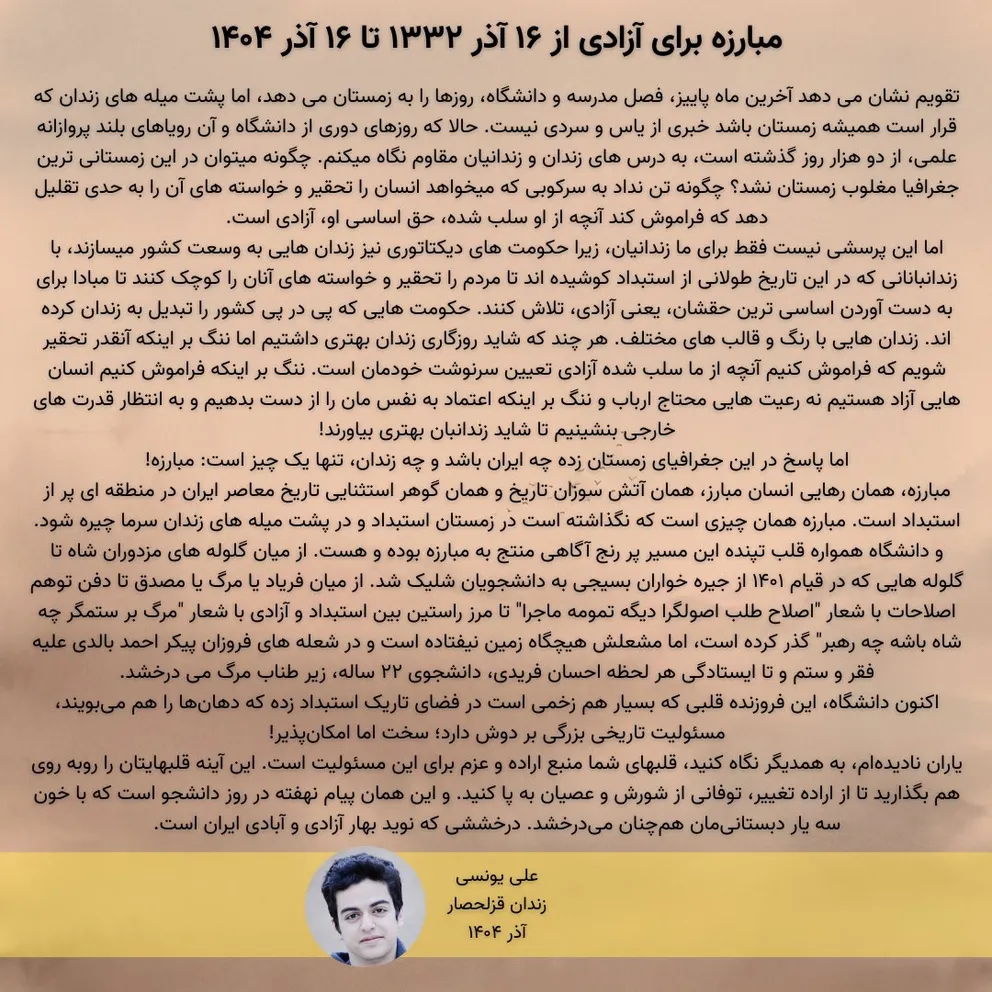
From Ghezel Hesar Prison, student prisoner Ali Younesi reflected on more than two thousand days of imprisonment and the meaning of Student Day from behind bars:
“The calendar shows the last month of autumn, the season of school and university. But behind prison bars—where winter is supposed to be eternal—there is no sign of despair or cold.”
He described the psychological struggle imposed by the regime:
“How can one avoid succumbing to a wintery geography that seeks to humiliate the individual and reduce their demands until they forget that what has been taken from them is their fundamental right: freedom?”
Younesi extended the metaphor from individual prisons to society under dictatorship:
“This is not a question only for us prisoners, because dictatorial governments build prisons as large as the country. Jailers throughout this long history of despotism have tried to humiliate people and diminish their demands so they will not strive for their most fundamental right: freedom.”
He warned against forgetting the essence of the struggle:
“Shame on us if we become so humiliated that we forget what has been stolen from us: the freedom to determine our destiny. Shame if we forget we are free human beings, not subjects dependent on a master. Shame if we lose our confidence and wait for foreign powers to bring us a better jailer.”
Younesi identified the true response:
“But the answer—whether in this winter-stricken geography of Iran or in prison—is only one thing: struggle. Struggle is the liberation of the fighting human being; the burning fire of history; the exceptional jewel of modern Iran in a region full of despotism.”
He emphasized the critical role of universities:
“The university has always been the beating heart of this painful path of awareness leading to struggle—from the bullets of the Shah’s mercenaries to the shots fired at students by Basij agents during the 2022 uprising.”
Younesi highlighted how student resistance has evolved through generations:
“From the cry of ‘Death or Mosaddegh’ to the burial of the illusion of reform with the slogan ‘Reformist, Principlist—this game is over,’ and to the true border between despotism and freedom with the slogan ‘Death to the oppressor, whether the Shah or the Leader.’ The torch has never fallen.”
He linked this legacy to recent tragedies:
“Its flame shines in the burning body of Ahmad Baledi against poverty and oppression, and in every moment of the resistance of Ehsan Faridi, a 22-year-old student under the noose of death.”
Younesi closed with a message directly to students across Iran:
“My unseen friends, look at each other. Your hearts are the source of will and determination for this responsibility. Place the mirrors of your hearts before one another so that from the will for change, a storm of revolt and defiance will rise. This is the hidden message of Student Day—still shining with the blood of our three schoolmates. A radiance that heralds the spring of freedom and the flourishing of Iran.”
A Legacy of Defiance
The messages from Moradi and Younesi reaffirm the historic position of Iranian students as a moral and political vanguard—from 16 Azar 1953 (December 7, 1953), when three Tehran University students were killed protesting the Shah’s ties with the U.S. government, to the present day where students face mass arrests, surveillance, torture, and execution threats.
Their words—written inside two of the regime’s harshest prisons—reflect both the immense suffering imposed by Iran’s rulers and the enduring resolve of a new generation that refuses to accept dictatorship as destiny.
On this Student Day, their voices resonate far beyond prison walls, reminding the nation that the path to freedom remains alive in the hearts of Iran’s young women and men.