



How deep economic collapse and political repression pushed Iranian society past the point of return
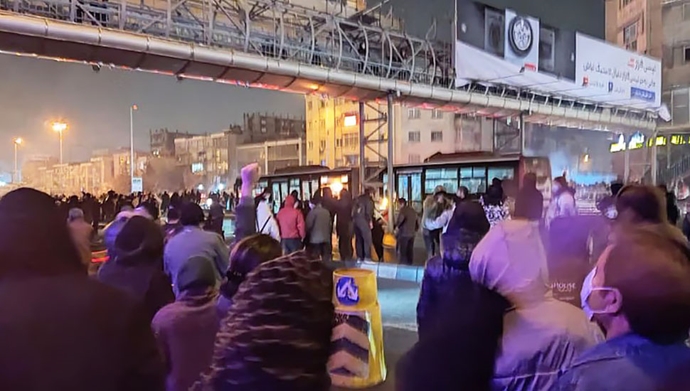
What unfolded on the streets of Iran in January 2026 was neither a spontaneous incident nor an emotional outburst destined to fade quickly. It was the predictable outcome of two long-standing and deeply rooted crises—economic collapse and political repression—that have steadily eroded Iranian society for years. Together, these crises widened the gap between a ruling minority and the vast majority of the population to such an extent that a social explosion became unavoidable.
Over the past decade, Iranians have been confronted with a harsh and undeniable reality: widespread poverty, the gradual elimination of lower-income and middle-class groups from any form of normal economic life, and the concentration of wealth and privilege in the hands of a small network closely tied to the ruling system. Millions have been pushed below subsistence levels, while national resources are diverted to preserve a closed, corrupt power structure centered on the doctrine of Velayat-e Faqih—the rule of the Supreme Leader.
In this context, daily life under the existing order has become not only difficult but degrading. For a growing segment of society, survival within the current system is experienced as an assault on basic human dignity. The promise of stability or gradual improvement has lost all credibility.
The nationwide protests of January 2026 made this reality unmistakably clear. Street slogans no longer focused on limited economic demands or calls for reform. Instead, they directly targeted the entire ruling structure and its apex, the Supreme Leader himself. Protesters openly identified him as the primary figure responsible for poverty, repression, lack of future prospects, and systemic violence. This shift marked a decisive moment: society had moved beyond the illusion that the system could be reformed from within.
Seen in this light, the January 2026 uprising cannot be reduced to a reaction against rising prices or police brutality. It represented a fundamental confrontation with a political system whose survival depends on denying freedom, choice, diversity of thought, democracy, and a viable future. Those who took to the streets were not merely rejecting current conditions; they were challenging a governing logic that treats human life and agency as expendable tools of control.
This is why mass arrests, widespread repression, and attempts to silence voices calling for regime change failed to push the movement to the margins. Unlike previous periods, the state’s machinery of fear no longer guarantees social silence. Each wave of repression now produces greater public awareness, deeper anger, and a wider divide between society and the ruling elite. Fear—the central pillar of the system’s longevity—has begun to crack and lose its effectiveness.
The Road Ahead
The January 2026 uprising was not an end point. It was a clear signal that Iran has entered a new phase in its confrontation with religious authoritarianism. The underlying economic and political conditions remain volatile, and there is no credible path to recovery within the existing power structure. Under these circumstances, the prospect of another nationwide uprising in the near future is not speculative—it is realistic.
As collective fear continues to erode, future protests may significantly alter the balance of power in favor of the people. The trajectory increasingly points toward a transition away from Velayat-e Faqih and toward a democratic republic grounded in popular sovereignty, fundamental freedoms, and social justice—an outcome that, for the first time in decades, appears not only imaginable but attainable.