


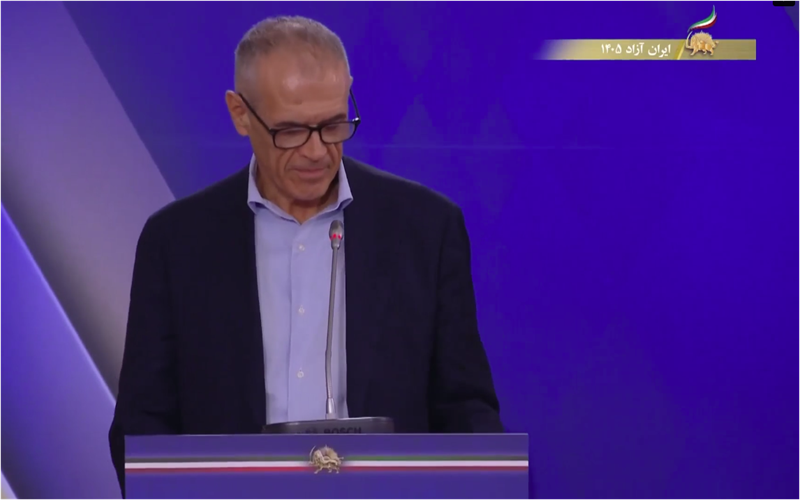

Former Italian Prime Minister-designate and former IMF official Carlo Cottarelli says lasting change in Iran must come from its people, warning that repression, economic failure, and military force cannot determine the country’s future.
Former Italian PM-Designate: The Iranian People Will Decide Iran’s Future
Speaking at the conference “Iran Beyond War: Human Rights and the Power of the People as the Solution,” former Italian Prime Minister-designate and former International Monetary Fund (IMF) official Carlo Cottarelli argued that the future of Iran will ultimately be determined by its own people—not by military intervention or diplomatic negotiations.
Addressing the gathering, Cottarelli described the current moment as “crucial for Iran, for Europe, and for the world,” while urging the international community not to allow regional conflict to overshadow the aspirations of the Iranian people.
“The future of Iran will ultimately be determined not by foreign powers, but by the Iranian people themselves.”
Executions Reveal the Regime’s Fear, Not Its Strength
Cottarelli condemned the regime’s escalating wave of arrests and executions, arguing that such repression reflects insecurity rather than confidence.
He said the authorities continue to rely on prisons, intimidation, and executions because they fear losing power in the face of widespread public dissatisfaction.
“Far from demonstrating the strength of the regime, this reveals its insecurity. The authorities have to kill because they are afraid of losing their power.”
According to Cottarelli, the unrest seen across Iran long predates recent military developments. He noted that women, students, workers, and young people had repeatedly taken to the streets demanding freedom and better economic opportunities.
Although those movements were met with severe repression, he said they demonstrated the resilience of a society determined to shape its own future.
Diplomacy and Military Force Alone Cannot Bring Lasting Change
Cottarelli cautioned against viewing either diplomacy or military action as sufficient to transform Iran’s political landscape.
While describing dialogue as an essential tool of foreign policy, he argued that decades of engagement had failed to produce meaningful political reform.
“Lasting political change cannot emerge automatically from diplomatic agreements.”
He also rejected the assumption that military campaigns can determine a nation’s political future, drawing on historical examples ranging from the Second World War to Vietnam.
“Military power and bombing rarely determine political outcomes on their own.”
External pressure, he argued, may weaken a government’s military capabilities, but it cannot create a legitimate political order.
“A new political order, when it emerges, can only be built by the Iranian people themselves.”
Iran’s Economic Crisis Predates War and Sanctions
Drawing on his decades of experience as an economist and former IMF official, Cottarelli devoted a significant portion of his remarks to Iran’s economic crisis.
He argued that while sanctions and recent military developments have aggravated economic conditions, they are not the root cause of Iran’s decline.
“Even without this bombing, even without the sanctions, the Iranian economy has been performing very poorly for years.”
According to Cottarelli, Iran possesses immense natural and human resources but has consistently failed to realize its economic potential because of structural weaknesses and policy failures.
He pointed to persistent inflation, weak economic growth, high youth unemployment, declining living standards, corruption, and excessive state control as evidence of longstanding economic mismanagement.
He also criticized the dominant role of political and military institutions in large sectors of the economy, arguing that ideological priorities have repeatedly taken precedence over the welfare of ordinary citizens.
“Too often, ideological and geopolitical ambitions have taken precedence over economic development and the well-being of ordinary citizens.”
Support for Democratic Principles
Cottarelli emphasized that many Iranians are seeking fundamental political change based on accountable government, political pluralism, equality before the law, religious freedom, and respect for human dignity.
He also highlighted the National Council of Resistance of Iran’s democratic vision, specifically referencing Maryam Rajavi’s Ten-Point Plan.
According to Cottarelli, the proposal’s emphasis on free elections, separation of religion and state, judicial independence, gender equality, minority rights, and the rejection of nuclear militarization offers principles worthy of international attention.
History Shows Even Entrenched Regimes Can Fall
Looking to history, Cottarelli argued that authoritarian systems often appear invulnerable until they suddenly collapse.
He cited the end of apartheid in South Africa and the fall of the Berlin Wall as reminders that dramatic political change can occur far more quickly than many expect.
“Systems founded on violence often appear stronger than they truly are until, unexpectedly, they collapse under the weight of their own contradictions.”
The International Community’s Responsibility
Concluding his address, Cottarelli stressed that democratic nations should not attempt to determine Iran’s future, but they do have a responsibility to defend universal values.
He called on governments to support human rights while rejecting the notion that military force alone can shape the destiny of a nation.
“Our responsibility is not to decide Iran’s future. That choice belongs to the Iranian people.”
Ending on a note of optimism, he reiterated the central message of his speech:
“The future of Iran will not be written in foreign capitals. It will ultimately be written by the courage and determination of the Iranian people themselves.”
Cottarelli’s remarks underscored a recurring theme of the conference: that sustainable democratic change in Iran depends not on foreign intervention but on the determination of the Iranian people and their struggle for freedom, human rights, and representative government.