


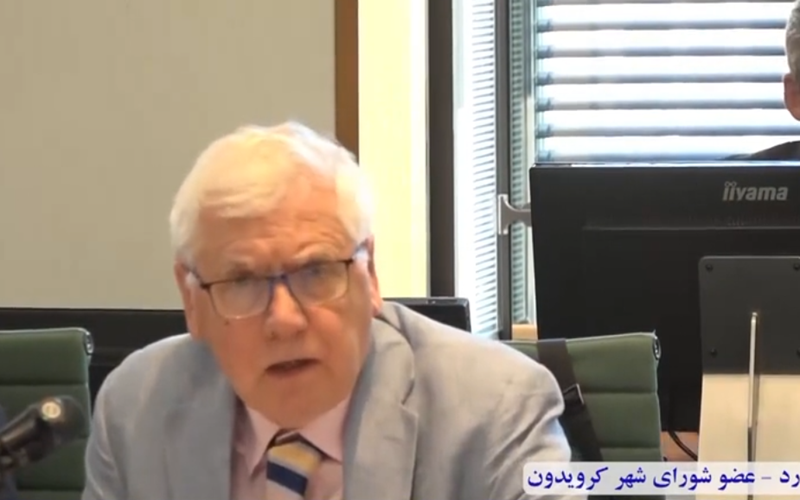

Speaking at a UK Parliament conference, Robert Ward called for stronger British support for the Iranian people, recognition of an organized democratic alternative, and tougher measures against Iran’s regime and the IRGC.
The Iranian people deserve international support as they continue their struggle for freedom, democracy, and human rights, Robert Ward said at a conference in the UK Parliament focused on the road to a free Iran.
Ward condemned the repression carried out by Iran’s regime, describing a system in which executions and state violence have become instruments of policy. He expressed particular concern that a country with Iran’s history and culture has been transformed into what he characterized as a prison for its own citizens.
Despite the scale of repression, Ward argued that Iranians have not surrendered. He pointed to political prisoners, human rights defenders, and people from different sections of Iranian society who continue to challenge the regime.
An Organized Resistance for Democratic Change
Ward identified the National Council of Resistance of Iran (NCRI), led by Maryam Rajavi, as a central force in the struggle against the regime. He also pointed to organized resistance movements affiliated with the NCRI that remain active inside Iran.
In his assessment, the continued activity of these networks demonstrates that there is not only an alternative to the current system but also an organized path toward political transition.
Ward argued that the scale of the regime’s repression itself demonstrates the importance it attaches to suppressing this opposition. He described Iran as being on the verge of political change while stressing that any future transition must be democratic.
Iran’s Future Must Be Decided by Iranians
A central theme of Ward’s remarks was opposition to any externally imposed political settlement.
He argued that no foreign government should designate an individual as Iran’s predetermined transitional leader. Instead, he maintained that the Iranian people must determine the country’s future “from start to finish” and must be able to exercise free democratic choice.
Ward proposed internationally supervised elections as an essential element of such a transition. He referred to the NCRI’s stated transition framework, which calls for a provisional government to operate for a maximum of six months, with its primary responsibility being to organize elections for a constituent and legislative assembly.
In this framework, the provisional period would serve as a bridge toward a representative political system rather than establish a permanent governing authority.
Rejecting Appeasement and Concessions
Ward also criticized decades of what he described as Western appeasement toward Iran’s regime.
He argued that concessions have failed to moderate the regime and called on the international community, particularly the United Kingdom, to give the democratic alternative an opportunity to succeed.
For Ward, this requires Britain to move beyond diplomatic statements and take concrete political measures. He argued that the UK has a particular responsibility to lead international efforts concerning Iran.
Among his proposals was recognition of the NCRI and its platform for a free Iran, alongside making human rights a central consideration in British policy toward Tehran.
Stronger Action Against the IRGC
Ward welcomed the British government’s decision to proscribe the Islamic Revolutionary Guard Corps (IRGC), noting the long campaign for such action.
However, he stressed that the proscription does not eliminate the IRGC’s influence. In his view, the organization continues to exist and exert influence despite being banned in Britain.
He therefore called for stronger measures against the IRGC and for the British government to recognize the organized democratic opposition and resistance movement.
Human Rights as a Condition for Relations With Tehran
Ward concluded with a call to make Britain’s future relations with Tehran conditional on measurable improvements in the human rights situation.
Specifically, he argued that relations should be linked to a verifiable end to executions and the release of political prisoners.
Such conditions, in his view, would place human rights and accountability at the center of British policy rather than treating them as secondary considerations in diplomatic relations.
Ward emphasized that the Iranian people have struggled for generations for freedom, justice, and democracy. He argued that British and international policy should reflect the scale of that struggle by supporting the Iranian people’s right to determine their own future and by giving an organized democratic alternative the opportunity to pursue a peaceful political transition.