



Iranian opposition figures tell U.S. media that the clerical regime has lost legitimacy, warning that the attempt to elevate Mojtaba Khamenei reflects a desperate bid to preserve a collapsing system.
Three Iranian opposition representatives speaking to American media outlets say Iran’s ruling clerical establishment has lost all legitimacy and is entering its final phase, as public anger and organized resistance movements continue to grow across the country.
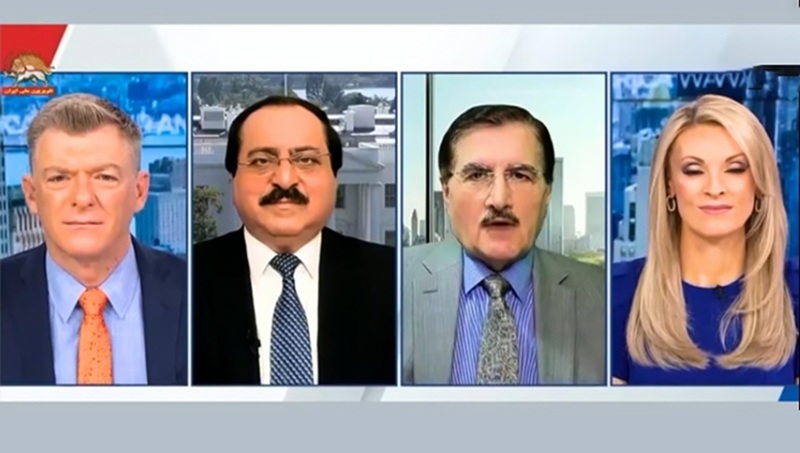
In separate interviews with Newsmax and One America News Network, Iranian political commentators Alireza Jafarzadeh, Ali Safavi, and Homeira Hassami argued that the Iranian people have already decided to end the religious dictatorship and establish a democratic republic. They also described the reported elevation of Mojtaba Khamenei as merely the latest unsuccessful attempt by the regime to prolong its survival.
Growing Resistance Inside Iran
Speaking to Newsmax, Jafarzadeh said the Iranian population has reached a decisive moment in its struggle against clerical rule.
He explained that many Iranians have resolved to bring an end to authoritarian rule carried out under the banner of religion. According to him, recent developments inside the country demonstrate that the demand for change is no longer theoretical but has taken practical form.
Jafarzadeh pointed to a recent operation carried out by members of the People’s Mojahedin Organization of Iran targeting the residence compound of Iran’s supreme leader in Tehran. The action, which occurred days before the outbreak of international tensions involving Iran, was presented as evidence of the expanding activities of organized opposition networks.
He argued that international attention should focus primarily on the Iranian people themselves and on the organized forces confronting the Islamic Revolutionary Guard Corps, saying that these groups are actively working to end the clerical establishment.
“Hereditary Rule” Signals Regime Weakness
Ali Safavi echoed similar views in his interview with Newsmax, referring to remarks made by Maryam Rajavi, the president-elect of the National Council of Resistance of Iran.
Safavi said Rajavi had warned that the appointment of Mojtaba Khamenei effectively turns the clerical system into a hereditary form of rule. However, he argued that such a move cannot rescue the regime.
According to Safavi, the political system in Tehran has already lost credibility among the Iranian population and is facing the same structural collapse that ultimately brought down the monarchy during the Iranian Revolution in 1979. In his view, the ruling establishment today resembles a sinking ship that can no longer regain public trust or legitimacy.
Opposition Says Conditions for Democratic Transition Exist
In a separate interview with One America News Network, Hassami said the opposition believes the essential components for political change already exist.
She stated that the Iranian resistance movement has developed the organizational and political framework needed to facilitate a democratic transition, including the ability to hold free and fair elections once the current system collapses.
Hassami also rejected the idea that Mojtaba Khamenei could represent any form of political alternative. She described him as a figure deeply embedded in the existing power structure and directly associated with repression against protesters.
According to her, the Iranian public’s demand goes beyond replacing one leader with another. Instead, she said, many Iranians seek the complete dismantling of the current system and the establishment of a democratic republic founded on the separation of religion and state.
A System Facing Mounting Pressure
The interviews collectively reflect the opposition’s view that the clerical establishment is increasingly isolated both domestically and internationally. With continuing protests, internal dissent, and the emergence of organized resistance networks, they argue that Iran is entering a decisive period in which political transformation may become unavoidable.
Opposition figures insist that the ultimate outcome will depend on the Iranian people themselves and their ability to sustain pressure for democratic change.