Interviews and reports highlight growing calls for regime change, democratic transition, and international recognition of Iran’s organized resistance
A major gathering of Iranian opposition supporters on March 19, 2026, outside European Union institutions has brought renewed attention to what organizers describe as the only viable solution to Iran’s ongoing crisis: regime change led by the Iranian people and their organized resistance.
According to coverage by Reuters, demonstrators gathered in large numbers in Brussels, voicing a unified message that rejects both foreign military intervention and continued Western appeasement of Tehran. Protesters carried banners and chanted slogans emphasizing their opposition to all forms of dictatorship, including both monarchy and the current clerical regime.
A Clear Political Message from the Opposition
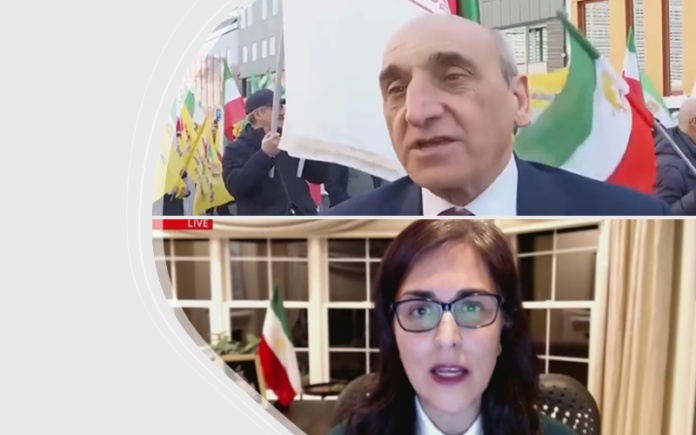
Among the key speakers was Shahin Gobadi, spokesperson for the People’s Mojahedin Organization of Iran (PMOI/MEK). Speaking on the sidelines of the demonstration, he underscored that the Iranian opposition has consolidated around a clear and consistent strategy.
Paraphrasing his remarks, Gobadi emphasized that neither war nor diplomatic concessions can resolve Iran’s deep-rooted crisis. Instead, he pointed to a third path: a democratic transformation driven by the Iranian population and coordinated through an organized resistance movement.
He further called on the international community—particularly the European Union—to formally recognize a transitional political framework based on the Ten-Point Plan proposed by Maryam Rajavi, the president-elect of the National Council of Resistance of Iran (NCRI). This framework, he argued, provides a roadmap for establishing a secular, democratic republic.
Gobadi also urged European governments to adopt firmer policies toward Tehran, including closing Iranian embassies, expelling regime operatives from European soil, and holding Iranian officials accountable for human rights violations and acts of terrorism.
Public Sentiment: Peace and Democratic Change
Participants at the rally echoed similar sentiments. Many stressed that ordinary Iranians are the primary victims of both internal repression and external conflict. Calls for an immediate end to war and a peaceful transition to freedom were central themes.
Others highlighted the need for European institutions to recognize the Iranian resistance as a legitimate democratic alternative, rejecting both the current regime and any return to authoritarian rule in other forms.
Strategic Outlook: Organized Resistance and Regime Fragility
In parallel, political analyst Ramesh Sepehrrad, speaking in an interview with GB News, offered a broader assessment of Iran’s internal dynamics and the prospects for change.
Sepehrrad argued that debates over leadership changes within the regime miss the central issue. The decisive factor, she said, is the growing organization and coordination of opposition forces determined to dismantle the system in its entirety—not merely reshuffle power within it.
She challenged the widespread assumption that the Islamic Revolutionary Guard Corps (IRGC) maintains unshakable control over Iranian cities. Instead, she pointed to an extensive network of resistance units operating across all provinces, suggesting that the regime’s grip on the streets is more fragile than commonly portrayed.
Transitional Plan and the Question of Stability
A key element of Sepehrrad’s argument centered on the readiness of the opposition to govern in a post-regime scenario. She highlighted the proposed transitional government led by Mrs. Rajavi as a structured and time-bound solution designed to prevent instability.
According to his assessment, this provisional framework is prepared to assume administrative control and guide the country toward democratic elections within a defined timeframe, minimizing the risks of power vacuums or internal chaos.
A Growing Call for Policy Shift
Taken together, the demonstrations in Brussels and the accompanying interviews reflect a coordinated effort by Iranian opposition figures to influence international policy. Their message is increasingly consistent: the global community must move beyond ineffective strategies of appeasement and avoid military escalation, instead recognizing and supporting a viable democratic alternative rooted in Iran’s own society.
As pressure mounts on Western governments to reassess their approach to Tehran, these voices are seeking to position the organized resistance not just as an opposition movement, but as a credible political successor.