


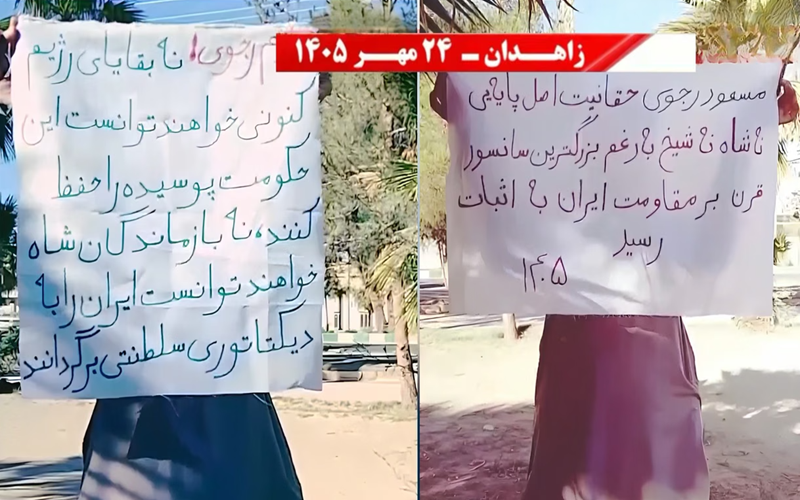

Banners and leaflets promote a democratic republic, freedom, and equality, echoing messages from Massoud Rajavi and Maryam Rajavi
PMOI Resistance Units in Zahedan carried out a series of activities on Friday, October 16, displaying banners and distributing leaflets that rejected both monarchical and clerical dictatorship and called for a democratic republic in Iran.
The messages drew on statements by Massoud Rajavi, the leader of the People’s Mojahedin Organization of Iran (PMOI/MEK), and Maryam Rajavi, president-elect of the National Council of Resistance of Iran (NCRI). They emphasized the rejection of both the former monarchy and the current ruling mullahs, opposition to political dependency, and the need to establish a democratic alternative based on popular sovereignty.
The central slogan of the activities was “No Shah, No Mullahs,” accompanied by calls for freedom, equality, and a democratic republic.
Rejecting Both Forms of Dictatorship
The banners and leaflets highlighted the Resistance’s position that replacing Iran’s current religious dictatorship with a restored monarchy would not deliver freedom or democracy. Instead, they presented the establishment of a democratic republic as the alternative to both systems.
Messages from Massoud Rajavi stressed the political significance of rejecting both the Shah and the mullahs, arguing that this principle establishes a clear boundary against dictatorship and foreign dependency.
One statement declared: “With the rejection of the Shah and the mullahs (dictatorship and dependency), the legitimacy of the democratic revolutionary alternative and its aligned front has been proven.”
Another stated: “What has been proven is the legitimacy and authenticity of the democratic alternative, namely the National Council of Resistance of Iran, which has firmly established the boundaries of the popular front against both the Shah and the mullahs.”
The messages also condemned efforts to promote figures associated with the former monarchy as an alternative to the current regime. They argued that such efforts undermine the Iranian people’s historic struggle for independence and freedom.
A further slogan displayed in the campaign summarized the position: “Dictatorship is dictatorship, whether it wears a turban or a crown.”
Calls for Resistance and the Overthrow of Iran’s Ruling Mullahs
The activities also emphasized organized resistance against Iran’s ruling theocracy. Messages from Massoud Rajavi called for continued struggle to end the regime’s rule and establish a system in which sovereignty belongs to the Iranian people.
One statement declared: “With the banner of No Shah, No Mullahs, we must raise the cry of freedom, take up arms, and rise in resistance.”
Maryam Rajavi’s messages similarly rejected both the continuation of the current regime and a return to monarchical rule.
“Neither the remnants of the current regime will be able to preserve this decaying government, nor will the remnants of the Shah be able to return Iran to a monarchical dictatorship,” one statement read.
Another emphasized the political direction of the Resistance’s position: “The demarcation of No Shah, No Mullahs directs all efforts of struggle toward the overthrow of the mullahs’ regime.”
The messages further described the establishment of a democratic republic as the objective of the Iranian people’s struggle, arguing that the ruling system must be replaced rather than reformed or preserved under a different political arrangement.
Condemning Executions and Repression
The banners and statements also addressed the regime’s escalating use of executions, torture, and mass arrests to suppress dissent and prevent popular uprisings.
Maryam Rajavi condemned these measures as instruments used to preserve the regime against the threat of its overthrow. She also paid tribute to protesters executed for their participation in uprisings and their opposition to the ruling system.
The messages reaffirmed the Resistance’s commitment to a society free from executions and torture, governed through a democratic republic.
Among the slogans highlighted in Zahedan were “Death to the oppressor, whether Shah or Supreme Leader” and “Neither monarchy nor supreme leadership—freedom and equality.”
Another slogan connected the city with the nationwide struggle against dictatorship: “From Zahedan to Tehran, death to the oppressor, whether Shah or Supreme Leader.”
A Democratic Republic as the Alternative
The PMOI Resistance Units’ activities in Zahedan reiterated the Resistance’s rejection of both the former monarchy and Iran’s current clerical dictatorship. Through banners, leaflets, and political slogans, the campaign promoted freedom, equality, independence, and a democratic republic as the alternative to both systems.
The message was unequivocal: Iran’s future should not mean a return to the Shah’s dictatorship or the continuation of rule by the mullahs, but the establishment of a republic based on the sovereignty of the Iranian people.