


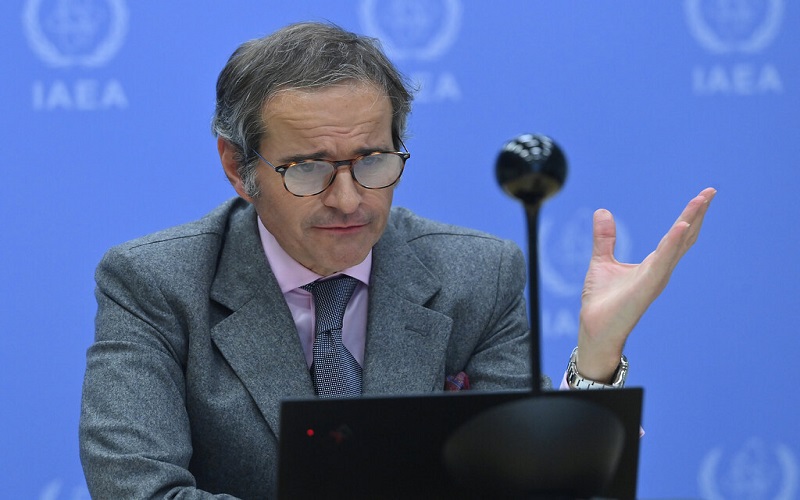

The head of the International Atomic Energy Authority (IAEA), Rafael Grossi, has expressed profound concerns regarding recent statements from Iranian officials hinting at the potential development of nuclear weapons and the country’s persistent lack of cooperation with United Nations inspectors. Grossi’s comments followed a meeting with British Foreign Secretary David Cameron, highlighting the escalating tensions surrounding Iran’s nuclear activities.
Speaking to the UK’s Guardian newspaper, Grossi emphasized the severity of the situation, stating, “Loose talk about nuclear weapons is extremely serious for me. And I think it should stop. We are moving closer to a situation where there is a big, huge question mark about what they are doing and why they are doing it.” His remarks underscore the growing unease within the international community about Iran’s nuclear intentions and the implications for global security.
The status of the agreement with Iran concerning the inspection of its civil nuclear program appears increasingly precarious. On May 8, Kamal Kharrazi, an adviser to Supreme Leader Ayatollah Ali Khamenei, was quoted by Iran’s Student News Network as saying, “We have no decision to build a nuclear bomb, but should Iran’s existence be threatened, there will be no choice but to change our military doctrine.” This statement, coupled with reports that Khamenei has called for the expulsion of UN weapons inspectors, exacerbates fears of Iran’s potential shift towards a nuclear weapons program.
Historically, Tehran has maintained that its nuclear program is intended solely for peaceful purposes—a claim met with skepticism by Israel and much of the Western world. Grossi, however, is not seeking a new agreement to replace the one signed with Iran in March 2023. Instead, he aims to clarify the scope of what inspectors are permitted to observe before the IAEA board of governors convenes again in June.
Following his recent visits to Tehran and Isfahan, Grossi expressed frustration over Iran’s “completely unsatisfactory” cooperation. He lamented the lack of access to critical information, noting, “There was a period when we were recording information and storing this information but could not access it. But there is another period in which there was nothing. Without us being able to see more in Iran, my ability to guarantee that everything is for peaceful uses in Iran would be limited and perhaps approaching the moment where I would not be able to say that anymore.”
Grossi warned that there would come a point when he would “draw the line” with Iran, marking a critical juncture for the international community. He cautioned that without transparency, the world would be left in the dark about Iran’s nuclear capabilities, forcing countries to make their own conclusions.
In February, Grossi reported that Iran continued to enrich uranium to 60 percent purity—a level far exceeding commercial nuclear needs and alarmingly close to weapons-grade 90 percent. This development follows Iran’s suspension of compliance with the 2015 nuclear deal after the United States, under former President Donald Trump, unilaterally withdrew from the agreement in 2018 and reimposed stringent sanctions.
Since the agreement’s collapse, tensions between Iran and the IAEA have intensified, with European Union-mediated efforts failing to reintegrate Washington into the accord or persuade Tehran to adhere to its terms. The IAEA has repeatedly criticized Iran for its lack of cooperation, citing issues such as the expansion of its nuclear activities, the barring of inspectors, and the deactivation of monitoring devices at its facilities.
In its most recent report presented at the board of governors meeting in March, the IAEA revealed that Iran’s estimated stockpile of enriched uranium had reached 27 times the limit established by the 2015 accord. This alarming escalation highlights the urgent need for international attention and action.
Warning to the International Community
The continuing appeasement of the Iranian regime by the international community and world powers carries significant risks. Failure to address Iran’s nuclear ambitions with firm and decisive action could lead to severe consequences, including the potential proliferation of nuclear weapons and heightened regional instability. It is imperative that global leaders unite to enforce stringent measures and ensure Iran’s compliance with international nuclear agreements to safeguard global peace and security.