



In a recent report titled “Passing from Surrender,” Iran’s state-run newspaper Shargh presented a bleak outlook for the country, describing two potential outcomes for the ruling clerical regime: capitulation or economic collapse.
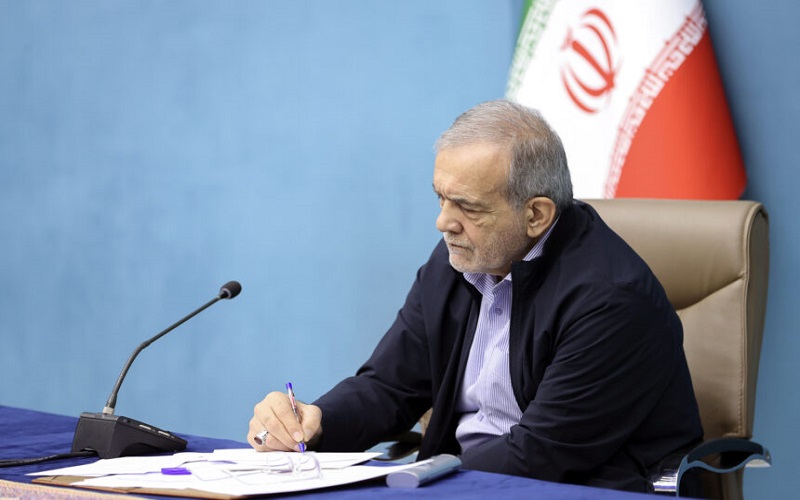
At a recent meeting with top exporters, Iran’s President Masoud Pezeshkian expressed frustration with what he called unrealistic mandates imposed by the Iranian Parliament. Highlighting the mounting burden of state debt, Pezeshkian is reported to have exclaimed, “Where is the money? They created a government in debt, and now they say solve the problem.” His criticisms reflect broader anxieties about Iran’s expanding budget deficit, which this year alone is estimated at nearly 850 trillion tomans, according to the Minister of Economy.
Shargh speculates that Pezeshkian’s remarks may be a prelude to harsher critiques and potential policy shifts within the government. With the national deficit expected to swell further next year, the government is left with few viable options. If it borrows from the central bank, inflation is likely to surge, while issuing government bonds will only delay the debt burden for future administrations. Another possibility is drawing from the National Development Fund, though Shargh warns that only $15 billion remains of the once substantial $160 billion reserve.
Raising fuel prices could provide some relief, but Shargh points out that this would come at a steep social cost, likely to ignite public discontent. An alternative would be to cut government spending, though this could risk antagonizing powerful stakeholders. In its analysis, Shargh notes the growing insecurity within the country and warns of mounting “dangerous challenges” cited by the Foreign Minister, who described the regional situation as “highly alarming.”
Despite securing a vote of confidence two months ago, Pezeshkian’s administration still grapples with unresolved economic and political challenges. Drawing parallels to the Iran-Iraq War, Pezeshkian warned that the pressures facing his government may force it into “submission.” The president’s concerns reflect not only his dissatisfaction with Parliament’s decisions but also public impatience for tangible solutions instead of mere diagnoses of the issues.
In addition to Pezeshkian’s critique, Shargh cited remarks from Masoud Nili, a prominent economist associated with the regime, who highlighted systemic imbalances in energy, banking, foreign trade, the currency market, pensions, water resources, and environmental policy. Nili emphasized that policymakers often prioritize energy market reforms due to their quick revenue potential, but he cautioned that this approach has failed repeatedly due to inherent complexities in the sector.
Nili argues that meaningful reform must extend beyond the economy to include foreign relations and social policies. However, the main hurdle, according to him, is the absence of a comprehensive analysis of Iran’s challenges within the governing system. He noted that persistent disagreements among officials have hindered the development of a cohesive and effective strategy, with none of the major players willing to adopt the proposals of others.
Nili further advocated for the preparation of a detailed report on the state of the country, urging that this be reviewed by decision-makers as an essential step to address the crisis. He warned that Iran’s current trajectory is a “dangerous path toward surrender,” questioning why such an assessment has not yet been prioritized by the government.
According to Shargh, public fatigue and resignation are widespread, with citizens becoming desensitized to warnings about “imbalances” and “social misery.” The dismal outlook, Shargh suggests, is only a partial glimpse of the greater crisis looming over Iran. In the first six months of 2024 alone, the budget deficit has reached 1,000 trillion tomans, with liquidity issues and severe setbacks in industry and production exacerbating crises in energy, water, electricity, and gas.
Shargh concludes that the Iranian regime is at a crossroads between two equally devastating paths: submission or self-destruction. Moreover, it hints that the true extent of the crisis is even more alarming, as many critical issues remain unreported due to censorship. Iran’s regimes’ faces dark times ahead, with difficult weeks and months on the horizon as it grapples with an existential struggle to secure its future.