


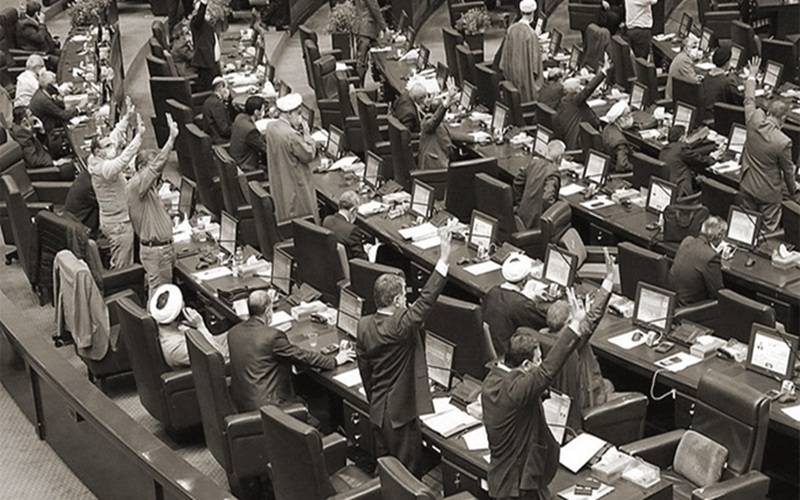

While Tehran’s ruling elite promotes a narrative of moderation and unity, critics warn that the internal reshuffling serves only to preserve the regime—not reform it.
In the aftermath of the 12-day Israel-Iran war, media outlets closely tied to senior figures in the Iranian regime have launched a coordinated campaign portraying a shift toward moderation, pragmatism, and national unity. But beneath the surface, analysts say this narrative is a strategic rebranding effort—aimed not at reforming the system but at deflecting blame, pacifying unrest, and preserving the status quo.
An op-ed published on July 29 by outlets linked to Supreme Leader adviser Ali Akbar Velayati framed so-called moderates and pragmatic hardliners as crucial for achieving national unity. The piece promoted figures like President Masoud Pezeshkian and Parliament Speaker Mohammad Bagher Ghalibaf as key actors in maintaining cohesion during the war and emphasized the need for a “transformational force” focused on gradual improvements.
However, critics argue that no such transformation is truly underway. The promoted narrative distinguishes between reformists, moderates, and ultra-hardliners—but all operate within the same authoritarian framework, lacking any real accountability or democratic legitimacy. The regime’s own history is replete with examples of internal factions posing as reformers while continuing to enforce the same repressive policies.
The renewed emphasis on “social satisfaction” and the need to revise outdated policies—echoed by both Velayati and Pezeshkian—reflects a growing awareness among officials of widespread public discontent. But rather than addressing the root causes of this dissatisfaction—such as political repression, economic crisis, and systemic corruption—the regime appears to be relying on rhetorical shifts and managed reshuffling.
This pattern extends into the strategic realm. On the same day, Nour News—an outlet linked to the Supreme National Security Council and increasingly associated with former secretary Ali Shamkhani—called for an overhaul of Iran’s internal and external strategy. The op-ed proposed the creation of a “Strategic Command Center” to centralize decision-making and improve the regime’s response to hybrid threats.
Such calls acknowledge the dysfunction and fragmentation within the regime’s power structure, particularly exposed during the recent war. Yet far from democratizing governance, these proposals are aimed at consolidating control, reducing factional infighting, and strengthening regime resilience—not empowering citizens or allowing pluralism.
Meanwhile, members of the Iranian parliament’s National Security and Foreign Policy Commission have demanded increased defense spending and tighter border security. These statements suggest that, despite the rhetoric of unity and reform, the regime’s priority remains its survival and militarization—not the well-being of its people.
The internal discourse following the war reveals not a new era of reform, but a tactical adjustment by the regime’s ruling factions. By promoting a false dichotomy between hardliners and moderates, Tehran seeks to manage public perception while doubling down on its core policies. Any hope of real change, critics contend, will not come from within the regime’s entrenched structures—but from the continued resistance of the Iranian people demanding true freedom and accountability.
Closing Reflection:
The so-called power shifts inside the Iranian regime often follow a pattern: public gestures of moderation after crises, cosmetic personnel changes, and vague promises of reform. But history has shown that these are tools of containment, not transformation. Observers warn that until the regime itself is dismantled, no internal reshuffling can lead to meaningful change.