



How the recent ceasefire exposed the strategic failure of Iran’s regional policy and weakened Khamenei’s hegemonic project
The two-year war in Gaza and the recent ceasefire have revealed another major strategic defeat for Iran’s regime. For Ali Khamenei, who sought to use the Palestinian cause to delay or suppress uprisings at home, the outcome is devastating. Even within the regime’s own media, a rare tone of acknowledgment has emerged — signaling that Tehran’s decades-old doctrine of exporting terrorism and fueling proxy wars has failed to create deterrence. Instead, it has placed Khamenei’s regional hegemony in grave danger.
In a remarkable departure from official orthodoxy, the state-run newspaper Setareh Sobh published an article titled “A New Middle East Against Iran,” admitting that Tehran’s intervention in the Arab–Israeli conflict had been a strategic blunder. It wrote:
“The 77-year conflict between Arabs and Israel was an Arab–Hebrew–Western issue, and Iran’s entry into this conflict after the withdrawal of Arab countries was a mistake and costly. Therefore, it is time for Iran to leave the continuation of the conflict or peace to the Arab–Hebrew axis.” (Setareh Sobh, October 12, 2025)
Such an admission from inside the regime’s media apparatus directly challenges one of the regime’s key ideological pillars — the notion that sustaining conflict in the region provides ideological legitimacy and security for the regime. By suggesting that Iran should “leave the conflict to the Arab–Hebrew axis,” the article implicitly concedes Tehran’s failure to maintain its geopolitical position.
The same article openly described Iran’s growing regional isolation, noting:
“Not a single Arab country is willing to support Hamas or Hezbollah; instead, they firmly support Donald Trump’s 20-point peace plan, and even Hamas has expressed gratitude toward Trump.”
This acknowledgment from Setareh Sobh is unprecedented. It reflects a clear understanding that the regime’s so-called “axis of resistance” is disintegrating. The proxy groups Tehran relied on for influence — from Hezbollah to Hamas — are no longer assets of deterrence but liabilities. The regime that once aspired to regional dominance has been reduced to a politically and diplomatically isolated sponsor of failed militias.
In another commentary, Setareh Sobh warned that the region’s geopolitical landscape is fundamentally changing to Iran’s disadvantage:
“The geopolitics of the Middle East are changing against Iran’s national interests and territorial integrity. Iran now faces a choice between continuing its costly old doctrine or changing course and accepting the peace plan, the two-state solution, and negotiations with the United States.”
This statement marks a profound shift in tone. For the first time, a state-controlled newspaper openly acknowledged that the regime’s long-standing policy of permanent confrontation no longer serves Iran’s national interests. What was once touted as “strategic depth” is now seen, even by regime insiders, as an unsustainable drain on the nation’s resources.
A similar realization is visible in Jomhouri Eslami (Islamic Republic), another key regime outlet. In an article titled “Did This Storm Have a Winner?”, it lamented the devastating consequences of the war:
“The loss of Syria, swallowed up by the U.S. and Israel, is one of the greatest damages of the events of the past two years.” (Jomhouri Eslami, October 12, 2025)
The paper continued by warning about new political alignments in Lebanon:
“Israel’s penetration into southern Lebanon is a direct consequence of Operation al-Aqsa Storm. Another major loss in Lebanon is the rise of a government aligned with the U.S. and Israel.”
These remarks constitute an extraordinary admission: Hezbollah — long considered Tehran’s most valuable regional asset — has lost its deterrent power. What was once the backbone of Iran’s regional strategy is now a hollow structure, unable to project strength or defend Tehran’s influence.
Perhaps most tellingly, Jomhouri Eslami concluded with a sentence that would have been unthinkable in the regime’s media just a year ago:
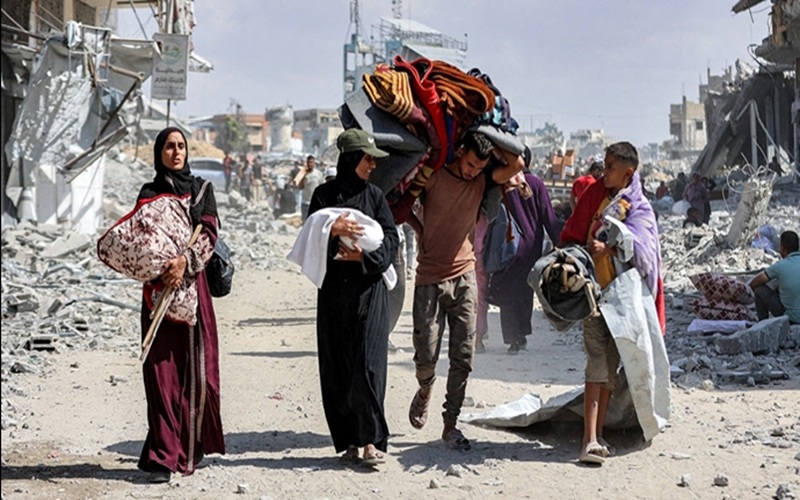
“The reality is that contrary to many analyses, Operation al-Aqsa Storm was a mistake. The destruction of Gaza — with 80 percent of its buildings and infrastructure annihilated — is a major loss.”
Such an acknowledgment from within Khamenei’s propaganda machinery amounts to an admission of defeat. The regime’s decades-long policy of exporting terrorism, financing proxy wars, and maintaining regional chaos as a tool of survival has backfired. Instead of expanding its influence, the Iranian regime finds itself increasingly isolated, both regionally and ideologically.
The Gaza war, which Tehran had hoped would bolster its regional leverage and distract from domestic dissent, has instead exposed the regime’s vulnerabilities. From Setareh Sobh to Jomhouri Eslami, regime outlets now echo a single theme — that the so-called “axis of resistance” has collapsed under its own contradictions.
What Khamenei once portrayed as the regime’s “strategic depth” has become a costly quagmire. The regime’s media are no longer able to conceal the truth: the clerical establishment’s foreign policy, built on aggression and proxy conflict, has failed. The stage is now set for the Iranian people to challenge the system not only in its foreign ambitions but in its domestic foundations — the very legitimacy that the regime tried to shield behind its regional wars.