


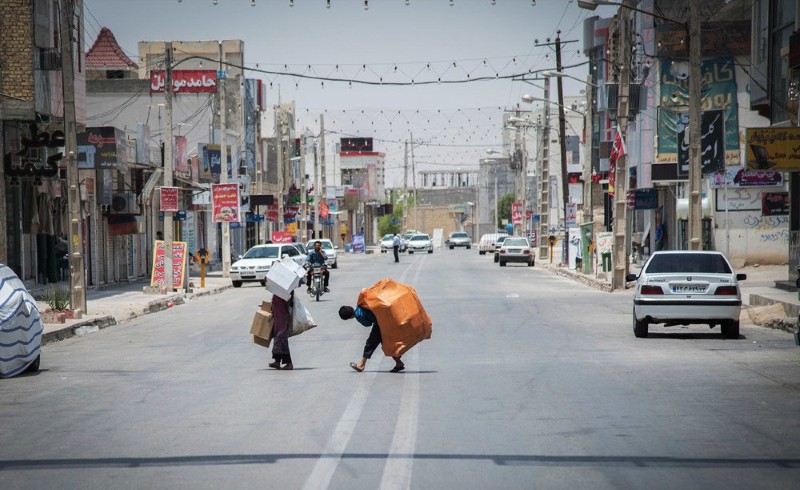

Despite publishing alarming statistics, state-run media and officials like Pezeshkian conceal the roots of poverty and inequality — protecting the regime that created them
One of the most powerful driving forces behind Iran’s 1979 revolution was the explosive growth of class inequality. As the Shah’s political repression intensified through SAVAK, economic disparity and poverty also deepened. Media outlets of that era routinely published statistics about social inequality, but under censorship and state control, they never dared to reveal the real causes or those responsible for it.
More than four decades later, the same cycle continues under the current regime. Iran’s state-controlled media are filled daily with statistics about poverty, unemployment, and social decay — yet they remain silent about the institutions and individuals behind these injustices. Despite countless reports, nothing changes. The so-called reformist rhetoric of officials like the regime’s president Masoud Pezeshkian only serves to deceive the public; his statements acknowledge the crisis but stop short of confronting its roots. The facts speak for themselves — Pezeshkian plays the role of a loyal actor in a well-rehearsed performance of denial.
Does anyone in the ruling elite truly not know why a nation “sitting on oil and gas” suffers from hunger?
In totalitarian systems, the media operate as precise instruments of the ruling power. Their reports and commentaries are aligned word for word with the interests of the regime. They publish data and even criticize certain policies, but always within boundaries set by those in power. This orchestrated show of “transparency” gives the illusion of free expression while serving as a safety valve to release public frustration — never to challenge the regime itself.
Consider one recent example from the state-run Tose’e Melli newspaper, dated October 20, 2025. The report reads:
“In the 2022–2023 academic year, 902,188 children dropped out of school. In the 2023–2024 academic year, this number rose to 928,729… Class inequality reveals itself in its most naked form. The issue is not merely inequality — the wealth of the few is built on the labor and suffering of the majority… The gap is not just wide; it’s a chasm from earth to sky.”
Such reports are cleared by censors and known to high-ranking officials before publication. Yet, they provoke no action, no reform, and no accountability. The statistics are allowed to circulate precisely because they pose no threat — they expose symptoms, not causes.
Meanwhile, the tragedies continue. A recent story described the deaths of five child laborers in a car accident near Mashhad. The children were being transported in the trunk of a vehicle to work in saffron fields in Fariman. They were mostly from impoverished Baluchi families, deprived of education, and forced into labor to survive. As one report noted, “These children travel miles away to work, only to be crushed under the wheels of capitalism.”
At the same time, elite schools in northern Tehran flourish, boasting bilingual curricula, luxury facilities, and foreign-trained staff — all under the supervision of the same Ministry of Education. This grotesque contrast lays bare the true nature of Iran’s economic structure: a regime built on exploitation, inequality, and privilege.
The root of this injustice lies in the regime’s own survival strategy. The government has no social legitimacy and relies instead on oligarchs, military-owned banks, and networks of corruption centered around the Supreme Leader’s office — the nerve center of Iran’s economy.
How is it that Pezeshkian claims to support the “reconstruction of Gaza” but cannot build schools for Iranian children? How can billions be funneled to Hezbollah and other proxy groups abroad, while schools in places like Chabahar remain abandoned and unfinished? As one local resident of Esfakeh village put it, “Our school has been left half-built for years and remains unfinished.”
The truth is clear: the regime’s media and its political figureheads serve not the people but the preservation of power. Their task is not to inform but to manage public perception — to normalize suffering and sustain a corrupt system. Behind every statistic of poverty and deprivation lies a deliberate policy of exploitation, and behind every headline of “reform” stands a regime determined to survive at the expense of its people.