


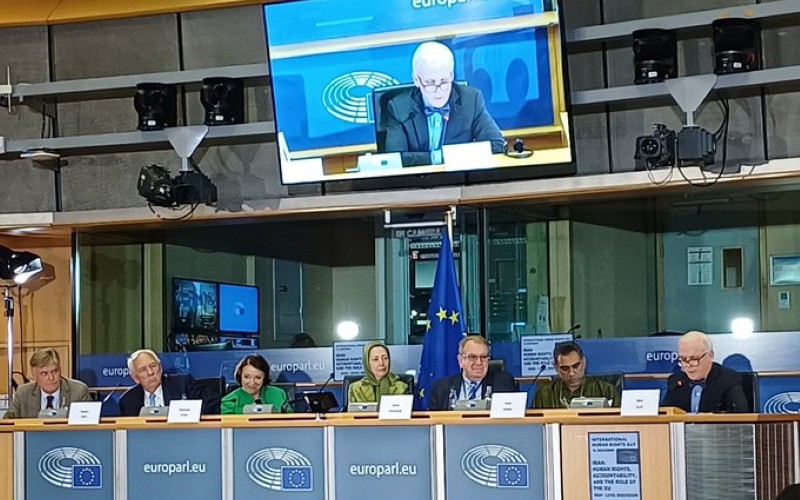

On International Human Rights Day, experts demand concrete action against Tehran’s state-sanctioned murder machine and its regional threats, asserting that justice will prevail.
As the world marks International Human Rights Day, the focus of global attention must be drawn to the unprecedented crisis unfolding in Iran, where the human rights situation has reached an unprecedented degree of severity.
The data is shocking: nearly 1,800 executions have occurred in 2025, with a reported 1,932 so far this year, reflecting a level of state terror rarely seen in modern history. As former MEP Dorien Rookmaker stated, “It is safe to say, I believe, that the regime in Iran is the most atrocious, most vicious, most cruel regime in the world today. It’s 100% pure evil.”
These deaths are not random criminal justice outcomes. Ambassador Stephen Rapp, former international prosecutor, underscored that “These judicial executions, these judicial murders, are not just sporadic, they’re calculated measures. They are acts of state terror to suppress dissent and to reassert control in the aftermath of two nationwide uprisings and the recent international conflict.”
International human rights lawyer Azadeh Zabeti confirmed this repressive strategy, noting that “The Iranian authorities are once again, as they have done previously, weaponizing the courts in order to silence dissent and to silence the Iranian people.”
This current wave of brutality openly invokes the horror of the 1988 massacre, where 30,000 political prisoners were executed.
Dominique Attias, Chair of the Board of Directors of the European Lawyers Foundation, insisted on naming this historical crime accurately: “This massacre constitutes both genocide and a crime against humanity. You must say it. If we don’t say it here, where will we say it?”.
The Force of Change
Despite the regime’s attempts to instill fear—through public executions and the targeting of activists like 67-year-old engineer Zahra Tabari—the flame of resistance has never gone out.
Struan Stevenson, the meeting chairman, emphasized that “The epicenter remains in Tehran, and the only force capable of removing it is the Iranian people themselves.”.
This belief in change is rooted deeply in society.
Dr. Sina Dashti, testifying about his family’s support for the democratic opposition, shared a profoundly moving testament: “My mother, when she left us forever, she was very proud that her children were supporters of the Mojahedin and asked us to take our support for this movement very seriously, since the people of Iran have no other hope and no other tool to achieve freedom.”
The determination of the Iranian people shows that, as former Amnesty Secretary General Kumi Naidoo advised, “In the moment of history that we find ourselves in, pessimism is a luxury we simply cannot afford.”
Europe’s Moral and Security Imperative
The time for appeasement and “moral cowardice” is over. The European Union must recognize that standing up for human rights in Iran is not merely an ideological preference but the core duty of its diplomacy.
Juan Fernando López Aguilar, a former Minister of Justice, stressed that “Accountability to human rights should certainly be the number one priority of the role of the EU when going global.”
Furthermore, the threat posed by the regime extends beyond its borders, destabilizing the entire region through its proxies. Antonio López-Istúriz White warned Europe directly about the implications of inaction: “I always say, make no mistake: Israel could be the [current] target, but the next one is Europe.”
The immediate demands for the EU are clear: impose a moratorium on executions, designate the IRGC as a terrorist organization, and condition all diplomatic relations on measurable human rights progress.
Accountability is Inevitable
The ultimate message must be one of unwavering commitment to justice. Mark Ellis, Executive Director of the International Bar Association, asserted the legal world’s resolve: “The architects and executioners of Iran’s atrocities should harbor no illusions that time is on their side.”
Evidence is being preserved, and the world is watching, ensuring that the perpetrators of these crimes will eventually be held accountable.
As tyrannies built on fear, lies, and violence are inevitably destined to collapse, the democratic world must stand ready to support the Iranian people at the moment of their liberation.
The commitment made today on the 77th anniversary of the Universal Declaration of Human Rights must be to never trade away justice for political expediency.