


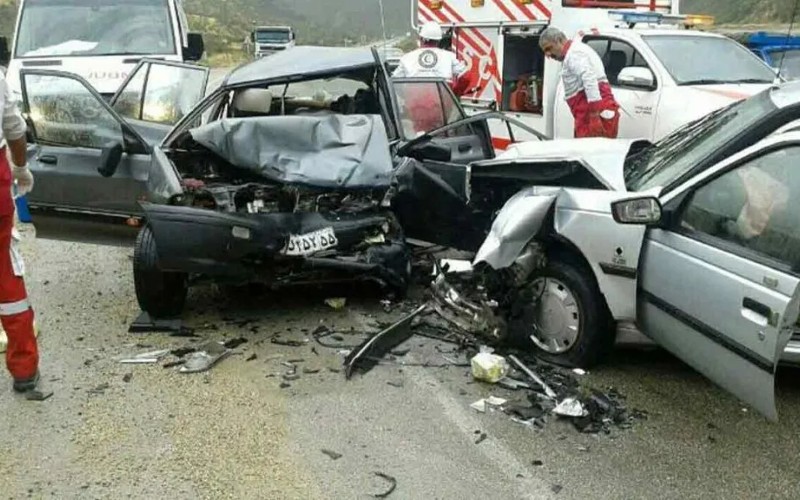

After Iran regime’s president likens traffic deaths to a daily plane crash, the real question remains unanswered: why has the ruling system allowed this silent massacre to continue for decades?
For years, road accidents in Iran have constituted one of the country’s deadliest yet most normalized disasters—a silent massacre that claims dozens of lives every day and leaves countless families shattered. Now, even the regime’s president has inadvertently exposed the scale of this ongoing catastrophe.
Masoud Pezeshkian, stated in remarks published by state-affiliated outlets including Eghtesad Online and Mehr News Agency on December 20, 2025, that “seventeen thousand deaths from road accidents are unacceptable; it is like a passenger plane crashing every day.”
This comparison is not an expression of compassion. It is an unambiguous confession of the magnitude of a disaster that the regime itself has created, sustained, and normalized. If a passenger plane truly crashed every day, the world would demand accountability. In Iran, however, daily death on the roads is treated as routine.
Acknowledgment Without Accountability
The Iranian regime has long perfected the art of verbal regret without responsibility. Officials recite statistics, express sorrow, and move on. What they systematically avoid is addressing the real causes behind the carnage. The people dying on Iran’s roads are not reckless volunteers. No family sends a loved one onto the highway expecting a coffin in return.
The causes of this tragedy lie elsewhere—firmly within the structure of power.
Iran’s roads have earned a grim reputation as “roads of death.” Vast stretches of the country’s transport network are outdated, unsafe, and incompatible with the volume of traffic they carry. Proper highways are scarce, maintenance is neglected, and safety standards are routinely ignored. At the same time, domestically produced vehicles—often referred to by Iranians themselves as “coffins on wheels”—lack even basic safety features. In many cases, minor collisions turn fatal.
Under these conditions, road accidents are not random incidents. They are predictable outcomes.
A Regime That Does Not Prioritize Human Life
The ruling system is mired in overlapping economic, political, and social crises. Yet public safety has never been a genuine priority. Road modernization, transport safety, and infrastructure development have been sidelined for years. Instead, national wealth is funneled into projects that have nothing to do with people’s well-being.
Missile production, nuclear programs with astronomical costs, and regional military adventures dominate the regime’s agenda. In this equation, human life is expendable. Thousands die annually on the roads, but for the ruling establishment these are merely numbers—useful for speeches, quickly forgotten afterward.
When Pezeshkian compares road deaths to daily plane crashes, he carefully avoids naming the causes. He does not explain why roads remain unsafe. He does not address why domestic vehicles fail basic standards. He does not ask why the national budget is not spent protecting lives. This silence speaks louder than any admission.
A Broader Pattern of Structural Violence
Road fatalities in Iran are not an isolated failure. They are part of a larger, deadly pattern—one in which human life carries no weight in strategic decision-making. Death on highways mirrors death in prisons, on protest streets, and under economic collapse. Poverty, repression, and insecurity are not accidents; they are symptoms of a system built on survival at any cost.
A regime that prioritizes its own endurance over its people cannot and will not protect them.
When the president of such a system publicly acknowledges daily killing on the roads, the real question is not whom he is addressing, but whom he is avoiding. Is this a government of the people, or a structure fundamentally hostile to them? Iranian society has already answered this question through lived experience.
No Reform Within a Death-Producing System
As long as this religious authoritarian regime remains in power, road deaths, poverty, repression, and preventable disasters will remain integral parts of daily life. Decades of governance have proven that human life has never been—and will never be—a priority within this structure.
The path out of this cycle of death and decay does not lie in reforming a system that thrives on neglect and repression. The only real solution is the removal of a regime whose very foundations are incompatible with human dignity, safety, and life itself.
Until that change occurs, Iran’s roads will continue to function not as pathways of connection, but as corridors of preventable death—another silent crime committed daily by a system that refuses to value the lives of its own people.