

Despite political changes in Damascus, the interception of anti-aircraft missiles near Albu Kamal highlights the enduring legacy of Tehran’s land corridor to Hezbollah
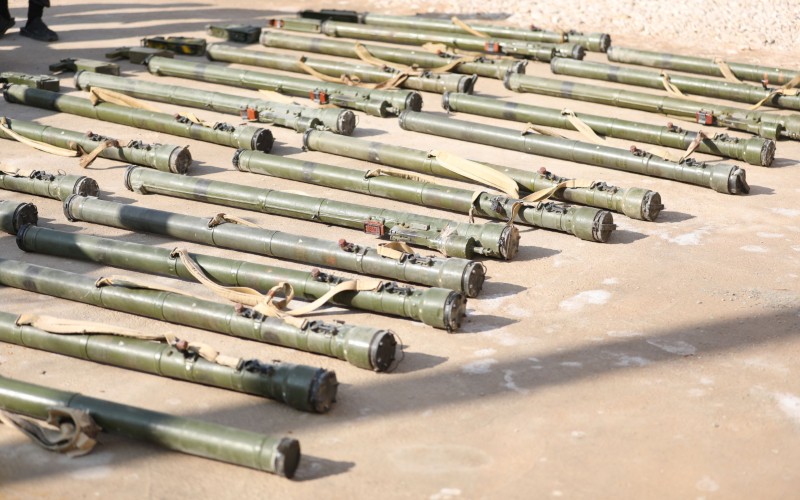
The seizure of surface-to-air missiles in eastern Syria has once again drawn attention to the Iranian regime’s long-standing role in transforming Syrian territory into a conduit for regional arms trafficking. On December 22, Asharq Al-Awsat reported, citing sources linked to Syria’s Interior Ministry, that a shipment of SAM-7 anti-aircraft missiles was intercepted in Albu Kamal, Deir ez-Zor province, near the Iraq–Syria border. According to the report, the weapons were being smuggled through Syria en route to Hezbollah.
Syrian security officials stated that the missiles were transferred during the war years by the Iranian regime via Iraq, using militia-controlled tunnel networks—an allegation consistent with years of intelligence assessments and investigative reporting on Tehran’s regional logistics infrastructure.
#Syria: the Security forces seized the largest cache of anti-aircraft missiles ever recorded.
Around 30 MANPADS, prepared for smuggling out of the country, were discovered in a house in #Abukemal, on border with Iraq.
The shipment also included a large number of grip stocks… https://t.co/roIwy2ZjG6 pic.twitter.com/lhxSEd4iGN
— Qalaat Al Mudiq (@QalaatAlMudiq) December 22, 2025
Targeted Security Operation in Albu Kamal
According to Syria’s Internal Security Directorate, a targeted security raid was carried out on Monday, December 22, on a residential property in Albu Kamal. During the operation, several SAM-7 missiles prepared for external smuggling were discovered and confiscated.
In an official statement, Syria’s Interior Ministry confirmed that the seized weapons had been secured and that judicial authorities had launched investigations to identify and arrest all individuals involved. The ministry reiterated its commitment to combating arms trafficking and illegal activities, emphasizing that all necessary measures would be taken to safeguard national security and stability.
This was not an isolated incident. Earlier this month, Syrian security forces in the Zabadani area of Rural Damascus thwarted an attempt to smuggle a weapons shipment—including significant quantities of RPG rockets—toward Lebanon. On December 20, another coordinated security operation in Qudsaya led to the arrest of five individuals accused of smuggling weapons to outlawed groups in Sweida province, areas under Syrian Democratic Forces (SDF) control, and cells linked to ISIS. The operation resulted in the seizure of FPV attack drones, TNT explosives, landmines, and anti-personnel bombs.
An Old Corridor with a New Political Context
Although Syria’s Interior Ministry did not publicly name the actors behind the Albu Kamal operation, the location itself is revealing. For years, Albu Kamal and Deir ez-Zor have been identified in numerous reports as critical chokepoints in networks affiliated with the Iranian regime and its regional allies.
Reuters previously reported in September 2019 that the reopening of the Al-Qaim–Albu Kamal border crossing—after ISIS was pushed out with the backing of Iran-aligned militias—significantly increased Tehran’s ability to move sensitive cargo. On the Iraqi side of the border, Iran-backed Popular Mobilization Forces (PMF) controlled key areas, facilitating cross-border transfers beyond effective state oversight.
Over time, this border crossing became central to Iran’s broader strategic objective: establishing a continuous land corridor from Iran, through Iraq and Syria, to Lebanon and the Mediterranean coast. The Atlantic Council has described control over Albu Kamal as strategically vital for Tehran, enabling sustained logistical support to Hezbollah.
Disruption After Assad, But Networks Remain
The sudden collapse of Bashar al-Assad’s regime and the rise of a new administration—have altered Syria’s political and security landscape. The new government has launched efforts to reassert control over borders and dismantle smuggling networks embedded during the war years.
However, the discovery of SAM-7 missiles in Albu Kamal demonstrates that the infrastructure built under years of Iranian regime influence has not been easily dismantled. According to the Combating Terrorism Center (CTC) at the U.S. Military Academy, Iran regimes’ Quds Force established organizational structures and offices across Syria, including in Deir ez-Zor, creating deep-rooted networks that persist even amid political change.
The Washington Post reported in April 2025 that Syria’s new authorities are actively targeting routes previously used by Iran to move weapons, cash, and narcotics—routes that once formed the backbone of Tehran’s so-called “land bridge” supporting Hezbollah and Hamas. These routes are now under intensified security pressure, yet recent seizures indicate that remnants of the network remain operational.
A Continuing Regional Contest
For regional observers, the Albu Kamal seizure underscores the ongoing competition over arms and finance corridors along the Iran–Iraq–Syria–Lebanon axis. For more than a decade, this route has been essential to Hezbollah’s military capabilities and has repeatedly drawn Israeli strikes and U.S. pressure.
The interception of SAM-7 missiles suggests that, despite setbacks and shifting alliances, the Iranian regime continues to rely on legacy smuggling networks to project power beyond its borders. It also highlights the long-term destabilizing impact of Tehran’s regional strategy—one that has entrenched armed non-state actors, undermined sovereignty, and left behind security vacuums that new governments are now struggling to contain.
What is increasingly clear is that while political leadership in Damascus has changed, the consequences of years of Iranian regime military and logistical entrenchment in eastern Syria are far from erased.