Demonstrators call for democratic change in Iran as Maryam Rajavi emphasizes that the Iranian people themselves will determine the country’s future without foreign intervention.
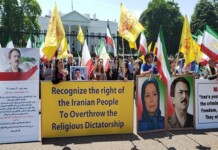
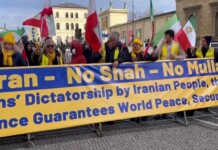
On Saturday, March 14, Iranians and supporters of the National Council of Resistance of Iran (NCRI) gathered in joint demonstrations in Hamburg, Germany, and Stockholm, Sweden, to express support for the NCRI’s announcement of a provisional government for Iran’s transition.

The rallies took place at a time when Iran is experiencing one of the most sensitive periods in its contemporary history, amid ongoing war and mounting internal tensions. Organizers and participants emphasized that these demonstrations were not only expressions of solidarity but also part of a broader effort to highlight the Iranian people’s aspirations for democratic change during a critical moment for the country.

Speakers at the gatherings outlined what they described as the central dynamics shaping Iran’s current situation and stressed the responsibility of democratic forces to respond to these extraordinary circumstances. They argued that both monarchical and clerical dictatorships had failed to establish a society that reflects the will of the Iranian people, instead leaving a legacy of crisis and conflict. According to the speakers, these failures have placed the ruling system on a path toward eventual collapse.

Several speakers also pointed to the possibility of a historic turning point. They noted that the potential end of the current leadership could open the door to a new era—provided that Iran’s diverse communities and political forces unite to prevent the reemergence of authoritarian rule in any new form.

A recurring theme in both demonstrations was the long history of resistance to authoritarian rule in Iran. Participants highlighted how, over the past century, both royal and clerical systems had marginalized the rights of various communities across the country. Yet despite decades of repression, they argued, the struggle for freedom has persisted, bringing Iran today to what many see as the threshold of significant political transformation. In that context, speakers stressed that unity among democratic forces is more essential than ever.

Another message from the rallies was directed at the international community. Participants sought to draw global attention to the extraordinary conditions facing the Iranian people, warning that years of political appeasement toward Tehran had contributed to the current crisis.

They also emphasized what they see as a roadmap toward a democratic Iran. Demonstrators highlighted support for the ten-point democratic platform proposed by Maryam Rajavi—a program that advocates a secular and pluralistic republic and rejects both monarchical and clerical rule.

Speakers further stressed that Iran’s crisis cannot be resolved through foreign war. While condemning the violence and repression carried out by the ruling establishment, they argued that lasting change must come from the Iranian people themselves through continued resistance and civic struggle.

In a message addressed to the demonstrators, Rajavi described the participants as representatives of a nation caught between war and repression.
“You are the voice of a defenseless people who are under the pressure of a devastating war and at the same time trapped in the grip of brutal repression,” she said.

Rajavi emphasized that the fundamental conflict in Iran is between the Iranian people and organized resistance on one side, and what she described as a system of religious authoritarianism on the other.
“Yes, the main war is between the people and the Iranian Resistance on one side and religious fascism on the other, and it is impossible for this regime to escape uprising and overthrow,” she stated.

She added that the combination of organized resistance and popular uprisings could ultimately break the regime’s hold on power.
“The people of Iran will write their destiny with the blood of their brave sons and daughters, and there is no need for foreign intervention,” Rajavi said.

She also reiterated that the resistance movement does not seek external military involvement or financial support from foreign governments.
“This Resistance does not seek money, weapons, or the presence of foreign forces on Iranian soil, and I have repeated this many times,” she said.

Rajavi concluded by emphasizing that the goal of the NCRI and the proposed provisional government is not to monopolize power but to transfer authority to the Iranian people through a democratic process.
“The National Council of Resistance and the Provisional Government are not seeking to seize power, but to transfer power to the sovereignty of the people of Iran,” she stated.