


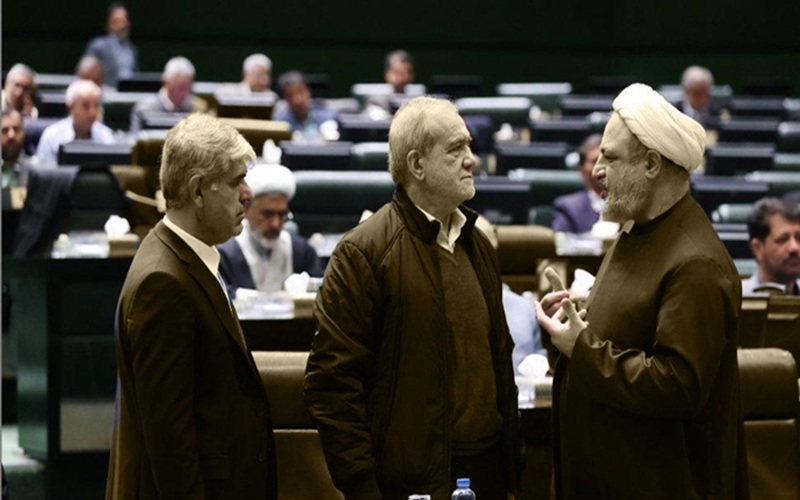

Conflicting statements from senior regime figures expose growing panic, strategic paralysis, and internal fractures as Tehran confronts mounting fears of social uprising and political collapse.
The Iranian regime’s internal fractures are widening at an unprecedented pace as competing factions openly clash over how to confront escalating domestic and international crises. Beneath the usual displays of unity and propaganda, a deeper reality is emerging: the regime is trapped in a strategic deadlock driven by fear of social explosion, economic collapse, and the growing prospect of regime overthrow.
Recent statements by senior regime officials reveal not merely political disagreement, but a profound crisis at the core of the system itself.
Fear of Social Explosion
Masoud Pezeshkian, the regime’s president has increasingly framed the regime’s greatest threat not as foreign military pressure, but as internal disintegration and popular unrest.
Speaking on Monday, May 18, 2026, during an event titled “Narrators of Iran,” Pezeshkian acknowledged the severity of the regime’s crises and warned against presenting a false image of stability.
“The country — meaning the system — is facing real problems, and we should not present an unrealistic picture of conditions,” he admitted. “We must honestly share realities with the people and avoid exaggerated analyses.”
More significantly, Pezeshkian warned that internal fragmentation could become the catalyst for collapse. In remarks that reflected deep anxiety about the possibility of nationwide uprising, he stated:
“They cannot conquer a country with missiles, bombs, and airplanes. But they can do it through division, fragmentation, and conflict. They do not even need to send missiles or aircraft; they can destroy a society from within. We must prevent this unity and cohesion from breaking.”
His comments amounted to an implicit acknowledgment that the regime fears internal rebellion far more than external confrontation. By redefining security in social and political terms, Pezeshkian appears to be urging the ruling establishment to avoid intensifying factional warfare at a moment when public anger continues to grow across Iran.
Escalation and Hollow Threats
But rival factions within the regime interpret such warnings as weakness and retreat.
Mohammad Javad Larijani sharply attacked Pezeshkian’s approach, accusing the government of hesitation and passivity in the face of foreign pressure.
“I am sorry that in the government apparatus, only the first vice president speaks clearly about the Strait of Hormuz,” Larijani declared. “We have not heard even a single word from the honorable president himself. Our Foreign Ministry also speaks with hesitation and reluctance when it comes to this issue.”
Larijani went further by calling for the suspension of Iran’s operational commitments under the Treaty on the Non-Proliferation of Nuclear Weapons (NPT), arguing that continued adherence would be a strategic mistake.
“We must immediately suspend our operational commitments under the NPT. Continuing this situation is wrong,” he said.
These remarks reflect the outlook of hardline factions that believe greater confrontation, nuclear escalation, and aggressive regional posturing are necessary to preserve the regime’s authority — even at the cost of deeper isolation and instability.
The Logic of Regional Hostage-Taking
The regime’s increasingly militarized rhetoric was further amplified by Manouchehr Mottaki, who openly described a doctrine of regional escalation and hostage-taking in the event of conflict with the United States.
“If the Americans start a third war, with their very first shot we must immediately begin a ground war,” Mottaki said. “Our fighters should move to seize American bases in the region, capture prisoners, and confiscate their military assets and equipment.”
Such statements reveal how segments of the ruling establishment are moving beyond conventional diplomacy toward increasingly radical military scenarios. The rhetoric also underscores the regime’s reliance on coercion and external confrontation as tools for preserving internal cohesion.
Yet this strategy carries enormous risks. The more the regime escalates externally, the more it intensifies domestic tensions inside a society already burdened by economic collapse, repression, corruption, and widespread disillusionment.
A Regime Trapped Between Retreat and Escalation
Taken together, these competing positions reveal a regime struggling to contain its own contradictions.
One faction fears that further confrontation could trigger nationwide revolt and accelerate the system’s collapse. Another insists that only greater aggression and defiance can preserve the regime’s survival. This is no longer a routine political disagreement; it is an existential conflict over the future of the Islamic Republic itself.
The regime now faces a dilemma from which it appears unable to escape:
Either retreat and negotiate — a path many hardliners interpret as surrender — or continue escalating confrontation at the risk of provoking deeper internal unrest and social radicalization.
But both paths point toward the same outcome.
Whether through forced concessions, mounting internal fragmentation, or intensified militarism, the regime increasingly appears trapped in an irreversible crisis. Politically isolated, economically weakened, socially fractured, and internationally cornered, Tehran faces a convergence of pressures that no amount of propaganda or factional maneuvering can conceal.
As fear of uprising grows within the ruling establishment itself, the struggle between competing factions is becoming less about governance and more about managing the conditions of a system confronting its own decline.