


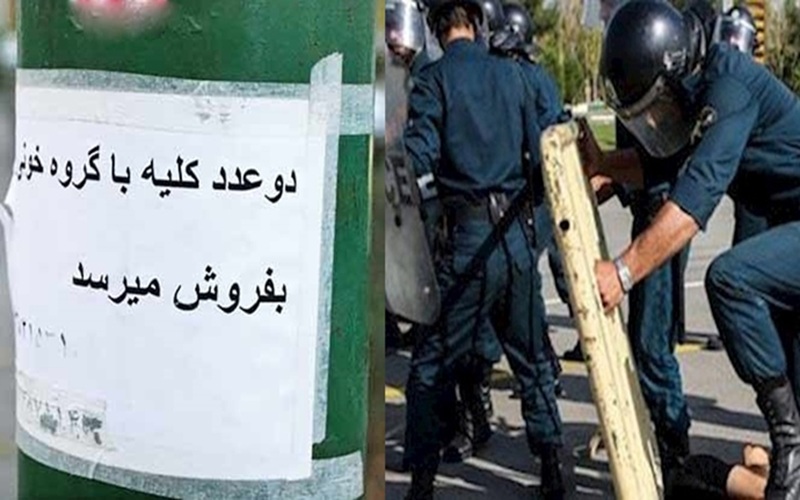

As speculation grows over possible negotiations and political agreements, ordinary people in Iran continue to face the same unresolved realities: repression and economic collapse.
Political developments in Iran may shift in any direction. The trajectory of war, negotiations, or possible agreements may change from week to week. Analysts and commentators may offer endless forecasts about diplomacy, regional tensions, or internal power struggles. Yet for ordinary people in Iran, the outcome of all these political calculations ultimately comes down to only two fundamental questions: What will happen to freedom? And what will happen to the economy and people’s livelihoods?
These two demands remain the central concerns of Iranian society. At the same time, they represent two of the regime’s deepest vulnerabilities and most persistent crises. This is precisely why, over the past three months — including the 40 days consumed by war — the Iranian regime’s priorities have focused on two parallel objectives: intensifying repression at home while using the shadow of war to obscure the country’s chronic economic collapse.
Now, reports and political analyses increasingly point toward the possibility of negotiations or new agreements. Such developments may temporarily dominate headlines and create political noise inside Iran. They may even serve as a short-term distraction from the country’s unresolved crises of freedom and economic devastation. But beneath the diplomatic spectacle, the same harsh realities remain untouched.
No political theater can erase the structural crises that define daily life in Iran.
The issue of freedom will ultimately be settled through future uprisings and the inevitable confrontation between Iranian society and the ruling establishment. But the economic crisis is even more immediate and relentless. Unlike political narratives that can temporarily shift public attention, economic collapse continuously imposes itself on people’s daily lives. Inflation, unemployment, poverty, and declining purchasing power cannot be hidden indefinitely behind negotiations or military tensions.
Iran’s current economic conditions are not accidental. They are the direct consequence of decades of systemic mismanagement, ideological governance, corruption, and the regime’s prioritization of political survival over national welfare.
Even state-affiliated economists and media outlets have acknowledged the severity of the crisis. Inflation in recent years has consistently fluctuated between 40 and 45 percent. In practical terms, this means that the purchasing power of ordinary citizens is effectively cut in half year after year. Youth unemployment has climbed above 20 percent, while countless university graduates remain unable to find work corresponding to their education and qualifications.
The situation facing working families in Iran has become even more catastrophic in 1405 (2026). Basic food prices now reveal the depth of social collapse more clearly than any economic report. A tray of eggs costs nearly 490,000 tomans. Organic chicken is reportedly sold at one million tomans per kilogram, while even chicken gizzards — once considered among the cheapest food items — have reached 400,000 tomans per kilogram.
For many families, a single chicken for one meal now costs more than a father’s daily wage.
Meanwhile, estimates for the minimum monthly living costs of a working-class family have risen dramatically. What was previously estimated at 45 million tomans has now reportedly reached nearly 70 million tomans. In Tehran alone, simple food expenses for a three-person working-class household may exceed 40 million tomans per month.
These are not temporary disruptions caused solely by war or sanctions. They are symptoms of a structurally broken economic system.
The central question therefore remains: what policy or program can realistically stop this accelerating collapse?
The answer is found in the regime’s own history. The Islamic Republic has repeatedly demonstrated that meaningful economic reform would require a strategic transformation of the system itself — a transformation that directly threatens the foundations of clerical rule. For the ruling establishment, genuine structural reform would amount to political self-destruction.
Even after the devastation caused by economic decline and the recent 40-day war, experts within the regime continue to acknowledge the same underlying problem: ideological priorities consistently take precedence over the people’s economic well-being.
One state-run newspaper recently admitted that the regime’s first priority remains political and ideological orientation, while officials continue to prioritize those ideological commitments over solving people’s livelihood problems.
Yet when these same outlets propose solutions, they inevitably return to vague calls for “reforming inefficient and anti-development structures.” But what does structural reform actually mean inside a political system built entirely around the absolute authority of the Supreme Leader?
Can genuine reform occur without dismantling the very foundations of Velayat-e Faqih and the ruling clerical oligarchy?
This is the contradiction at the center of Iran’s crisis. The system cannot solve the economic catastrophe without changing its core structure, yet changing that structure would fundamentally threaten the regime’s survival.
That is why, regardless of whether negotiations succeed or fail, regardless of whether tensions escalate or temporarily subside, the two defining questions of Iran’s future remain unchanged: freedom and the economy.
And neither can be resolved within the framework that created the crisis itself.