
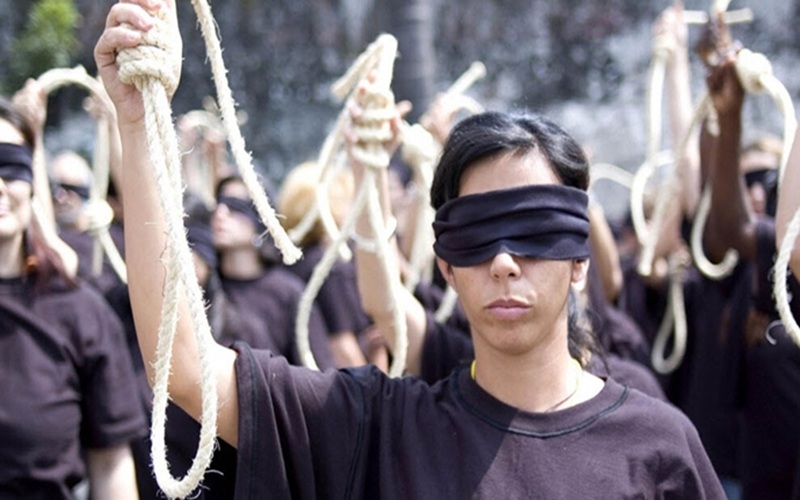

As executions continue across Iran, growing concerns are emerging over the regime’s attempt to normalize the death penalty and desensitize society to state violence.
The escalating wave of executions in Iran is raising concerns not only about the lives being taken, but also about the regime’s broader effort to make executions appear routine and inevitable.
A social media user recently shared a video message warning Iranians against allowing what could be an even greater tragedy than the executions themselves: the normalization of death as a tool of government.
“The danger is not only execution,” the message explains. “More dangerous is that the clerical regime wants to repeat executions and their daily news coverage until executions become psychologically normalized in society, causing people to become indifferent to the news.”
The warning highlights a critical dimension of the regime’s repression. By repeatedly exposing the public to reports of executions, authorities may hope that outrage will eventually give way to exhaustion and indifference.
The Language of Death
Yet reactions on social media indicate that this strategy has not gone uncontested.
Last week, another user shared a poem reflecting on the transformation of ordinary objects into instruments of death:
“No tree ever dreamed of becoming a gallows,
and the purpose of a rope
was to reach hands, not throats…
Who first translated
the innocence of a tree
and the kindness of a rope
into the language of death?”
The poem illustrates how executions have entered Iran’s cultural and social consciousness. Rather than disappearing into the daily news cycle, the imagery of the gallows, rope, prison and execution continues to generate reflection and resistance.
The Gallows as an Admission of Failure
Another social media user cited a passage from Arthur Koestler’s Reflections on the Gallows, describing the death penalty as an admission of political failure:
“Every time a gallows is erected, the power structure admits that it is incapable of understanding, calculating, and solving the problems of society.”
The observation offers a different perspective on the regime’s reliance on executions. The gallows can be viewed not as a demonstration of strength, but as evidence of a government unable or unwilling to address the underlying crises confronting society.
Instead of resolving economic hardship, social discontent and political grievances, the regime resorts to imprisonment, executions and intimidation.
Every Execution Adds to Social Anger
The regime’s strategy is clearly intended to spread fear and discourage resistance. Yet repeated executions do not necessarily produce the passive society the authorities seek.
For many Iranians, each execution becomes another addition to a growing collective memory of repression. Names, photographs, family testimonies, reports and social media posts prevent victims from simply disappearing from public consciousness.
In this sense, words such as execution, prison, poverty and deprivation have become deeply interconnected in the public perception of the regime’s rule. Each reflects a different dimension of a broader crisis affecting millions of Iranians.
The regime may seek to use executions to intimidate society into silence, but every execution can also deepen resentment and reinforce the perception that the ruling structure has no solution to the crises it has helped create.
Breaking the Cycle of Normalization
The central challenge, therefore, is not only opposing individual executions but preventing the normalization of state violence.
Keeping public attention focused on executions, preserving the memory of their victims, amplifying the voices of their families and documenting repression are ways to counter the regime’s attempt to turn extraordinary violence into an ordinary part of daily life.
Executions, poverty and economic hardship have become interconnected sources of suffering for millions of Iranians. The regime’s effort to suppress the resulting anger through fear may ultimately deepen the very grievances it seeks to contain.
The struggle over executions is therefore also a struggle over whether fear or human dignity will define Iran’s future. Preventing indifference to state violence remains essential to preserving society’s capacity to resist repression and demand fundamental change.