


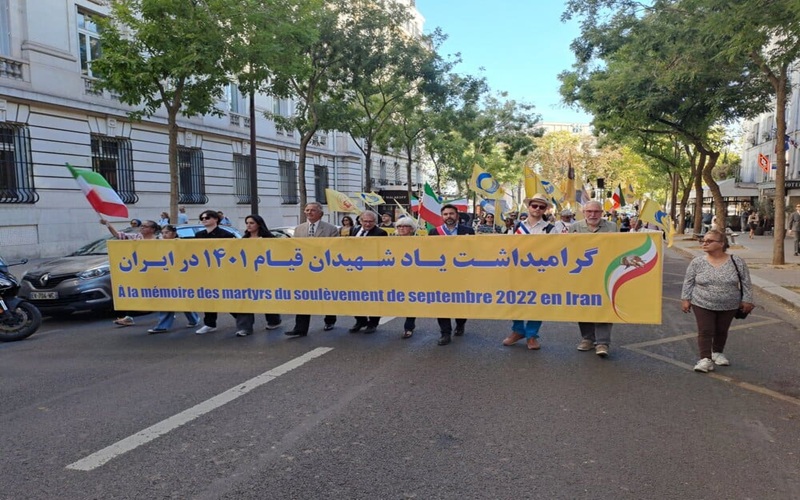

Speakers at a September 12 demonstration in Paris denounced executions and repression in Iran, highlighted the courage of resistance activists and women, and called for international support for the Iranian people’s struggle for freedom.
A demonstration by supporters of the Iranian Resistance in Paris on Saturday, September 12, brought together French political figures, human-rights advocates, representatives of the Syrian-French community, and activists in solidarity with the Iranian people. Speakers focused on the continuing repression in Iran, the growing role of organized resistance inside the country, the persecution of women and political prisoners, and the urgent need to stop executions.
A central message of the rally was that the Iranian people continue to resist despite the severe risks imposed by the regime.
Courage Inside Iran Is Challenging the Regime’s Repression
Parnian Saramad highlighted recent acts of defiance in Karaj, near Tehran, where motorcyclists reportedly raised the flags of the People’s Mojahedin Organization of Iran (PMOI/MEK). She described the act as a significant expression of courage given the potentially lethal consequences of displaying symbols associated with the organized opposition.
She also pointed to the election of Mahnaz Maimant as the PMOI’s Secretary-General following three rounds of voting in several European countries, presenting the development as another indication of the organization’s determination to continue its struggle against Iran’s ruling theocracy.
Jean-Pierre Brard, former mayor of Montreuil and president of the French Committee for a Democratic Iran, emphasized the persistence of people inside Iran who continue to challenge the regime despite arrests, torture, and the threat of execution.
He stressed the importance of the Resistance Units operating inside Iran, arguing that their activities demonstrate that opposition to the regime is not confined to demonstrations abroad. According to Brard, activists who distribute leaflets, burn images of regime officials, or carry out other acts of resistance do so with full knowledge of the dangers they face.
He also drew attention to imprisoned women and young people who continue to encourage resistance from behind prison walls and in the face of execution. Their refusal to retreat, he argued, represents an extraordinary example of courage.
Women Remain Central to Iran’s Struggle for Freedom
Several speakers focused on the role of Iranian women.
Pegah Jahanmiri recalled the 2022–23 nationwide uprising and emphasized the prominent participation of women at the forefront of the protests. She presented their role as evidence of the determination of Iranian women to challenge the regime and its system of repression.
She also stressed the rejection of both monarchical and theocratic dictatorship, referring to the slogan “Death to the oppressor, whether Shah or leader” as an expression of opposition to all forms of dictatorship.
Sara Nouri likewise described misogyny in Iran as a deeply institutionalized system that has persisted for decades. Yet, she noted, Iranian women have continued their struggle in the streets, universities, and prisons.
Nouri argued that genuine democracy cannot be achieved without full and unconditional equality and respect for women’s rights. She presented the slogan “Women, Resistance, Freedom” as reflecting the central role of women in Iran’s democratic transformation.
Calls for International Action Against Executions
The issue of executions was another dominant theme at the Paris gathering.
Alexis Martin, deputy mayor of Nantes, called for an immediate halt to executions in Iran and urged the French government to exert meaningful pressure on the Iranian regime. He stressed that people facing execution include protesters, students, and young Iranians seeking the right to live freely and determine their own future.
Martin’s message was echoed by other speakers who called on the international community to reject silence in the face of executions and political repression.
Mohsen Pouyanmehr paid tribute to political prisoners who continue to send messages of resistance from Iranian prisons. He argued that the international community should end its caution and silence and stand openly with the Iranian people and their organized resistance.
International Support for a Democratic Alternative
Jean-François Legaret, former mayor of Paris’s first arrondissement and president of the Middle East Studies Foundation, said Iran has become an increasingly important international issue, extending from regional security to energy supplies.
He argued that decades of repression have demonstrated the failure of Iran’s theocratic system to resolve the country’s fundamental crisis. In his view, a lasting transformation requires the overthrow of the ruling theocracy.
Legaret identified the National Council of Resistance of Iran (NCRI), its Ten-Point Plan for a free Iran, and the PMOI’s Resistance Units as components of an organized political alternative to the current regime.
Human-rights advocate Pierre Bercis emphasized another dimension of the international campaign: legal and human-rights efforts. He referred to recent legal developments involving the PMOI and highlighted the importance of continuing the struggle through judicial and institutional channels while honoring those who have been killed by the Iranian regime.
“The Only Way Out of the Cycle of Terror Is Not to Be Afraid”
Najib Ben Arfa, a councillor from France’s Hauts-de-Seine department, focused on the regime’s reliance on fear. He argued that a government willing to order its security forces to shoot its own people ultimately condemns itself through its own actions.
He portrayed the Islamic Revolutionary Guard Corps (IRGC) as determined to preserve its power regardless of the cost to Iran and said that the regime uses fear, arrests, torture, and killings to suppress a population that has grown increasingly defiant.
Yet, he argued, Iranian women and men have demonstrated that fear can be overcome. Their willingness to confront imprisonment, torture, and death has become a source of inspiration beyond Iran’s borders.
Laurence Tubiana, president of the French Climate Foundation, expressed solidarity with the Iranian struggle and condemned what she described as the international silence surrounding it. She stressed the persistence and courage of those who have continued their struggle for years without surrendering.
Solidarity From the Syrian-French Community
Ali Al-Zarqan, president of the Syrian-French Council, also expressed solidarity with the Iranian Resistance. Speaking on behalf of the Syrian-French community and what he described as the children of the Syrian revolution, he linked the struggles of the Iranian and Syrian peoples against systems that disregard human life and turn justice into executions.
His message extended solidarity from Paris to Tehran and through Syrian cities including Damascus, Aleppo, and Deir ez-Zor, presenting opposition to executions and political repression as a shared human-rights cause.
Across the speeches, one message stood out: repression and executions have not extinguished resistance inside Iran. Instead, speakers portrayed the courage of protesters, women, political prisoners, and Resistance Units as evidence of a continuing struggle for political change.
The Paris gathering therefore served not only as a protest against executions but also as an appeal to the international community to recognize the Iranian people’s resistance and support their aspiration for a free and democratic future.