



Resistance Units carried the prisoners’ “No to Executions Tuesdays” campaign into cities across Iran, demanding an end to executions and calling for the overthrow of the clerical regime.
As prisoners across Iran continue their weekly “No to Executions Tuesdays” campaign against the death penalty, Resistance Units took the campaign’s message into streets and public spaces across the country, demonstrating solidarity with prisoners facing execution and calling for the abolition of the death penalty.
On September 22, 2026 (31 Shahrivar 1405), young Resistance Units carried out field activities, installed leaflets, and staged photo actions in Tehran, Karaj, Gorgan, Tabriz, Mashhad, Isfahan, Shiraz, Rasht, Ahvaz, Abadan, Bojnurd, Yazd, Kerman, Khorramabad, Parand, and Varamin.
Their messages directly echoed the demands of prisoners participating in the nationwide campaign: abolish executions and overthrow the clerical regime responsible for systematic repression.
Bringing prisoners’ voices into the streets
The Resistance Units’ actions provided a visible expression of solidarity with prisoners who have continued the No to Executions Tuesdays campaign despite the regime’s security pressure.
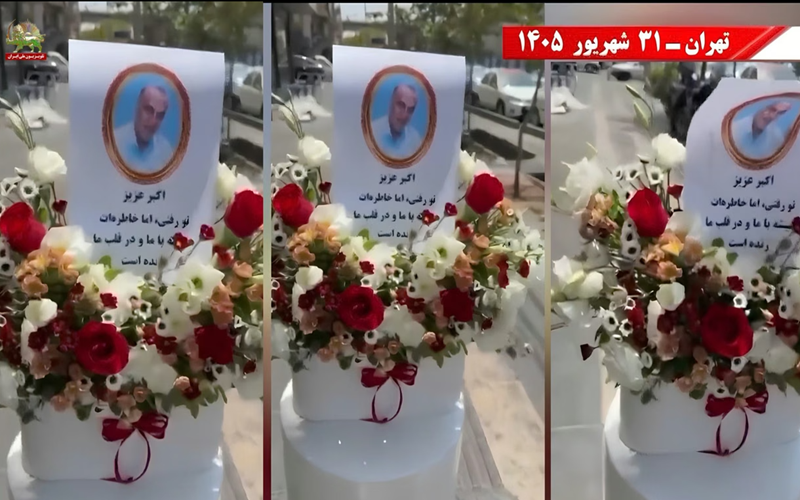
In Tehran, activists installed leaflets calling for the abolition of death sentences for political prisoners and innocent prisoners. One action also honored Akbar Daneshvar Kar, a executed PMOI member, with a floral tribute bearing a message that his memory remains alive among those continuing the struggle.
The activities connected the campaign against executions with the broader struggle against political repression. For the Resistance Units, opposition to the death penalty is not an isolated humanitarian demand but part of a wider confrontation with a regime that uses executions as an instrument of fear and repression.
Spotlight on prisoners facing execution
Several actions specifically highlighted prisoners whose death sentences have become symbols of the campaign.
In Karaj, Resistance Units called for the abolition of the death sentence imposed on Zahra Tabari, describing the sentence as unjust.
In Tabriz, activists installed leaflets demanding the abolition of death sentences for innocent prisoners.
In Mashhad, a leaflet called for the immediate cancellation of the death sentence against national boxing champion Mohammad Javad Vafaei Sani, whose case has drawn sustained attention from the Iranian Resistance and human-rights campaigners.
In Isfahan, activists again displayed the central message of the campaign: No to executions.
These actions transformed individual cases into a broader public demand against the regime’s use of capital punishment.
A nationwide message against executions
The geographical spread of the activities—from Tehran and Karaj to Tabriz, Mashhad, Isfahan, Shiraz, Rasht, Ahvaz, Abadan, Yazd, Kerman, Khorramabad, and other cities—underscored the nationwide character of the campaign.
The Resistance Units’ actions also demonstrated how the prisoners’ weekly campaign is being echoed beyond prison walls. While prisoners use collective hunger strikes and other forms of resistance inside Iran’s prisons, activists outside the prisons are carrying their message into the streets.
The message is uncompromising: the death penalty must be abolished, political prisoners must be protected, and the regime’s machinery of repression must be confronted.
For the Resistance Units, supporting the No to Executions Tuesdays campaign is therefore part of the broader struggle for a free Iran. Their activities seek to ensure that the voices of prisoners facing execution are not silenced behind prison walls—and that the regime cannot carry out executions in silence.