


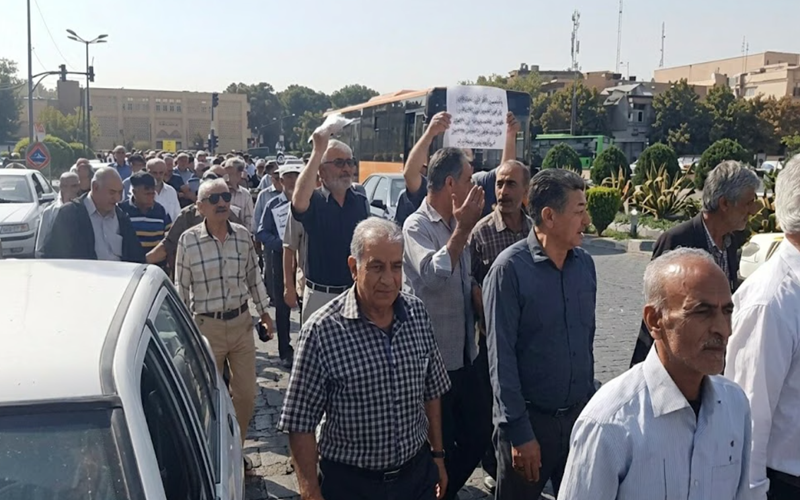

With poverty reportedly reaching 40 percent and some 34 million people facing extreme poverty, Iran’s deepening livelihood crisis exposes the limits of temporary relief and raises fundamental questions about the distribution of national wealth, public accountability, and economic security.
Poverty in Iran: A Crisis Beyond Inflation and Sanctions
Poverty in Iran has become more than a question of household income. It reflects a deeper crisis in the relationship between political power, national resources, and the living conditions of ordinary citizens.
Figures cited in recent reporting point to a sharp deterioration in living standards. According to figures attributed to the head of Iran’s State Welfare Organization, the poverty rate rose from approximately 20 percent before 2018 to 40 percent in 2024. The same reporting estimates that around 34 million people are living in extreme poverty. These figures do not capture every dimension of deprivation, but they indicate the scale of the pressure on Iranian households.
External sanctions, restrictions on trade, and military tensions have imposed substantial costs on Iran’s economy. Reduced access to investment, difficulties in conducting financial transactions, and higher import costs have constrained businesses and employment. War and uncertainty have added further obstacles to investment and economic stability.
Yet these pressures alone cannot explain the persistence and depth of the crisis.
The fundamental question remains: Why has a country with extensive oil and gas resources failed to provide lasting economic security for so much of its population?
The answer lies partly in the structure of economic and political decision-making, limited transparency, weak public accountability, and priorities that often leave the broader public interest on the margins. When economic policy operates without effective independent oversight, citizens have limited means to assess how national wealth is allocated or hold decision-makers accountable for its consequences.
External shocks can intensify these accumulated weaknesses. Sanctions may deliver an economic blow from outside, but a society’s capacity to withstand that pressure also depends on the quality of its institutions, the distribution of resources, and public trust.
The Middle Class Is Losing Its Economic Security
The spread of poverty is not confined to households that have long lived on low incomes. One of its most significant features is the growing difficulty faced by people who work, receive regular salaries, or depend on pensions to cover ordinary living expenses.
Employees whose wages remain fixed, workers whose earnings fall behind inflation, and retirees with limited savings can all find themselves progressively unable to meet basic needs. For these households, economic insecurity develops gradually as the cost of food, housing, healthcare, and education consumes an increasing share of available income.
Economist and University of Mazandaran professor Zahra Karimi has cited figures indicating that approximately 1.2 million people disappeared from the list of individuals insured through employer-related insurance arrangements between 2024 and 2025. The figure has been presented as an indication of mounting employment pressures. The loss of insured status does not, by itself, establish why a person’s employment or insurance coverage ended, but it raises questions about job stability and access to social protection.
The effects of inflation also fall unevenly across society. Wealthier households are more likely to possess diversified assets, savings, and multiple income sources. Rising asset prices may partly offset their losses in purchasing power. Wage earners and low-income families, by contrast, tend to depend heavily on their current earnings and have fewer options when essential expenses rise.
The result extends beyond a widening income gap. Access to education, healthcare, social mobility, and opportunities to plan for the future becomes increasingly unequal. Children growing up in financially insecure households may face disadvantages that persist into adulthood, turning a period of economic hardship into a longer cycle of intergenerational poverty.
Shrinking Household Consumption Signals a Deeper Failure
One of the clearest indicators of declining living standards is the changing composition of household consumption.
When real incomes fall, families initially cut discretionary spending. As the pressure continues, however, reductions reach essential goods and services, including meat, dairy products, fruit, medical care, and education. At that stage, cutting consumption is no longer simply a budgeting decision. It becomes a forced response to insufficient income.
Children and older people are particularly vulnerable to these changes. Inadequate nutrition, delayed medical treatment, and reduced educational opportunities can have lasting consequences for health and individual development.
A society in which millions must devote an increasing share of their time and resources to basic economic survival also has less room for productivity, innovation, and meaningful social participation. Poverty therefore imposes costs that extend well beyond individual households and affect the country’s long-term economic prospects.
Cash transfers and electronic food vouchers can provide some relief, but they cannot guarantee that households retain their purchasing power. If inflation continues and the cost of essential goods rises faster than the value of assistance, the real benefit of these programs diminishes. Poorly designed eligibility systems can also exclude families in need while directing resources toward households that are less vulnerable.
These are not merely administrative problems. Effective social protection requires reliable information, transparent implementation, and mechanisms through which citizens can challenge decisions and hold public institutions accountable. Without these safeguards, assistance may alleviate some immediate hardship without addressing the conditions that produce it.
Food Insecurity: When Economic Uncertainty Reaches the Household
Food security is not simply a matter of whether a country produces or imports enough wheat, cooking oil, and agricultural products. Essential goods must also move reliably through supply chains, from producers and importers to processing facilities, distributors, retailers, and consumers.
Disruptions to transportation, shortages of production inputs, financing difficulties, and rising operating costs can interfere with this process. War and trade restrictions can intensify these vulnerabilities, particularly when businesses struggle to secure supplies or absorb additional expenses.
Low-income families are the least equipped to withstand such disruptions. A household that already spends most of its income on food has little financial room to absorb another increase in prices. Wealthier families have more options, including drawing on savings or adjusting their purchasing patterns without sacrificing basic nutrition.
Food insecurity must therefore be understood as part of the wider crisis of economic security. Reliable access to essential goods depends not only on domestic production and imports but also on functioning distribution networks, economic stability, and institutions capable of responding effectively to shortages.
Incomplete public information can compound the problem. When people cannot obtain timely and reliable information about supply conditions and government responses, uncertainty grows, creating fertile ground for rumors and panic buying.
Why Temporary Relief Cannot Resolve Structural Poverty
Iran’s experience demonstrates the limits of relying on short-term compensation while inflation, employment insecurity, and declining purchasing power continue to reinforce one another.
Financial assistance can help households meet immediate needs, but it cannot substitute for stable employment, affordable essential goods, dependable public services, and wages that sustain a decent standard of living. When these foundations remain weak, relief measures risk treating the consequences of economic insecurity without changing its underlying causes.
The central issue is how national resources are managed and whether economic decision-making serves the public interest.
A more accountable economic system requires transparent public budgets, independent oversight of state resources, access to reliable information, equal protection under the law, and meaningful opportunities for citizens to participate in decisions affecting their livelihoods. Independent media and institutions capable of scrutinizing government policy are also essential to identifying failures and preventing the misuse of public resources.
These principles raise fundamental questions about Iran’s political structure, where concentrated power limits the public’s ability to influence major decisions and scrutinize how national wealth is used.
From a democratic political-economy perspective, replacing authoritarian rule with a democratic, secular system grounded in human rights would create a framework for rebuilding the relationship between the state and society. Political change alone, however, would not automatically eliminate poverty. Lasting improvements would also require accountable institutions, effective social protection, sound economic management, and policies that distribute opportunities and resources more equitably.
The objective must be an economy in which the country’s natural wealth contributes to the well-being of its population rather than reinforcing political privilege.
Iran’s Natural Wealth Must Serve Its People
Poverty in Iran is visible not only in shrinking household budgets but also in the opportunities that children lose, the futures young people struggle to plan, and the economic security that wage earners and retirees increasingly find beyond their reach.
The reported scale of poverty underscores the gap between Iran’s substantial natural resources and the economic security experienced by millions of its citizens. Sanctions, inflation, and regional instability have added significant pressure, but addressing these challenges also requires examining domestic institutions, economic priorities, and the distribution of national wealth.
As long as public decision-making remains insufficiently accountable and the public interest is not central to economic policy, the country’s oil and gas resources alone cannot guarantee widespread prosperity.
Rebuilding Iran’s economy therefore involves more than stabilizing prices or expanding temporary assistance. It requires restoring the connection between national wealth and public welfare through transparency, accountability, equal rights, and meaningful public participation.
Ultimately, economic security should not be a privilege available only to those with assets or political connections. It should be a foundation of dignified life for every citizen.