


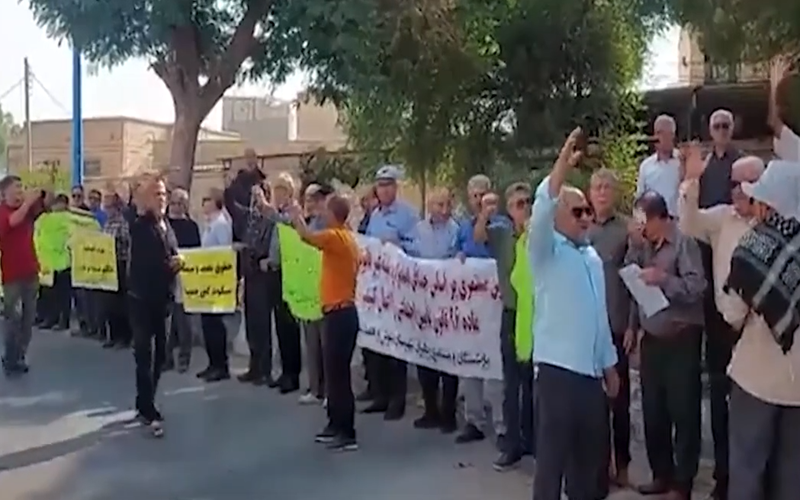

From Rasht and Ahvaz to Tehran, Kermanshah, Isfahan, and Shush, retired workers and pensioners denounce soaring prices, inadequate pensions, corruption, and the imprisonment of workers, teachers, and political dissenters.
Years of Work, Yet No Security in Retirement
Iranian retirees are once again taking to the streets to demand their basic rights, denouncing a system in which decades of work have failed to secure even a dignified retirement. On October 18, 2026, pensioners from the Social Security Organization, as well as retired steel and mining workers, staged protests in several cities, linking their economic grievances to broader opposition to repression, executions, and corruption.
From Rasht and Ahvaz to Kermanshah, Tehran, Isfahan, and Shush, protesters voiced a common message: pensions no longer provide a secure livelihood amid relentless inflation, rising living costs, and deteriorating access to healthcare. Their slogans also made clear that they see their hardship as part of a wider political and economic crisis, rather than an isolated problem affecting retirees.
People who spent their working lives serving the country now find themselves compelled to demonstrate in the streets to obtain rights they regard as fundamental. Their protests reflect mounting frustration over the gap between the promises of economic security and the daily reality of poverty.
One recurring slogan captured their determination: “Our rights can only be won in the streets.”
Poverty and Inflation Leave Retirees Struggling to Survive
Economic hardship was at the center of the October 18 demonstrations. In Kermanshah, pensioners denounced poverty, rising prices, and the failure of government policies to protect their living standards.
“Poverty and oppression are rampant; they drove us into the streets,” protesters declared.
Other slogans directly challenged the regime’s handling of the economy. “Where is the oil-dollar revenue? We get the inflation,” pensioners chanted, questioning how a country with substantial oil resources could leave retired workers struggling to meet basic expenses.
Another slogan drew a sharp contrast between privileged families and ordinary pensioners: “The officials’ children have their safes; retirees are suffering.”
The protesters also rejected explanations that attribute their hardship solely to external pressures. In Kermanshah, they declared: “War and sanctions are the excuse; our lives are the target.”
Their message was that economic mismanagement, corruption, and political priorities have placed the burden of the crisis on ordinary people. Rising prices affect food, housing, transportation, and medical treatment, while fixed retirement incomes leave pensioners with little ability to absorb further increases.
Healthcare was another major concern. Protesters described medical care for retirees as a widespread disaster, underscoring the difficulties facing older people who need regular treatment but cannot afford its rising costs.
In Ahvaz, pensioners summed up their circumstances with the slogan: “The retiree’s table is emptier than ever.”
“No to Executions”: Pensioners Challenge Political Repression
The demonstrations extended beyond economic demands, with pensioners in Rasht and Ahvaz explicitly opposing executions.
In Rasht, Social Security retirees chanted:
“Swearing by the blood of our comrades, we will stand until the death sentences are abolished.”
They also called for solidarity and an end to injustice, connecting their campaign for economic rights with the broader struggle against repression.
In Ahvaz, protesters repeatedly chanted “No to executions,” placing opposition to capital punishment alongside their demand for fair pensions.
These slogans are significant because they show that the protesters are not limiting their demands to adjustments in pension payments or government spending. Their demonstrations also express opposition to the use of executions as an instrument of state repression.
By bringing the issue into pensioners’ rallies, the protesters are asserting that social justice cannot be separated from human rights and the protection of life. Their position challenges the notion that economic grievances should be addressed independently of the wider political environment.
Calls for the Release of Workers, Teachers, and Prisoners
In Kermanshah, pensioners called for the release of imprisoned protesters and members of different social groups.
“Release the imprisoned protesters,” they chanted, followed by demands to free imprisoned workers and teachers.
The slogans presented solidarity across occupational and social boundaries as an essential part of the struggle for justice. Retirees, workers, and teachers face different immediate problems, but protesters portrayed their demands as connected by a common opposition to repression and economic injustice.
The message was reinforced in Shush, where pensioners described the streets as “the stronghold of the toilers” and urged retirees to speak out for their rights.
These calls also highlight the political dimension of the demonstrations. The protesters are demanding not only better material conditions but also the release of people imprisoned for their activism and the right to organize and express dissent without intimidation.
From Tehran to Isfahan, Pensioners Demand Unity
Solidarity was another defining theme of the October 18 protests.
In Tehran, Social Security pensioners called for unity among different pension systems, chanting: “Armed Forces, civil servants, Social Security—unity, unity.”
The slogan sought to bridge divisions among retired employees and workers whose pension arrangements differ but who face similar pressures from inflation and declining purchasing power.
In Isfahan, retired steel and mining workers demanded that authorities address their grievances, repeatedly calling on their fellow workers to raise their voices.
“Steelworker, shout out; demand your rights,” they chanted.
Another slogan directly challenged the regime’s political messaging: “Our enemy is right here; they lie when they say it is America.”
The message rejected attempts to divert attention from domestic problems by focusing on foreign adversaries. Protesters instead directed responsibility toward the authorities and their handling of the economy.
In Shush, pensioners echoed the same demand for collective action, declaring that their rights could only be won through continued demonstrations.
Across these cities, the emphasis on unity reflected a broader recognition that isolated complaints have limited leverage when confronting entrenched economic and political problems.
Corruption and Government Accountability Under Fire
The protesters also targeted corruption and the conduct of state institutions.
In Tehran, pensioners chanted: “High prices, embezzlement—this is your economy.”
In Kermanshah, they demanded accountability from parliament and the government, declaring: “Enough betrayal.”
These slogans reflected anger over the contrast between the hardships experienced by ordinary citizens and the privileges enjoyed by politically connected groups. They also challenged the government’s responsibility for the worsening economic conditions.
For retirees, the issue is immediate: after years of employment and contributions, they expect pensions that cover basic necessities. When payments fail to keep pace with inflation and healthcare becomes increasingly unaffordable, the promise of retirement security loses credibility.
The protests therefore represent more than demands for higher payments. They challenge the economic priorities of a system in which, according to the protesters, public resources and political privilege take precedence over the needs of ordinary people.
The Streets Become a Platform for Wider Dissent
The October 18 demonstrations show how pensioners’ protests have developed into a platform for a range of social and political demands. Calls for adequate pensions and affordable healthcare appeared alongside opposition to executions, demands for the release of prisoners, denunciations of corruption, and appeals for solidarity among workers and other social groups.
The repeated slogan “Our rights can only be won in the streets” expresses the protesters’ conviction that official channels have failed to deliver meaningful change.
For people who have already completed decades of work, continued demonstrations carry a particular significance. Retirement should mark the beginning of a period of security and rest. Instead, many pensioners say they must keep fighting for the income, healthcare, and dignity they earned through their working lives.
Their message is increasingly direct: economic hardship cannot be separated from accountability, political repression, and the distribution of power and resources in Iran.
The protests in Rasht, Ahvaz, Kermanshah, Isfahan, Tehran, and Shush demonstrate the breadth of these grievances. Whether demanding an end to executions, the release of imprisoned workers and teachers, or relief from inflation, pensioners are using the streets to insist that their rights cannot be ignored.
After a lifetime of work, they are demanding more than survival. They are demanding dignity, justice, and the right to live without fear of poverty.