


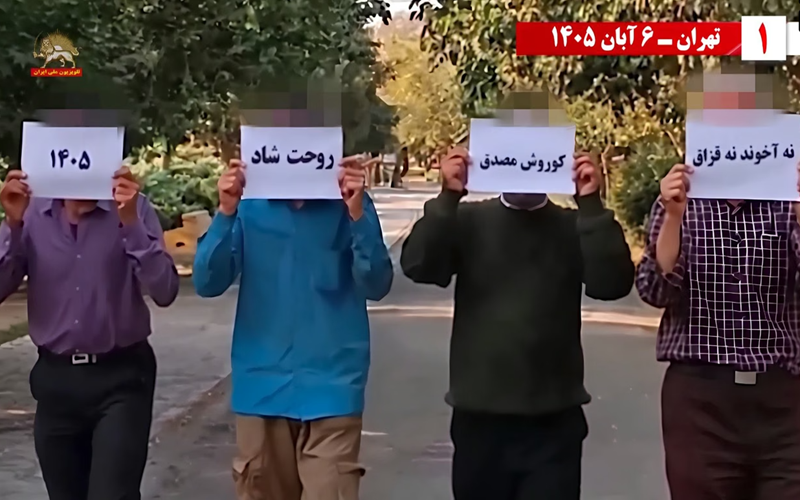

Coordinated activities across 17 Iranian cities highlight the demand for an end to religious and monarchical dictatorship, invoking Cyrus the Great, Mohammad Mossadegh, and a democratic republic based on Maryam Rajavi’s Ten-Point Plan.
Resistance Units Deliver a “No Shah, No Mullahs” Message Across Iran
Iranian Resistance Units have reported 60 activities across 17 cities and localities to mark October 29, known as Cyrus Day, with a clear political message: neither the ruling religious dictatorship nor a return to the monarchy represents Iran’s democratic future.
Under the slogans “Neither Mullah nor Cossack—Down with Dictatorship” and “Death to the Oppressor, Be It Shah or Supreme Leader,” the activities included street actions, posters, banners, handwritten messages, and photographic displays. The reported locations included Tehran, Shiraz, Mashhad, Isfahan, Karaj, Shahriar, Ahvaz, Rasht, Kermanshah, Bandar Abbas, Hamedan, Arak, Ilam, Lahijan, Shahin Shahr, Jahrom, and Ramsar.
The activities combined references to Cyrus the Great, associated in Iranian historical memory with just governance, and Mohammad Mossadegh, the nationalist prime minister overthrown in the 1953 coup, with calls for an end to authoritarian rule. Messages repeatedly rejected both the Shah and the mullahs, asserting that Iran’s future must be determined by its people rather than imposed by a hereditary monarch or an unelected religious leadership.
The campaign also promoted the democratic alternative advocated by the National Council of Resistance of Iran (NCRI), including its commitment to a republic and Maryam Rajavi’s Ten-Point Plan.
Cyrus and Mossadegh Invoked Against Dictatorship
In Tehran, Resistance Units staged small group actions and displayed posters featuring Cyrus the Great and Mossadegh. Their slogans linked historical identity with contemporary resistance, declaring: “Cyrus, Mossadegh, we fight, we die, we will take Iran back.”
Other messages included “Death to the oppressor, be it Shah or Supreme Leader” and “Neither Shah nor Mullah.” One slogan proclaimed, “We are the children of Cyrus; we are Resistance Units.”
These messages challenged attempts to frame Iran’s political future as a choice between the current regime and the restoration of the Pahlavi monarchy. Instead, the activities presented opposition to both systems as a defining principle of the struggle for freedom.
In Shiraz, posters featuring Cyrus and Mossadegh were displayed on vehicles, while other actions highlighted the rejection of hereditary rule and religious dictatorship. Messages also invoked the memory of Cyrus as a symbol of justice and freedom, arguing that Iran’s historical heritage should not be used to justify a return to monarchy.
Similar displays were reported in Ramsar and Bandar Abbas, extending the campaign’s historical and political message beyond the capital.
Resistance Units Reject Both the Shah and the Supreme Leader
A central theme across the reported activities was the rejection of all forms of dictatorship, regardless of whether they operate under religious or royal authority.
In Karaj, posters carried messages stating that the era of both religious and monarchical dictatorship had ended. Other displays declared that the ruling clerics, like the Shah, must go and that sovereignty belongs to the Iranian people.
In Shahriar and Lahijan, written messages repeated the slogan “Death to the oppressor, be it Shah or Supreme Leader.” In Ilam, the same message appeared as wall writing. In Arak, another slogan declared: “Neither crown nor turban; mullah, your time is up.”
These messages reflect the Resistance Units’ rejection of the notion that replacing Iran’s current rulers with a monarchist system would, by itself, establish democracy. Their campaign instead emphasizes the need to dismantle authoritarian structures and establish a political system grounded in popular sovereignty.
The activities also sought to challenge the polarization of Iran’s opposition around competing authoritarian alternatives, presenting the demand for a democratic republic as distinct from both the existing theocracy and hereditary monarchy.
Ten-Point Plan Presented as a Democratic Alternative
In Isfahan, Resistance Units conducted group actions featuring slogans against the principle of velayat-e faqih, the system of clerical supreme authority underpinning the current regime. Other messages expressed support for the NCRI and its proposed alternative.
One action linked the Cyrus Day commemoration to the Ten-Point Plan, declaring that Iran’s historical roots should inform its future without determining it through a return to the past. The slogan called for a free Iran based on the plan advanced by Maryam Rajavi.
Other displays emphasized the need to reclaim Iran through organized resistance and presented the establishment of a democratic republic as the objective of the struggle.
In Tehran, Shiraz, and Karaj, posters featuring Maryam Rajavi carried messages asserting that the era of religious and monarchical dictatorship had ended and that sovereignty belonged to the Iranian people.
The Ten-Point Plan advocates a democratic republic, separation of religion and state, gender equality, and the abolition of the death penalty, among other principles. Its inclusion in the reported activities placed the Cyrus Day campaign within the Resistance Units’ broader effort to promote a defined political alternative to the current regime.
Activities Across Iran Signal a Broader Political Message
The reported activities extended across central, western, southern, and northern Iran.
In Hamedan, Resistance Units staged two-person actions and photographic displays using slogans such as “We are the Resistance Units, children of Cyrus” and “A nation that knows its past is not powerless to build its future.” Wall writing in the city declared: “No to the Shah, no to the Mullah.”
In Ahvaz, wall slogans called for reclaiming Iran and repeated the message that dictatorship must be rejected regardless of its form. In Kermanshah, posters featuring Cyrus carried the Resistance Units’ slogan. In Rasht, a display featuring Maryam Rajavi conveyed the message that Iran would be reclaimed and rebuilt.
Activities in Mashhad, Jahrom, and Shahin Shahr likewise repeated the rejection of monarchy and religious dictatorship. In Isfahan, the reported actions also included slogans expressing support for the NCRI and its leadership.
According to the Resistance Units’ account, the 60 activities combined historical symbolism, opposition messaging, and calls for a democratic future. The reported locations and methods illustrate the campaign’s attempt to connect national identity with resistance to the current ruling regime while rejecting monarchist restoration.
A Republic Based on Popular Sovereignty
The significance of the campaign lies in its explicit rejection of both the Shah and the Supreme Leader as models for Iran’s future. By combining references to Cyrus the Great and Mossadegh with the slogan “No Shah, No Mullahs,” the Resistance Units presented national heritage as compatible with democratic change rather than a justification for hereditary rule.
The message also addresses a central question facing Iran’s opposition: whether the end of the current regime would lead to genuine democratic transformation or merely replace one concentration of power with another.
The Resistance Units’ stated answer is a democratic republic in which sovereignty belongs to the people, religious authority is separated from the state, and no individual or institution can claim an inherited or unelected right to rule.
Their October 29 campaign sought to carry that message into public spaces across Iran. Its central demand was unambiguous: the country’s future must be built on freedom and popular sovereignty, not on the restoration of the monarchy or the continuation of religious dictatorship.