


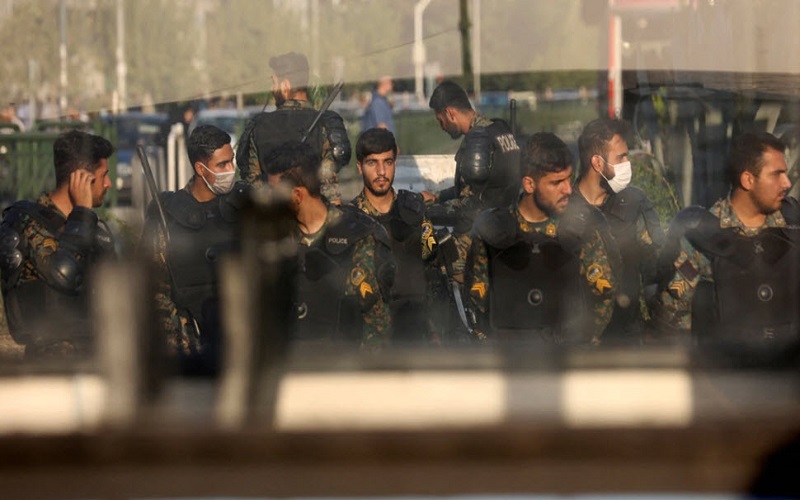

On June 3, 2025, Iran’s state media announced the formation of a “meeting to review the neighborhood-based management model,” describing it as a step toward “reducing inequality, promoting social capital, and increasing society’s resilience to threats.”
At first glance, this may sound like a social welfare initiative. However, the composition of the meeting’s participants reveals a more ominous agenda.
Present at the meeting were Masoud Pezeshkian, the regime’s president; Hossein Salami, Commander-in-Chief of the IRGC; the Minister of Interior; the Minister of Culture and Islamic Guidance; and senior Basij commanders.
This lineup strongly suggests that the plan is less about social services and more about establishing a new security and surveillance infrastructure at the neighborhood level.
In classical governance terms, inequality refers to socio-economic disparities, social capital refers to community trust and participation, and service delivery refers to the government’s duty to meet the population’s needs. But what do the IRGC and Basij—a paramilitary force historically used to suppress dissent—have to do with these concepts?
The answer lies in the regime’s approach to crisis management. Iran’s clerical establishment has long relied on militarization and repression to maintain control. With widespread public dissatisfaction, deepening economic inequality, and recurring waves of protests, the regime appears to be laying the groundwork for even tighter control.
Instead of entrusting government ministries responsible for economic and social affairs—such as the Ministries of Economy, Industry, and Labor—the regime has placed the IRGC and Basij at the center of this initiative.
General Salami’s announcement that 64,000 Basij bases are prepared to support the plan is telling. Far from a community development strategy, the “neighborhood-based management” project is designed to monitor and control citizens under the guise of “service provision.” Salami’s statement was echoed by the head of the Basij, who revealed plans to form 30,000 neighborhood development councils tasked with “identifying needs and capacities.” This language masks the true purpose: comprehensive surveillance of society down to the block level.
Khabar Network TV emphasized this point on June 3, stating: “Neighborhood-oriented management is a new approach to local governance and the consolidation of support measures around the Basij axis. It prevents dispersion.” This is not a social program. It is a militarized network embedded in everyday life—modeled to track, intimidate, and neutralize dissent.
The Iranian people are no strangers to such tactics. Similar programs in the past—under names like “Student Mobilization” and “ideological-political circles” in schools—have left scars on generations. These programs have functioned not as educational or civic efforts, but as tools of indoctrination, control, and repression. Students and their families have suffered harassment, surveillance, arrests, and, in some tragic cases, extrajudicial killings.
The new plan echoes these same mechanisms, but on a broader, society-wide scale. It is designed to transform Iranian cities into tightly monitored zones where any sign of rebellion—especially among the younger generation—is swiftly and ruthlessly suppressed.
At the heart of Iran’s crisis lies two deeply rooted issues: crushing economic inequality and unrelenting political repression. These are the twin engines of public unrest, driving strikes, protests, and civil disobedience across the country. Instead of addressing these grievances, the regime responds with force and intimidation.
Seen in this light, the “neighborhood-based management” plan is not a solution but a symptom of the regime’s fear. It is a desperate attempt to preempt further uprisings by militarizing everyday life and turning neighborhoods into cells of surveillance.
But this strategy may backfire. Just as the enforcement of the so-called “chastity and hijab” law deepened public resentment, this new plan risks inflaming tensions further. The more the regime tightens its grip, the more it alienates the very people it seeks to control.
In the end, the comments made during the June 3 meeting laid bare the regime’s intentions. As reported by state TV, General Salami declared the IRGC’s and Basij’s full readiness to “solve the country’s problems” by integrating into the government’s neighborhood initiative. The head of the Basij boasted of 30,000 neighborhood councils ready to identify “needs”—language that sounds more like targeting dissent than serving communities.
What is unfolding is not governance—it is occupation. And the Iranian people, who have endured decades of similar plans, recognize it for what it is.