

As war rhetoric recedes, economic grievances are again driving Iranians into the streets, exposing a crisis rooted in the regime’s political and economic structure.
Iran’s deepening economic and livelihood crisis has become one of the most urgent challenges facing its people. The moment the atmosphere of war and its accompanying propaganda subsides, different sectors of Iranian society once again take to the streets to demand their rights.
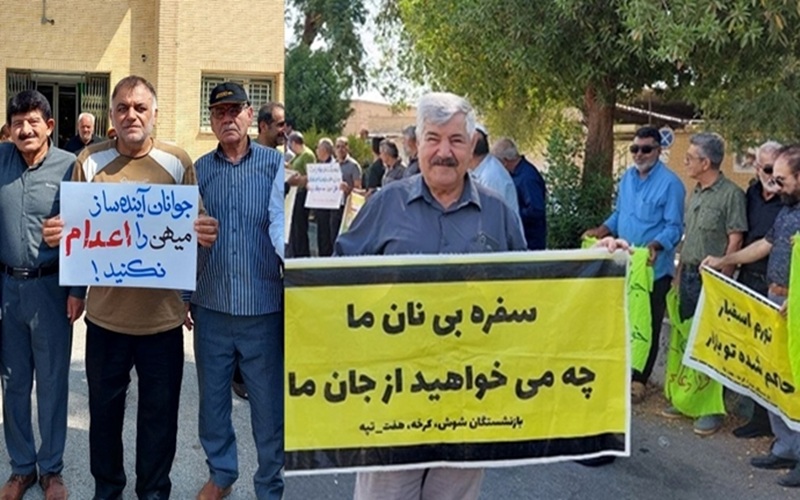
On Sunday, August 9, Social Security retirees demonstrated in nine Iranian cities, voicing grievances over deteriorating living conditions and the failure of the authorities to address their basic needs. Their chants captured the intersection of economic hardship and political repression:
“War and negotiations are excuses—our lives are in ruins.”
“When human beings are being executed, what human rights are you talking about?”
These protests are significant because they demonstrate that the economic crisis has not been erased by war, political theater, or repression. Beneath the surface, the same grievances continue to accumulate.
An economy inseparable from political power
Iran’s economic crisis cannot be understood simply as the result of poor management or temporary external pressures. The country’s economic structure is inseparable from the political system that controls it.
A deeply entrenched system of state intervention, privilege, corruption, and rent-seeking has produced an economy in which the costs are increasingly borne by ordinary people while politically connected networks benefit from preferential access to resources.
The widening class divide is not merely an accidental consequence of economic hardship. It has been reinforced by a system of government-connected rent-seekers whose privileges have expanded under successive administrations.
This is why changing individual officials or announcing new economic packages has repeatedly failed to resolve the underlying crisis. The problem is structural.
The Iranian economy has reached a point where even the regime’s own economic experts acknowledge the contradictions created by its policies.
A commentary published by the state-run Arman Emrooz on August 11, 2026, addressed the question of why the government and Central Bank cannot simply force the exchange rate lower:
“Why don’t the government and the Central Bank use intervention to keep the exchange rate low? Keeping the exchange rate artificially low does not mean actually making goods cheaper or increasing people’s purchasing power. Such a policy is usually accompanied by the consumption of foreign-exchange reserves, the formation of queues, import rents, and pressure on exports. The result is that the official rate remains low on paper, but its gap with economic realities becomes greater. Under such circumstances, the exchange rate is not merely a number on the market board; it is an indicator of the general condition of the economy.”
The admission is revealing. Even when the government attempts to manipulate one of the most visible indicators of economic instability, the underlying mechanisms of the economy work against it.
Artificially suppressing the exchange rate cannot create purchasing power. It cannot restore production, attract investment, or repair the loss of household incomes. Instead, it can create new distortions, shortages, preferential import channels, and opportunities for corruption.
A state-dominated economy trapped in its own contradictions
The same newspaper offers another revealing assessment:
“Around 80 to 85 percent of economic decision-making is in the hands of the government. This level of intervention, particularly under special conditions and in a wartime environment, can expand the field for advocates of a state-controlled and closed economy.”
This is the central contradiction.
The regime simultaneously attempts to control the economy and then confronts the consequences of that control. Government intervention creates distortions; those distortions produce shortages and unequal access; and the resulting instability encourages even more intervention.
The cycle becomes self-perpetuating.
The problem is therefore not simply that the government has failed to find the correct economic formula. The deeper problem is that economic policy remains chained to the regime’s broader political priorities.
As Arman Emrooz acknowledges:
“The issue of the exchange rate cannot be understood separately from the broader picture of Iran’s economy. If production declines, investment falls, and people’s real incomes become smaller.”
That relationship is critical. Currency instability is not an isolated phenomenon. It is connected to declining production, weak investment, shrinking household purchasing power, and the broader erosion of economic confidence.
The political roots of the economic deadlock
In Iran, virtually every major economic or social crisis ultimately encounters the same political barrier.
Whether the issue is inflation, unemployment, declining wages, pensions, currency depreciation, energy shortages, or poverty, the underlying policies are shaped by a political structure in which economic resources and decision-making remain heavily concentrated in the hands of the state and its affiliated networks.
The expansion of government-linked rent-seeking therefore moves in parallel with the deterioration of the wider economy.
This helps explain why ordinary Iranians increasingly see their economic grievances as inseparable from the political system itself.
Retirees demanding adequate pensions, workers demanding unpaid wages, teachers protesting deteriorating conditions, and households struggling with inflation may have different immediate demands. But their grievances converge around a common reality: an economy that repeatedly fails to provide security and dignity for the people who sustain it.
Economic protests are becoming political pressure
The regime is well aware of this danger.
As soon as the intensity of war-related developments diminishes, social discontent can quickly return to the streets. The authorities have therefore increasingly relied on nighttime gatherings, propaganda, and security measures in an apparent effort to prevent protests from developing into broader movements.
But repression cannot resolve an economic crisis.
It can suppress a demonstration temporarily. It cannot lower inflation, create jobs, restore purchasing power, repair production, or eliminate corruption.
The persistence of protests despite the risks involved demonstrates the depth of public frustration. People are increasingly prepared to confront the authorities because the economic pressures of daily life have become impossible to ignore.
The chants of retirees are therefore more than expressions of economic dissatisfaction. They reflect a broader political realization: that the deterioration of livelihoods is connected to the structure of power governing the country.
A crisis that cannot be treated without addressing its cause
Iran’s economic crisis has effectively become a political crisis because the two cannot be separated.
The regime can intervene in currency markets, announce new economic measures, change ministers, promise reforms, or blame external circumstances. Yet none of these measures addresses the fundamental problem.
An economy cannot be repaired while its institutions remain dominated by political privilege, corruption, rent-seeking, and centralized control.
The regime’s own economic commentary inadvertently confirms this reality. If 80 to 85 percent of economic decision-making remains under regime control, if exchange-rate intervention produces new distortions, and if declining production simultaneously undermines investment and real incomes, then the crisis is not simply the result of an unfortunate policy choice.
It is a systemic deadlock.
For millions of Iranians, this reality is becoming increasingly clear. Economic demands are converging with demands for fundamental political change.
That is why, whenever the regime’s war rhetoric and political distractions recede, people return to the streets.
The economic crisis is not merely pushing Iranians toward protest. It is exposing the deeper political structure that prevents the country from escaping the crisis.
And as the gap between a privileged ruling establishment and an increasingly impoverished population continues to widen, the question facing Iran is no longer simply how to repair a broken economy. It is whether an economy so deeply subordinated to the ruling system can be transformed without transforming the system itself.