


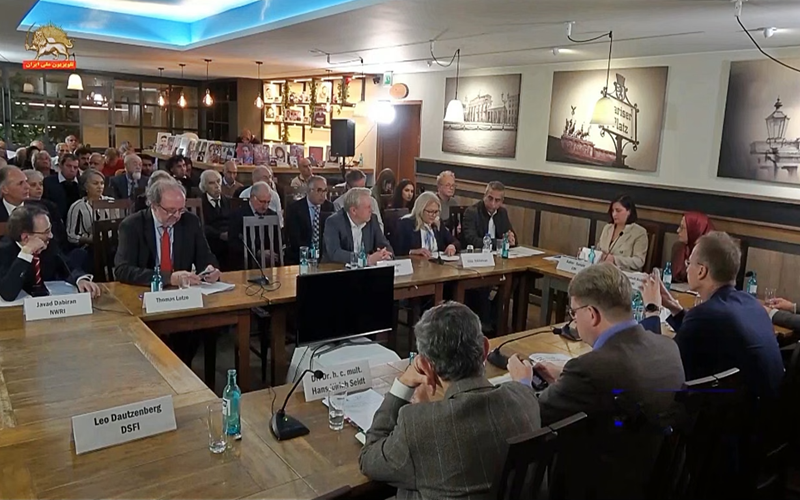

Speakers at a Berlin conference described threats against opponents of hereditary rule, raised concerns about alleged attempts to recreate SAVAK-style surveillance structures in Europe, and called for support for Maryam Rajavi’s Ten-Point Plan.
Representatives of Iranian communities in Germany used a Berlin conference on Iran’s political crisis to address intimidation targeting opponents of both the current theocracy and the former monarchy. Sahar Sanaei, Vida Nik-Talehan, Behnam Vafaseresht, and sociologist Reza Mousavi discussed threats against political activists, alleged attempts to establish SAVAK-inspired structures in Europe, Iran’s deepening socioeconomic crisis, and the need for an organized democratic alternative.
The speakers argued that Iran’s future should not be defined by a choice between the Shah and the mullahs. They called for accountability for human rights abuses, protection of political freedoms, and support for the National Council of Resistance of Iran (NCRI) and Maryam Rajavi’s Ten-Point Plan for a democratic republic.
Sahar Sanaei: Defending the Right to Resist Dictatorship
Sahar Sanaei emphasized that the struggle for freedom was motivated by a commitment to democracy and accountability, not revenge. She called for those responsible for human rights violations in Iran to be held accountable, describing justice as a foundation of a democratic society.
She also urged European governments to recognize the Iranian people’s right to resist repression and rejected the Iranian regime’s argument that the country faces only two possible futures: continued theocratic rule or chaos.
Sanaei criticized what she described as efforts to inflate Reza Pahlavi’s political standing through expensive lobbying, coordinated social media campaigns, and propaganda. In her view, presenting Pahlavi as a representative of the Iranian people without an established electoral mandate risks diverting attention from an organized democratic alternative.
She also condemned attacks on opposition gatherings and online campaigns targeting political opponents, warning that intimidation and division ultimately benefit the ruling regime.
Speaking as a member of the generation born after the 1979 revolution, Sanaei reaffirmed her support for the Iranian people’s right to self-determination and for Maryam Rajavi’s Ten-Point Plan.
Vida Nik-Talehan: Allegations of SAVAK-Inspired Surveillance in Europe
Vida Nik-Talehan described threats, gender-based insults, online harassment, doxxing, cyberattacks, and physical violence that she said she and more than 100 other Iranian men and women in Germany had experienced from monarchist supporters.
She argued that these incidents formed a recurring pattern intended to silence opponents of restoring the monarchy and push them out of political life.
Nik-Talehan cited the ongoing criminal proceedings in Canada involving two individuals accused of first-degree murder in the case of Masoud Masjoody, an outspoken critic of both Iran’s regime and Reza Pahlavi. She noted that the judicial proceedings had not concluded.
She also referred to information reportedly submitted by French security authorities to courts concerning threats against an NCRI demonstration planned for June 20, 2026, in Paris. According to her account, messages containing SAVAK symbols threatened a bombing if the demonstration received authorization, and the gathering was ultimately banned and canceled.
Nik-Talehan further cited the public display of SAVAK symbols in Regensburg on May 10 and in London on April 26. She said activists associated with the monarchist current had publicly described establishing security, intelligence, and operational structures modeled on SAVAK in Europe, claiming that files had been compiled on approximately 600 political activists, including herself.
She warned that surveillance, intimidation, and threats against political opponents in Germany and elsewhere in Europe were not ordinary political disagreements but raised serious concerns about civil liberties and democratic security.
Behnam Vafaseresht: Legal Action Against Threats and Harassment
Behnam Vafaseresht, a former political prisoner, described what he said were similarities between the intimidation he experienced from monarchist supporters and the treatment he had endured during interrogations and imprisonment in Iran.
He said he had reported three incidents to police and that the individuals involved had been identified. In one case, he said, a person responsible for an attack had been ordered to pay a €1,500 fine.
Vafaseresht alleged that the purpose of the harassment was to intimidate opponents into withdrawing from public life or pressuring them to adopt pro-monarchy slogans. He urged activists to report threats, insults, and attacks to law enforcement and called for the protection of freedom of expression and peaceful political activity.
He argued that intimidating opponents of the monarchy weakens the broader opposition to Iran’s ruling regime and ultimately serves the interests of the theocracy.
Reza Mousavi: Economic Crisis and the Need for Organized Resistance
Sociologist Reza Mousavi focused on Iran’s socioeconomic conditions, describing severe inequality, declining purchasing power, and growing insecurity over basic living costs as major drivers of nationwide unrest.
He argued that Iran’s economic crisis cannot be explained solely by sanctions or mismanagement, pointing instead to the concentration of wealth and economic power among ruling elites, particularly the Islamic Revolutionary Guard Corps (IRGC) and business conglomerates associated with the Supreme Leader’s office.
Drawing on political theorists Antonio Gramsci, Hannah Arendt, and Vladimir Lenin, Mousavi argued that spontaneous protest alone cannot overcome a heavily repressive political system without sustained organization and strategic coordination.
He described the PMOI’s Resistance Units as a mechanism for connecting public discontent with organized political action. He also presented Maryam Rajavi’s Ten-Point Plan as a political framework for a pluralistic Iran based on the separation of religion and state.
Mousavi called for a change in Western policy, including recognition of organized resistance and the NCRI as a political representative of the opposition.
Across their speeches, the four participants emphasized accountability, political freedoms, and the rejection of both hereditary monarchy and religious dictatorship. They presented organized resistance and a democratic republic as the alternative they believe can secure Iran’s political future.