



As Iran’s economic and social crises deepen, the regime increasingly relies on external confrontation and manufactured insecurity—not as a foreign policy choice, but as a strategy for political survival.
For more than four decades, one sentence has captured the strategic mindset of Iran’s ruling establishment: “War is a blessing.”
When Ruhollah Khomeini uttered those words during the Iran-Iraq War, many viewed them as revolutionary rhetoric. History, however, has shown that they became something far more consequential—a governing doctrine. For the regime built upon the doctrine of Velayat-e Faqih, perpetual confrontation has never been merely a security policy. It has been an indispensable mechanism for preserving power, suppressing dissent, and diverting public attention from mounting domestic failures.
Ali Khamenei later reaffirmed the same philosophy in different words. Defending the regime’s regional interventions, he argued that if Iran did not fight in Syria, Lebanon, and Yemen, it would eventually have to fight “in Tehran and Hamadan.” The statement revealed a worldview in which exporting conflict is considered essential to maintaining internal control.
Today, that doctrine is facing its greatest test.
The Return of Iran’s Internal Crisis
With the recent regional conflict subsiding and diplomatic negotiations once again drifting into uncertainty, the regime can no longer hide behind the fog of war.
Iran’s underlying crises have reemerged with renewed intensity. Inflation continues to erode purchasing power. Bread prices have become a source of widespread anger. Water shortages, electricity blackouts, industrial decline, unemployment, corruption, and institutional collapse have once again become the dominant concerns of ordinary Iranians.
These are not temporary disruptions. They represent decades of structural mismanagement and economic priorities that have consistently favored military expansion, regional proxy warfare, and ideological projects over domestic development.
The regime therefore faces a stark choice.
It can either respond to the demands of its own people—addressing economic hardship, restoring public trust, and accepting meaningful political reform—or it can once again seek refuge in what Khomeini called the “blessing” of war.
Its behavior suggests that the second option remains its preferred path.
Even Regime Media Warns of Manufactured Escalation
Signs of this strategy are no longer visible only to outside observers or opposition groups. Increasingly, voices within the regime’s own media acknowledge the dangers.
The state-affiliated newspaper Sazandegi recently criticized what it described as contradictory policies, emotional rhetoric, and reliance on threats in foreign policy. It warned that ambiguous messaging and inflammatory language risk strengthening international consensus against Iran rather than enhancing deterrence.
More significantly, the newspaper acknowledged the obvious economic consequences of renewed conflict. It warned that any escalation would directly undermine investment, production, livelihoods, and what little social optimism remains. National security, it argued, cannot be separated from economic stability, public welfare, and public confidence.
The article effectively admitted what many Iranians already understand: the country’s greatest vulnerabilities are no longer military. They are economic, social, and political.
A Remark That Revealed the Regime’s Thinking
Perhaps the clearest illustration of this mentality emerged during a recent interview on the Iranian internet television channel Ey Kash.
Former parliamentarian Mostafa Kavakebian recounted a conversation held inside the House of Political Parties regarding the regime’s declining electoral participation. Faced with the problem that a majority of eligible voters had boycotted recent elections, one participant reportedly suggested a shocking solution.
According to Kavakebian, the individual confidently remarked that they knew how to increase public participation: simply create conditions that would lead Israel to attack Iran once again. External military pressure, they argued, would rally society behind the government.
Kavakebian himself expressed astonishment at what he described as the depth of the disaster—that some within the political establishment viewed foreign attack as a tool for restoring domestic legitimacy.
Whether the statement reflected official policy or merely exposed the thinking of influential insiders, its political significance is undeniable. It illustrates a system that increasingly views national insecurity not as a threat to be avoided but as a resource to be exploited.
Crisis Has Become the Regime’s Political Currency
This pattern has repeated itself throughout the history of the clerical regime.
Whenever domestic dissatisfaction reaches dangerous levels, external confrontation rises in parallel. Nuclear crises, regional proxy conflicts, maritime tensions, missile escalation, and military brinkmanship have repeatedly shifted public discussion away from inflation, unemployment, corruption, and repression.
The objective is not necessarily victory in war. Rather, it is the political atmosphere that war creates.
Emergency conditions justify tighter security, suppress dissent, discourage organized protest, and encourage citizens to postpone demands for accountability in the name of national unity.
For an authoritarian system facing profound legitimacy deficits, permanent crisis functions as a substitute for genuine public support.
But Iran Has Changed
The assumptions that sustained this strategy for decades are increasingly breaking down.
Iranian society today bears little resemblance to that of previous generations. Years of economic hardship, mass protests, internet censorship, political repression, and unprecedented executions have profoundly altered public attitudes toward the regime.
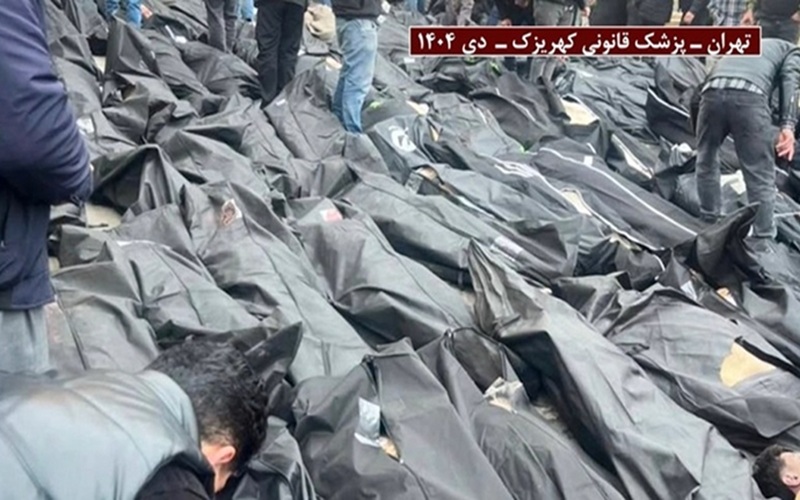
The nationwide uprising in January 2026 demonstrated that large segments of society no longer separate economic grievances from political demands. Rising prices, corruption, environmental degradation, and lack of political freedom are increasingly understood as interconnected symptoms of the same governing system.
Attempts to manufacture external crises may temporarily dominate official headlines, but they cannot erase these realities.
The Real Question Facing Iran
The central question confronting Iran today is not whether another regional confrontation may occur.
It is whether a political system built upon perpetual confrontation can continue governing a society whose demands are increasingly focused on accountability, prosperity, and democratic change.
For decades, war and regional instability allowed the regime to postpone confronting its internal failures. That strategy appears to be reaching its limits.
No amount of military rhetoric can permanently conceal collapsing public services, economic decline, or the widening gap between the rulers and the ruled.
The defining struggle for Iran is therefore no longer between war and peace abroad.
It is between a regime that depends on crisis for survival and a society increasingly determined to resolve the crisis at its source.