


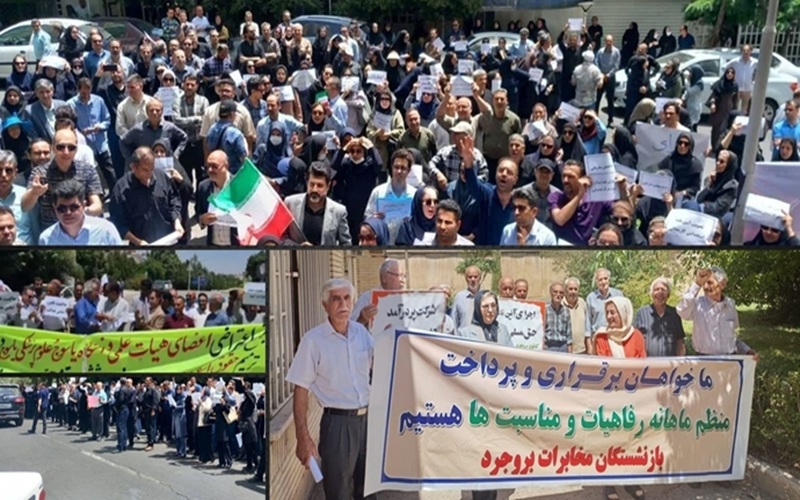

Workers, pensioners, students, farmers, healthcare staff, and other social groups staged at least 135 protests in June 2026, underscoring growing public discontent amid Iran’s worsening political and economic crisis.
The death of Supreme Leader Ali Khamenei and the end of the recent war have pushed Iran into a new phase of political uncertainty and economic instability, triggering a sharp increase in public protests across the country.
Despite the regime’s efforts to project an orderly transfer of power and a return to stability, the weeks following the conflict have exposed mounting structural crises. Rather than restoring public confidence, the post-war period has been marked by worsening inflation, unemployment, declining living standards, and expanding social unrest.
Against this backdrop, workers, pensioners, students, farmers, truck drivers, healthcare workers, and numerous other social groups have taken to the streets, demanding solutions to long-standing economic grievances while increasingly criticizing government policies.
At Least 135 Protest Actions Recorded in June
According to compiled reports, at least 135 separate protests, strikes, and demonstrations took place across Iran during June 2026, reflecting the breadth of dissatisfaction affecting nearly every sector of society.
The protests included:
| Social Group | Number of Protests |
|---|---|
| Pensioners | 40 |
| Students (High School) | 40 |
| Workers | 12 |
| University Students | 10 |
| Farmers | 4 |
| Bakers | 1 |
| Truck Drivers | 1 |
| Nurses | 1 |
| Other Social Groups | 26 |
| Total | 135 |
The demonstrations were reported across numerous provinces, highlighting that public unrest is no longer confined to isolated regions or professions.
Pensioners Lead Nationwide Demonstrations
Pensioners accounted for the largest organized protest movement during the month.
Retirees from the Social Security Organization, the telecommunications sector, the steel industry, and the military held repeated demonstrations over declining living conditions, delayed implementation of pension reforms, healthcare costs, housing problems, suspended insurance coverage, and the government’s failure to fully implement legal obligations regarding pensions.
Many demonstrators argued that soaring inflation has rendered their pensions insufficient to cover basic necessities.
Among the slogans frequently chanted were:
- “The poverty line is 100 million rials; our salary is only 20 million.”
- “Bread is expensive, medicine is expensive.”
- “We want neither war nor bloodshed—we want lasting prosperity.”
- “Political prisoners must be freed.”
- “Unity against poverty and corruption.”
The slogans reflected not only economic frustration but also growing political dissatisfaction.
Students Protest Examination Policies Nationwide
High school students organized one of the largest protest campaigns of the month, staging demonstrations in 27 cities across 24 provinces.
Their demands focused primarily on examination policies, including:
- The grading system for 11th and 12th grades.
- Refusal to postpone examinations.
- Insufficient time between exams.
- Concerns over educational fairness.
Students repeatedly gathered outside education offices, insisting that authorities revise examination regulations introduced during a period of national instability.
Among their chants were:
- “If our problems are not solved, there will be protests every day.”
- “Postponing exams is our undeniable right.”
- “Students die, but they do not accept humiliation.”
- “Student, raise your voice and demand your rights.”
Workers Continue Labor Protests
Workers from numerous industries also launched strikes and demonstrations over unpaid wages, deteriorating working conditions, lack of job security, and employment uncertainty.
Protests were reported among employees of:
- Petrochemical terminals in Mahshahr.
- Takht-e Jamshid Petrochemical Company.
- Gachsaran Oil and Gas facilities.
- Zahedan’s 100-megawatt solar power project.
- Textile factories in Ilam, Rasht, and other cities.
- Tabriz Machinery Manufacturing Company.
- Municipal workers in Likak.
Many workers reported months of unpaid salaries and the loss of welfare benefits while demanding implementation of employment reforms.
University Students Demand Flexible Education Policies
University students also joined the growing protest movement.
Students at branches of Islamic Azad University in Tehran, Karaj, Borujerd, Mashhad, Bushehr, and Ahvaz protested mandatory in-person examinations, arguing that the country’s security and social conditions justified remote education.
Their slogans included:
- “No in-person exams until there is security.”
- “Virtual education, virtual examinations.”
- “Students, shout for your rights.”
Farmers Protest Water Shortages
Water shortages remained another major source of unrest.
Farmers in Garmsar and Aradan protested over the denial of their legal water rights from the Hableh River, while farmers in Ahmadabad near Ardakan demonstrated against repeated interruptions to agricultural water supplies.
The protests highlighted the continuing impact of Iran’s water crisis on agricultural communities.
Healthcare Workers and Nurses Demand Better Conditions
Healthcare employees also continued their protests.
Nurses and medical personnel in Tehran demanded improved living conditions, implementation of employment regulations, and revisions to nursing tariffs.
Additional demonstrations were held by health workers in:
- Eslamabad-e Gharb
- Tabriz
- Qazvin
- Kermanshah
Participants cited salary disparities, delayed benefits, worsening living conditions, and unequal compensation policies.
Diverse Social Groups Join Growing Unrest
The remaining demonstrations reflected the widening scope of public dissatisfaction.
Residents in several villages protested mining projects they say threaten local communities and environmental resources, including:
- Taftan Gold Mine
- Kerman Chromite Mine
- Gohar Taban Alborz Concentrate Project
University professors and faculty members at Yasuj University and Yasuj University of Medical Sciences demonstrated over unresolved professional demands.
Employees at Tehran’s Behesht Zahra cemetery protested cuts to employment benefits.
Drivers of heavy vehicles in southeastern Iran protested fuel quota reductions that disrupted their livelihoods.
Contract drivers from multiple cities gathered in Tehran demanding permanent employment status.
Motorcycle couriers working for Snapp in Shiraz staged protests over high commissions, low earnings, fuel subsidy cuts, lack of insurance, and rising living costs.
Employees of Khuzestan Regional Electricity Company also demonstrated over salary structures and compensation policies.
Meanwhile, homebuyers, automobile purchasers, and investors who claim financial losses organized protests involving delayed housing projects, vehicle import disputes, and unresolved commercial cases.
Economic Crisis Continues to Fuel Public Anger
The diversity of June’s demonstrations illustrates that public discontent extends well beyond any single profession or economic sector.
From pensioners struggling with inflation to students demanding educational fairness, from workers seeking unpaid wages to farmers confronting water shortages, protesters increasingly share common concerns over declining living standards, economic insecurity, and the government’s inability to address mounting social pressures.
With political uncertainty following Khamenei’s death compounded by the economic consequences of war, the steady rise in labor strikes and public demonstrations suggests that social unrest is becoming an increasingly persistent feature of Iran’s post-war landscape.